
Why Is My Plant Dropping Leaves? Common Causes Explained

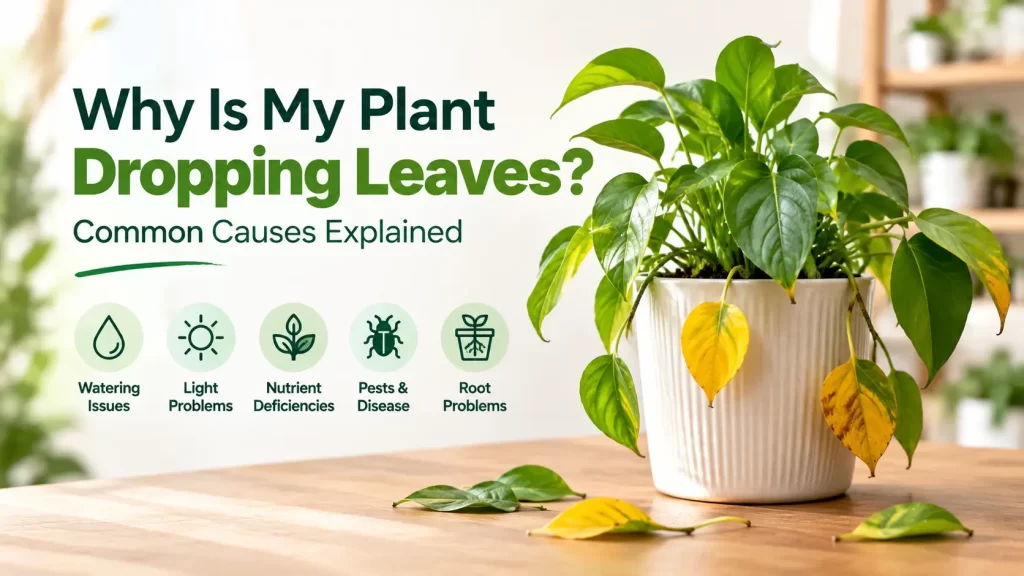
A plant dropping leaves can look alarming, but leaf loss does not always mean the plant is dying. Older leaves naturally age and fall, deciduous plants shed leaves as part of their seasonal cycle, and some evergreens regularly replace a portion of their older foliage.
Heavy or sudden leaf drop is different. A plant may shed leaves because of drought, excess water, poor drainage, low light, temperature stress, a sudden move, root damage, pests, disease, or another major change in its environment.
The most useful clues are which leaves are falling, what they look like before they fall, how quickly the drop is happening, and what changed before it started.
Quick Answer: Why Is My Plant Dropping Leaves?
Common causes include:
- normal aging of older leaves,
- seasonal leaf fall,
- too little water,
- too much water or poor drainage,
- root rot or other root problems,
- insufficient light,
- cold, heat or sudden temperature changes,
- a recent move or change in growing conditions,
- transplanting or repotting stress,
- pests, and
- disease.
Illinois Extension lists sudden temperature change, transplant shock, sudden changes in light, overwatering and lack of light among causes of general defoliation in houseplants. UC IPM similarly lists poor root health, sudden changes in light, temperature or humidity, overwatering, excessive dryness, compacted soil and pot-bound roots among causes of sudden leaf drop.
Do not diagnose the plant from the fallen leaves alone. Check the root zone and recent growing conditions.
Is Leaf Drop Normal or a Sign of a Problem?
A few leaves falling from an otherwise healthy plant can be normal.
RHS notes that older leaves on healthy houseplants naturally die back over time. It also explains that evergreen plants do not keep individual leaves forever and may shed a proportion of their older foliage as new growth replaces it.
Seasonal leaf fall is also normal in deciduous trees and shrubs. Shorter days and lower temperatures help trigger the natural process that separates aging leaves from the plant.
Leaf drop is more likely to be normal when:
- only a few older leaves are falling,
- new growth looks healthy,
- the plant is otherwise vigorous,
- the pattern matches the species’ normal seasonal cycle, and
- there are no signs of widespread yellowing, wilting, spotting, root decay or pest activity.
Leaf drop deserves investigation when:
- many leaves fall in a short period,
- young leaves are dropping,
- green leaves fall suddenly,
- the plant also wilts or stops growing,
- the root zone stays unusually wet or becomes extremely dry,
- leaves show spots, webbing, sticky residue or unusual distortion, or
- the plant recently experienced a major change.
Dropping Leaves vs Drooping Leaves
These two symptoms are easy to confuse.
Drooping means leaves remain attached but hang or wilt. Dropping means the plant actually sheds leaves from the stem.
A plant can do both, but they are not the same symptom.
Drooping is especially useful for diagnosing water balance. Plants can droop when soil is too dry, but they can also droop in saturated soil when roots are damaged or short of oxygen.
If the leaves are still attached but limp, see Why Is My Plant Wilting?.
Leaf-Drop Pattern Guide
| What you see | Possible explanation | What to check next |
|---|---|---|
| One or two old lower leaves fall gradually | Natural aging | Whether new growth is healthy |
| Many green leaves fall suddenly after a move | Environmental shock | Recent changes in light, temperature, humidity or location |
| Yellow lower leaves fall while soil stays wet | Overwatering or root stress | Drainage and root condition |
| Dry, crispy leaves fall from a very dry plant | Drought or underwatering | Moisture throughout the root ball |
| Lower leaves fall in a dark location | Insufficient light | Actual light exposure |
| Leaves fall after a cold night or draft | Temperature stress | Windows, doors, vents and recent weather |
| Leaf drop starts after repotting | Root disturbance or transplant stress | Root-zone moisture, pot size and drainage |
| Leaves are sticky or speckled before falling | Possible pest infestation | Leaf undersides, stems and growing tips |
| Leaves have spots or lesions before falling | Possible disease | Species-specific disease symptoms |
| Plant is pot-bound and dries very rapidly | Root restriction | Overall root-ball condition |
These patterns narrow the possibilities, but they do not replace a full diagnosis.
1. Natural Aging or Seasonal Leaf Fall
Leaves are temporary organs. Even evergreen plants eventually replace older foliage.
RHS explains that older leaves become less efficient at photosynthesis. Plants can break down and reuse some of the chlorophyll and nutrients before the leaf is shed.
A mature houseplant dropping an occasional old lower leaf can therefore be completely normal.
Normal aging is more likely when:
- the affected leaves are the oldest on the plant,
- only a small number are lost at one time,
- new leaves continue to develop normally, and
- the plant shows no wider signs of stress.
Do not try to stop normal leaf replacement by fertilizing or watering more.
Deciduous plants are different
Deciduous trees and shrubs naturally shed most or all of their leaves as part of their seasonal cycle. This is not comparable to an evergreen houseplant suddenly becoming bare.
When judging whether leaf fall is abnormal, first identify whether the species is deciduous, evergreen, semi-evergreen or seasonally dormant.
2. Underwatering and Drought
Prolonged drought can cause leaf drop because the plant cannot keep all of its foliage adequately supplied with water.
University of Maryland Extension notes that extended drought can cause yellowing, leaf scorch, browning, early leaf drop and stunted growth. RHS similarly associates brown, falling lower leaves with underwatering and excessive heat in many houseplants.
Clues that the plant may be too dry
- the root zone is dry well below the surface,
- the plant wilts before leaves fall,
- fallen leaves are dry or crispy,
- brown edges or tips appear first,
- the container feels unusually light, and
- leaf loss worsens during hot, sunny or windy conditions.
Severely dried potting mix can also shrink away from the sides of a container. Water may then run around the root ball rather than wetting it evenly.
If dry conditions recur frequently, see How Often Should You Water Plants?.
3. Overwatering, Poor Drainage or Root Rot
Too much water can cause leaf drop even though the plant appears thirsty.
Excess water fills air spaces in the root zone and reduces oxygen available to roots. University of Maryland Extension notes that waterlogged plants can show the same types of symptoms as drought-stressed plants, including wilt, yellowing, scorch and leaf drop.
RHS likewise states that waterlogging can interrupt water uptake and lead to yellowing, leaf drop and rotten roots.
Clues that excess water may be responsible
- potting mix stays wet for a long time,
- lower leaves yellow before falling,
- the plant wilts despite wet soil,
- growth has slowed,
- the container drains poorly, or
- roots are soft, collapsing or decayed.
If you cannot tell which watering extreme is responsible, see Overwatering vs Underwatering: How to Tell the Difference.
If drainage is consistently poor, see What Is Well-Draining Soil?. If roots are decaying, use Root Rot: Signs, Causes, Treatment, and Prevention.
4. Too Little Light
Insufficient light can cause plants to shed leaves they can no longer support efficiently.
RHS notes that weak growth, pale leaves and lower leaves yellowing and falling can indicate insufficient light. UC IPM also lists inadequate light as a cause of yellowing and dropping leaves in houseplants.
Low light is more plausible when:
- leaf drop begins after the plant is moved farther from a window or into a darker position,
- new growth becomes stretched or weak,
- lower leaves yellow and fall,
- flowering declines, or
- the problem worsens as seasonal daylight decreases.
A common example occurs when outdoor houseplants are brought indoors. University of Maryland Extension notes that reduced indoor light can slow growth and contribute to leaf yellowing and leaf drop while plants adjust.
Do not respond by moving a shade-adapted plant directly into harsh sunlight. Match the location to the species and increase exposure gradually when needed.
See Full Sun vs Partial Sun vs Shade for help interpreting plant light requirements.
5. Temperature Stress and Drafts
Plants can shed leaves after exposure to temperatures outside their preferred range or after rapid temperature changes.
Illinois Extension lists sudden temperature change among causes of general defoliation. RHS notes that cold temperatures, sudden drops in temperature and drafts can contribute to yellowing and leaf fall in houseplants.
Look for:
- leaf drop after a cold night,
- plants placed close to an exterior door,
- cold air from a window,
- hot air from a heater,
- air-conditioning drafts,
- rapid moves between indoor and outdoor conditions, or
- heat stress combined with dry soil.
Temperature problems can be very local. A room may be comfortable for people while the foliage next to cold glass or directly above a radiator experiences a much more extreme environment.
6. Sudden Environmental Change
Some plants shed leaves after a move even when the new location is not inherently bad.
Illinois Extension notes that plants may go through an adjustment period when moved from a nursery to a home, from one room to another, or between indoors and outdoors. Changes in light, temperature, humidity and watering can all occur at once.
This is especially important with sensitive houseplants. A greenhouse-grown plant may have developed its foliage under brighter light, higher humidity and more controlled temperatures than it receives after purchase.
Environmental adjustment is more likely when:
- leaf drop starts soon after bringing the plant home,
- the plant was moved to another room or window,
- it was recently brought indoors for the season,
- the heating or cooling system was recently turned on, or
- the plant otherwise appears structurally healthy.
Do not keep moving a stressed plant from place to place unless the current location is clearly unsuitable. Repeated changes can prolong the adjustment.
7. Transplanting or Repotting Stress
Moving a plant into a new pot or planting it into the ground can disturb roots and temporarily reduce their ability to supply the foliage.
Illinois Extension lists transplant shock among causes of general defoliation. Root disturbance may be especially stressful when combined with a sudden change in sun, wind, temperature or moisture.
Post-transplant leaf drop is more plausible when:
- the problem begins shortly after repotting or planting,
- roots were heavily disturbed or divided,
- the plant was moved into stronger sunlight,
- the root ball dried during the move, or
- the new pot stays much wetter than the old one.
If the plant was recently moved, see Transplant Shock: Signs, Causes, and How to Help a Plant Recover.
If the problem began after moving into a larger container, also review How to Know When a Plant Needs Repotting.
8. Pests
Sap-feeding insects and mites can weaken plants enough to cause yellowing, distorted growth and leaf drop.
UC IPM lists scale, mealybugs and aphids among pests associated with sticky foliage, sooty mold, distortion, leaf drop and branch dieback. Spider mites can produce tiny pale speckles, bronzing, drying and fine webbing.
Inspect for:
- sticky honeydew,
- black sooty mold,
- white cottony material,
- small shell-like scale insects,
- clusters of aphids,
- fine webbing,
- speckled or bronzed leaves, and
- distorted new growth.
Check leaf undersides, stems, leaf joints and growing tips.
Do not spray simply because leaves are falling. Identify the pest if possible, then use an appropriate integrated pest-management approach and follow the product label and local regulations if pesticide use becomes necessary.
9. Disease
Disease can cause leaf drop, but it is usually more convincing when additional symptoms appear.
Look for:
- expanding leaf spots,
- water-soaked lesions,
- powdery or fuzzy growth,
- stem lesions,
- root decay,
- unusual mosaic or ring patterns,
- dieback, or
- rapid deterioration of multiple leaves.
Disease symptoms are highly species-specific. A general “leaf drop” diagnosis cannot tell you which pathogen is present.
If the plant is valuable or the problem is spreading through a collection or garden, use a local plant diagnostic service or qualified horticultural professional when a precise diagnosis matters.
10. Root Restriction, Compaction or Other Root Stress
Roots can cause leaf loss even when watering appears reasonable.
UC IPM lists compacted soil and pot-bound roots among possible causes of sudden wilting and leaf drop. Root restriction can make water management difficult because a pot may dry very quickly, while compacted or degraded growing medium can remain too wet.
Consider root-zone stress when:
- roots densely circle the container,
- there is very little potting mix left in the root ball,
- the plant dries unusually fast,
- growth has slowed,
- the growing medium has become compacted, or
- water no longer moves through the pot normally.
Root stress can overlap with both underwatering and overwatering. Inspecting the root ball can sometimes resolve the confusion.
Why Are Green Leaves Falling Off My Plant?
Green leaves falling suddenly often suggest a faster environmental or root stress rather than the slow aging of an old leaf.
Possible causes include:
- a sudden change in temperature,
- moving the plant to a new environment,
- abrupt changes in light,
- root stress from excessive water or severe dryness,
- transplanting or repotting, and
- chemical or physical injury.
UC IPM specifically associates sudden leaf drop with poor root health and sudden changes in light, temperature or relative humidity.
If the leaves look healthy until they fall, think carefully about what changed in the previous days or weeks.
Why Are Yellow Leaves Falling Off?
Yellowing before leaf fall can occur during natural aging, but widespread yellow leaf drop deserves investigation.
Possible causes include:
- overwatering,
- underwatering,
- low light,
- cold temperatures,
- root problems,
- nutrient or pH issues,
- pests, and
- disease.
If yellow leaves are the main symptom, use the more detailed guide Why Are My Plant Leaves Turning Yellow? 9 Common Causes and What to Do.
Why Are Brown Leaves Falling Off?
Brown leaves often indicate that leaf tissue has already been severely damaged before it falls.
RHS associates brown leaves followed by leaf drop with underwatering and excessive heat in many houseplants, while direct sun can scorch shade-loving foliage. Severe root damage from waterlogging can also result in browning and drop because the roots cannot supply the leaves normally.
Look at whether the leaf first became:
- dry and crispy,
- soft and water-soaked,
- spotted,
- scorched on the sun-facing side, or
- brown only at the tips and margins.
If browning begins at the leaf tips or edges, see Why Are My Plant’s Leaf Tips Turning Brown?.
Why Do Houseplants Suddenly Lose Leaves?
Houseplants often experience sharper environmental changes than outdoor plants.
Common triggers include:
- moving home from a greenhouse or nursery,
- moving from one window to another,
- bringing plants indoors after summer,
- turning heating or air conditioning on,
- reduced seasonal light,
- cold drafts,
- dry indoor air,
- overwatering as growth slows, and
- pest populations increasing indoors.
RHS notes that winter houseplant problems commonly involve overwatering, poor light and dry air. University of Maryland also warns that plants brought indoors can yellow and drop leaves as they adjust to reduced light.
Do not compensate for lower light with more water
When light levels fall, many houseplants grow more slowly and use water more slowly. Continuing a high-frequency summer watering routine can leave the root zone wet for too long.
Check soil moisture rather than following the calendar.
Leaf Drop on Outdoor Plants
Outdoor leaf loss is influenced by weather, soil and season in ways that differ from indoor plants.
Common causes include:
- normal deciduous leaf fall,
- drought,
- heat waves,
- waterlogging after heavy rain,
- cold or frost,
- transplant stress,
- root damage,
- pests,
- disease, and
- competition or soil problems.
University of Maryland notes that drought can cause early leaf drop in landscape plants, while prolonged excess water can also lead to leaf drop by damaging fine roots.
If an entire bed or several unrelated species show symptoms at the same time, investigate the environment before assuming each plant has a separate disease.
What to Do First When a Plant Starts Dropping Leaves
- Identify the plant. Determine whether it is deciduous, evergreen or naturally prone to seasonal leaf loss.
- Check which leaves are falling. Old lower leaves, young leaves or leaves from the whole plant?
- Look at the leaf before it falls. Green, yellow, brown, spotted, sticky or distorted?
- Check the root-zone moisture. Dry, appropriately moist or saturated?
- Check drainage. Make sure excess water is not trapped around roots that need aeration.
- Review recent changes. New location, repotting, transplanting, heating, cooling, weather or light?
- Check temperature and drafts.
- Inspect for pests.
- Look for disease symptoms.
- Inspect roots when the evidence points underground.
- Correct the strongest cause first. Avoid changing every part of the care routine at once.
This sequence is more reliable than assuming every falling leaf means the plant needs water or fertilizer.
How to Tell Whether the Plant Is Recovering
Leaves that have already entered the shedding process may still fall after the underlying problem is corrected.
Judge recovery by the direction of new growth and the rate of continued leaf loss.
Encouraging signs include:
- leaf drop slows or stops,
- remaining foliage stays firm and normally colored,
- new leaves develop normally,
- wilting becomes less frequent,
- roots show healthy new growth, and
- normal stem extension or flowering resumes when seasonally appropriate.
Do not expect a damaged yellow or brown leaf to become perfect again. Healthy new growth is more informative.
Common Mistakes When a Plant Drops Leaves
Mistake 1: Watering immediately without checking the soil
Both drought and waterlogging can cause leaf loss. Check moisture first.
Mistake 2: Assuming all leaf drop is abnormal
Older leaves naturally fall, and deciduous plants have normal seasonal leaf loss.
Mistake 3: Moving the plant repeatedly
If relocation caused the problem, repeatedly changing its environment can prolong the stress.
Mistake 4: Fertilizing a stressed plant automatically
Fertilizer will not correct poor light, root rot, drought, temperature stress or an unsuitable location.
Mistake 5: Repotting every plant that loses leaves
Repot only when the root system or growing medium gives you a reason. Repotting adds another disturbance.
Mistake 6: Treating pests without finding them
Leaf drop is too nonspecific to justify pesticide use on its own.
Mistake 7: Ignoring a sudden environmental change
Think about what changed before the leaves began to fall, not just what the plant looks like today.
Mistake 8: Expecting fallen leaves to be quickly replaced
Recovery speed depends on species, season, light, root health and the severity of the original stress.
Frequently Asked Questions
Why Is My Plant Suddenly Dropping Green Leaves?
Sudden green-leaf drop can follow a rapid change in temperature, light, humidity, location or root conditions. Check recent environmental changes and the root zone before assuming disease.
Can Overwatering Cause Leaves to Fall Off?
Yes. Excess water reduces oxygen around roots and can damage fine roots. Continued waterlogging can lead to yellowing, wilting, scorch, leaf drop and root rot.
Can Underwatering Cause Leaf Drop?
Yes. Prolonged drought can cause wilting, yellowing, brown or crispy foliage and eventual leaf drop.
Why Are the Bottom Leaves Falling Off?
A few old lower leaves dropping can be normal. Widespread lower-leaf loss can also occur with low light, watering problems, root stress or other cultural problems. Look at the number of leaves affected and the plant’s overall health.
Why Is My Plant Dropping Leaves After I Moved It?
A sudden change in light, temperature, humidity or watering conditions can trigger temporary leaf loss. Keep conditions stable and make sure the new location suits the species.
Why Is My Plant Dropping Leaves After Repotting?
Root disturbance, a larger and wetter pot, altered watering, stronger light or transplant stress can all contribute. Check root-zone moisture before watering again.
Can Low Light Cause Leaves to Drop?
Yes. Some plants shed lower leaves when there is not enough light to support the existing canopy. Low light often also causes weak or stretched growth.
Can Cold Air Make a Plant Lose Leaves?
Yes. Cold drafts and sudden temperature drops can cause leaf yellowing, collapse or shedding in sensitive plants.
Do Pests Cause Leaf Drop?
Yes. Heavy infestations of scale, mealybugs, aphids, mites and other pests can weaken plants and lead to leaf loss. Look for insects, honeydew, webbing, stippling or distorted growth.
Should I Cut Off Leaves That Are About to Fall?
You can remove fully dead or badly damaged leaves, but there is usually no need to strip off green or partly functional leaves simply because you expect them to fall. Diagnose and correct the cause instead.
Will a Plant Grow Its Leaves Back?
Often, if the stems and roots remain healthy and the growing conditions improve. Whether leaves return from the same stem positions depends on the species and where active buds are located.
How Long Does It Take for Leaf Drop to Stop?
There is no universal timeline. Mild environmental adjustment may settle relatively quickly, while damaged roots, severe drought or disease can take much longer to resolve. Watch whether the rate of leaf loss is decreasing and whether healthy new growth is appearing.
Sources and Further Reading
- Illinois Extension: Troubleshooting houseplants
- University of California IPM: Houseplant problems
- Royal Horticultural Society: Leaf damage on houseplants
- Royal Horticultural Society: How to help a poorly houseplant
- Royal Horticultural Society: How plants use light to grow
- Royal Horticultural Society: How plants age
- University of Maryland Extension: Drought and excessive heat stress
- University of Maryland Extension: Excess water damage on flowers
- University of Maryland Extension: Overwatered indoor plants
Bottom Line
Leaf drop is best treated as a pattern to investigate, not as a diagnosis by itself.
A few old leaves falling from an otherwise healthy plant can be normal. Heavy, sudden or widespread leaf loss is more likely to involve stress from water, roots, light, temperature, relocation, transplanting, pests or disease.
Start with the leaves that are falling, then check the root zone and recent history. Green leaves falling suddenly point toward a different set of possibilities than old yellow leaves dropping slowly. Diagnose the strongest clue first, make the smallest useful correction, and judge recovery by whether leaf loss slows and healthy new growth resumes.


