
Why Are There Brown Spots on My Plant Leaves? Causes and What to Do

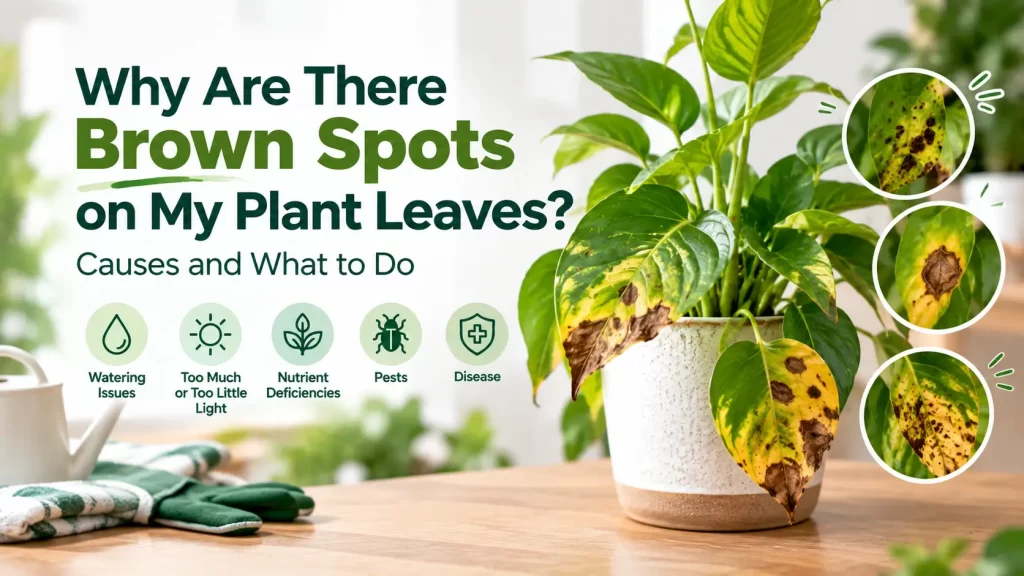
Brown spots on plant leaves can mean very different things. A dry tan patch on the sun-facing side of a leaf is not the same problem as a soft, water-soaked spot with a yellow halo, and neither is the same as fine bronze stippling caused by mites.
The most useful way to diagnose brown spots is to look at their shape, texture, position, speed of spread, and the conditions around the plant. Check whether the spots are dry or soft, round or angular, surrounded by yellow tissue, limited to exposed leaves, concentrated near the margins, or accompanied by webbing, powdery growth, wilting, or root problems.
Do not assume every brown spot is a fungal disease. Environmental stress and growing-condition problems can produce very similar symptoms.
Quick Answer: What Causes Brown Spots on Plant Leaves?
Possible causes include:
- fungal leaf spot diseases,
- bacterial leaf spot diseases,
- sunscald or excessive direct light,
- overwatering or root stress,
- edema from water imbalance,
- spider mites and other pests,
- fertilizer or soluble-salt injury,
- chemical spray injury,
- cold or chilling injury,
- physical bruising or rubbing, and
- certain viral or other species-specific disorders.
UC Statewide IPM lists excess light, chilling, chemical spray injury, overwatering, and fungal or bacterial infection among causes of spots, blotches, blisters, and scabby marks on houseplant leaves. RHS similarly notes that dark spots with yellow margins can indicate fungal leaf spot, while pale spots may result from excessive sun, cold-water splashes, or aerosol damage.
The spot itself is only the starting clue.
How to Diagnose Brown Spots on Leaves
Before treating the plant, examine the spots closely.
Are the spots dry, papery, or crispy?
Dry tan or brown patches are more consistent with sunscald, drought-related scorch, salt injury, old physical damage, or some leaf-spot diseases after the tissue has died.
Are they soft, wet, or mushy?
Water-soaked or soft lesions make bacterial disease, some fungal diseases, cold injury, or tissue collapse more plausible.
Are the spots round or angular?
Fungal spots are often roughly circular or irregular. Bacterial spots may be angular because veins limit how the damaged area expands. This is a clue, not a universal rule.
Is there a yellow halo?
Yellow tissue around a brown or black lesion can occur with fungal or bacterial leaf spots. It does not identify the pathogen by itself.
Are the spots mainly on the sun-facing side?
That pattern makes sunscald more plausible, especially if the plant was recently moved into stronger light.
Are there tiny pale dots rather than true lesions?
Fine stippling that becomes bronzed or brown can be caused by spider mites. Check the undersides of leaves for mites and fine webbing.
Are several unrelated plants affected at once?
A shared environmental or chemical cause becomes more likely. Consider recent weather, irrigation, spraying, fertilizer, herbicide drift, or a sudden light change.
Brown-Spot Pattern Guide
| What you see | Possible cause | What to check next |
|---|---|---|
| Round tan, brown, or black spots that slowly enlarge | Fungal leaf spot | Yellow halos, leaf wetness, humidity, spread to nearby leaves |
| Angular or water-soaked brown spots | Bacterial leaf spot | Leaf veins, yellow margins, soft tissue, wet conditions |
| Bleached patches that turn tan or brown | Sunscald | Recent move into stronger sun, exposed leaf surfaces |
| Raised blisters that become corky brown patches | Edema | Overly wet medium, cool or humid conditions, lower leaf surfaces |
| Fine pale speckles becoming bronze or brown | Spider mites | Leaf undersides, webbing, hot dry conditions |
| Brown tips and margins with white crust on soil or pot | Salt or fertilizer injury | Fertilizer history, water quality, root health |
| Irregular spots after a spray or cleaner touched foliage | Chemical injury | Recent pesticide, fertilizer, aerosol, cleaner, or leaf-shine use |
| Dark or water-soaked tissue after cold exposure | Chilling or frost injury | Cold window, outdoor cold event, sudden temperature drop |
| Spot exactly where a leaf rubs a wall or was bent | Physical injury | Pets, handling, transport, wind, rubbing surfaces |
| Brown or black rings plus distortion or mosaic patterns | Possible virus | Species-specific symptoms and diagnostic testing |
More than one problem can occur at once, so use the whole plant and its recent history rather than one spot in isolation.
1. Fungal Leaf Spot
Many fungi can produce brown leaf spots, and the exact appearance depends on both the pathogen and the plant.
University of Maryland Extension describes fungal leaf spots on indoor plants as tan, reddish-brown, or black lesions that are often roughly circular. Individual spots can enlarge, merge, and eventually blight a larger section of the leaf.
Penn State Extension describes fungal leaf spot on houseplants as brown or black oval spots that may have a yellow halo or purple border.
Clues that fungal leaf spot is plausible
- spots begin small and gradually enlarge,
- there are multiple lesions rather than one isolated bruise,
- spots may have darker edges or lighter centers,
- yellow tissue develops around lesions,
- several leaves become affected over time,
- spots begin to merge into larger dead areas, and
- the plant has experienced prolonged leaf wetness or humid, poorly ventilated conditions.
Some fungal leaf spots are highly host-specific. A spot pattern that fits one species does not necessarily indicate the same pathogen on another.
Why wet leaves matter
UC IPM notes that many foliar fungal pathogens require continuous leaf wetness for infection. Reducing unnecessary splashing, allowing leaves to dry, and improving spacing or air movement can therefore reduce disease pressure.
What to do
- Remove badly affected leaves when practical.
- Dispose of diseased material rather than leaving it around the plant.
- Avoid repeatedly wetting foliage, especially when leaves remain wet for long periods.
- Improve spacing and air movement where crowding is contributing.
- Water early enough that wet foliage can dry rather than remaining wet overnight where that is relevant.
- Identify the plant and, if possible, the disease before using a fungicide.
2. Bacterial Leaf Spot
Bacterial leaf spots can resemble fungal spots, but several patterns can make them more suspicious.
University of Maryland Extension describes bacterial lesions as black to brown and often water-soaked. Because some infections expand between leaf veins, they may appear angular or V-shaped. Yellow margins can surround the damaged tissue, and severely affected areas may become soft or collapse.
Possible bacterial clues
- water-soaked appearance when lesions are young,
- angular spots limited by veins,
- yellow halos around brown or black centers,
- soft, mushy tissue,
- lesions along leaf margins,
- spots that merge into larger areas, and
- rapid collapse of tender new tissue.
Warm, wet conditions can favor many bacterial leaf diseases. Splashing water can also move bacteria from infected to healthy tissue.
Do not diagnose bacteria from a yellow halo alone
Fungal leaf spots can also produce yellow margins. Accurate identification can require host-specific knowledge or laboratory diagnosis.
What to do
Remove heavily affected material, reduce leaf wetness, improve spacing and air movement, and avoid spreading contaminated water between plants. If the disease appears systemic or severe, species-specific guidance or a plant diagnostic service may be needed.
3. Sunscald or Excessive Light
Strong direct light can bleach and kill leaf tissue, leaving pale, tan, or brown patches.
RHS notes that direct summer sun through a window can produce brown scorched patches and a washed-out appearance on houseplant foliage. University of Minnesota diagnostic resources describe sunscald as exposed leaf tissue first bleaching yellow or white and then turning brown and brittle in severe cases.
Sunscald is more likely when:
- damage is concentrated on the side facing the strongest light,
- the plant was recently moved into brighter conditions,
- spots are dry and papery rather than wet,
- the paler areas of variegated leaves are damaged first,
- the problem appeared after a sudden outdoor move, or
- heat and drought occurred at the same time.
Scorched tissue will not turn green again.
What to do
Move the plant to the light level appropriate for its species or provide temporary protection while it acclimates. Do not move a shade-adapted plant from low light directly into intense sun.
For help interpreting exposure, see Full Sun vs Partial Sun vs Shade: What Plant Light Requirements Really Mean.
4. Watering and Root Problems
Brown spots are not always a leaf-surface problem. Root stress can show up in the foliage.
UC IPM includes overwatering among the possible causes of leaf spots, blotches, blisters, and scabby marks on houseplants. Poor root health can also make leaves more vulnerable to browning because the plant cannot regulate water normally.
Overwatering and poor drainage
When the root zone remains saturated, oxygen around the roots declines. Over time, this can cause yellowing, wilting, browning, slow growth, root decay, and leaf loss.
If brown spots appear together with wet soil, yellow leaves, wilt, or soft roots, investigate the root zone before treating the leaves.
See Overwatering vs Underwatering: How to Tell the Difference and Root Rot: Signs, Causes, Treatment, and Prevention.
Underwatering
Drought more often produces brown tips, margins, or broad scorched areas than neat circular spots, but severely dehydrated tissue can die in irregular patches.
If the root ball dries very hard between waterings, some sections may also rewet unevenly.
For a condition-based watering approach, see How Often Should You Water Plants?.
5. Edema
Edema, also spelled oedema, is a physiological disorder rather than an infectious disease.
It occurs when roots absorb water faster than the leaves can lose it. University of Maryland Extension describes wart-like or crusty raised bumps and blisters, often on the undersides of leaves. These areas can later become brown, corky, or necrotic and may be mistaken for pest or disease damage.
Edema is more likely when:
- spots are raised or blister-like rather than flat,
- they occur mainly on lower leaf surfaces,
- the plant is prone to edema,
- the growing medium stays wet,
- conditions are cool or humid, and
- air movement is poor.
Plants reported as susceptible include geranium, schefflera, jade, snake plant, African violet, and several other indoor species.
What to do
Avoid keeping the root zone excessively wet, allow appropriate drying between waterings for the species, and improve air movement when conditions are overly humid and stagnant.
The brown corky tissue already formed will remain damaged. Judge improvement by new leaves.
6. Spider Mites and Other Pests
Pest feeding can create spots that are easy to mistake for disease.
Spider mites
Spider mites feed by piercing leaf cells. University of Minnesota Extension describes the resulting injury as tiny white or yellow spots that create a stippled or mottled appearance. As damage increases, foliage can become bronzed or bleached, turn brown, and eventually fall.
UC IPM gives a similar pattern and notes that fine webbing may appear when populations become high.
Check for:
- fine pale dots rather than distinct circular lesions,
- bronzing,
- very fine webbing,
- damage concentrated on leaf undersides,
- hot, dry conditions, and
- tiny moving mites visible with magnification.
A useful diagnostic method is to hold white paper under a suspicious leaf, tap the foliage, and look for tiny moving specks.
Other pests
Thrips, leafhoppers, scale insects, and other pests can also create discoloration or dead patches depending on the host.
Do not use an insecticide simply because a plant has brown spots. Find the pest or a characteristic feeding pattern first.
7. Fertilizer, Salt or Chemical Injury
Brown tissue can develop when roots or leaves are exposed to damaging levels of salts or chemicals.
Fertilizer and soluble salts
University of Maryland Extension notes that high soluble-salt levels from excessive fertilizer can cause browning and dieback of leaf tips and margins, reduced growth, wilting, lower-leaf drop, and root-tip damage.
Salt injury often begins at tips and margins rather than as neat circular spots, but direct contact with concentrated fertilizer or chemical solutions can cause more localized burns.
Look for:
- white crust on the soil surface or pot,
- recent heavy fertilizer use,
- brown tips and margins on several leaves,
- damaged root tips,
- wilting despite apparently moist soil, and
- burn patterns where fertilizer touched foliage.
Chemical spray injury
UC IPM lists chemical spray injury as a possible cause of spots and blotches. RHS also notes that aerosol products can create pale or damaged spots on exposed leaf surfaces.
Potential sources include:
- pesticide applied too strongly or under unsuitable conditions,
- leaf-shine products,
- cleaning sprays,
- fertilizer sprayed directly on sensitive foliage, and
- other household chemicals.
If multiple spots appeared soon after spraying, chemical injury deserves consideration.
Herbicide injury outdoors
Herbicide drift can injure vegetables and ornamentals. University of Minnesota Extension notes that symptoms depend on the herbicide and species. Some injuries appear as yellowing and browning, while growth-regulator herbicides often produce twisted or distorted new growth.
If several unrelated broadleaf plants develop unusual symptoms at the same time after nearby spraying, investigate possible chemical exposure.
8. Cold or Chilling Injury
Cold can damage leaf cells and leave dark, water-soaked, pale, or brown patches.
UC IPM includes chilling injury among causes of leaf spots and blemishes on houseplants. RHS also notes that cold water splashes can cause pale spots on some sensitive plants.
Chilling injury is more plausible when:
- damage appeared after a cold night,
- leaves touched cold window glass,
- the plant was moved outdoors too early,
- a cold draft affected one side of the plant, or
- new growth looks normal after temperatures improve.
Cold-damaged tissue generally cannot repair itself. Protect healthy remaining leaves and watch whether new growth develops normally.
9. Physical Damage
A surprisingly large number of brown marks are simply damaged tissue.
Leaves can be bruised, pinched, scraped, bent, crushed during transport, rubbed against walls, or damaged by pets and people. RHS specifically mentions bruising from pets or people as a possible cause of brown leaf damage.
Physical injury is more likely when:
- the spot has a clear crease or tear,
- it occurs where the leaf touches a wall or neighboring object,
- only one or two leaves are affected,
- new spots are not appearing, and
- the plant otherwise looks healthy.
No treatment is needed beyond preventing repeated damage.
10. Virus and Other Less Common Causes
Some viral diseases can produce necrotic spots, rings, streaks, or black flecks.
University of Minnesota diagnostic guidance shows that viruses can cause brown or black ringspots together with stunting, distortion, mottling, or abnormal new growth on susceptible plants.
Virus becomes more plausible when brown spots occur with:
- mosaic patterns of light and dark green,
- ringspots,
- distorted leaves,
- stunting,
- unusual flower or fruit symptoms, or
- persistent symptoms that do not fit watering or environmental stress.
Visual symptoms alone may not identify the virus. Laboratory testing may be needed.
Other species-specific disorders can also produce spots. That is why identifying the plant is an important part of diagnosis.
Why Do Houseplants Get Brown Spots?
Houseplants commonly develop spots from environmental and cultural problems because indoor conditions are very different from their natural habitats.
Common possibilities include:
- too much direct sun through glass,
- overwatering,
- cold windows or drafts,
- chemical or aerosol exposure,
- fertilizer-salt buildup,
- edema,
- spider mites,
- fungal or bacterial leaf spot, and
- physical damage.
UC IPM emphasizes that most houseplant problems are caused by care or environmental conditions rather than pests or disease.
Start with the growing environment
Before assuming infection, check:
- how wet the potting mix remains,
- whether the pot drains,
- the strength and duration of direct light,
- cold or hot drafts,
- recent fertilizer or spray use, and
- the undersides of leaves for mites or other pests.
If the plant has become root-bound or the potting mix has degraded, review How to Know When a Plant Needs Repotting.
Brown Spots on Outdoor Plants
Outdoor plants face additional disease pressure and environmental exposure.
Rain and overhead irrigation can keep leaves wet long enough for some fungal and bacterial pathogens to infect. Outdoor plants can also experience:
- sunscald,
- drought scorch,
- hail or wind injury,
- frost,
- herbicide drift,
- fertilizer burn,
- spider mites,
- species-specific leaf spot diseases, and
- soil or root problems.
When several plants in the same bed develop similar spots after a weather event, irrigation change, or chemical application, investigate the shared environment before assuming multiple independent diseases.
Brown Spots vs Brown Leaf Tips
The pattern can help narrow the diagnosis.
Brown spots are localized patches within the leaf blade or scattered across the surface. They more strongly suggest localized injury, sunscald, pests, edema, leaf-spot disease, or chemical damage.
Brown tips and margins are more often associated with water balance, salts, fertilizer injury, low humidity in sensitive houseplants, or root problems.
The categories can overlap. Severe sun, root damage, or chemicals can create both spots and edge browning.
If the damage begins mainly at the tips or outer edges, see Why Are My Plant’s Leaf Tips Turning Brown?.
What to Do First When You See Brown Spots
- Identify the plant. Disease susceptibility and environmental tolerance vary by species.
- Look at the spot texture. Dry, papery, raised, blistered, soft, or water-soaked?
- Look at the shape. Round, angular, ring-shaped, irregular, or fine stippling?
- Check which leaves are affected. Old, new, lower, upper, or only the sun-facing side?
- Check the root-zone moisture. Too dry, appropriate, or saturated?
- Inspect drainage and roots if needed.
- Check for pests. Especially leaf undersides.
- Review recent changes. New location, stronger sun, cold weather, spraying, fertilizer, or repotting?
- Look for spread. Are new spots appearing on previously healthy leaves?
- Separate heavily affected plants when contagious disease is plausible.
- Correct the strongest cause first.
A single old brown spot on one leaf rarely requires the same response as rapidly expanding lesions across several plants.
Should You Remove Leaves With Brown Spots?
It depends on the cause and severity.
Remove leaves when:
- they are heavily affected by a suspected contagious leaf-spot disease,
- the leaf is mostly dead,
- infected tissue is helping disease spread, or
- species-specific disease guidance recommends sanitation.
University of Maryland and Penn State both recommend removing infected plant parts as part of managing many fungal leaf spots on indoor plants.
You do not need to remove every cosmetic spot
A leaf with one stable sunscald patch or old mechanical injury can still photosynthesize. Removing large amounts of healthy green tissue can reduce the plant’s photosynthetic capacity.
Use clean tools where cutting is necessary, particularly when disease is suspected.
Do You Need a Fungicide for Brown Spots?
Not automatically.
A fungicide cannot fix:
- sunscald,
- edema,
- spider mites,
- bacterial disease,
- fertilizer burn,
- chemical injury,
- cold damage, or
- physical injury.
Even when a fungal leaf spot is involved, sanitation and changing the conditions that favor infection may be the most important steps in a home setting.
University of Maryland notes that removal of infected plant parts, lower humidity, reduced leaf wetness, and better air circulation can help manage fungal leaf spots indoors.
If a fungicide is being considered, identify the disease as accurately as practical, confirm that the product is labeled for the plant and disease, and follow all local regulations and label directions.
How to Tell Whether the Problem Is Improving
Dead brown tissue will not become green again.
Judge recovery by whether:
- new spots stop appearing,
- existing spots stop enlarging,
- new leaves emerge healthy,
- root-zone conditions normalize,
- pest numbers decline, and
- the plant resumes normal growth.
If the plant is also growing slowly, see Why Is My Plant Growing Slowly?.
If spotted leaves begin yellowing and falling, see Why Is My Plant Dropping Leaves?.
Common Mistakes With Brown Leaf Spots
Mistake 1: Assuming every spot is fungal
Environmental injury, bacteria, mites, chemicals, edema, cold, and physical damage can all produce brown spots.
Mistake 2: Spraying fungicide before identifying the cause
Fungicide will not solve a non-fungal problem and can sometimes add chemical stress.
Mistake 3: Overwatering because the leaf looks dry
Brown tissue can occur while roots are already waterlogged. Check the soil.
Mistake 4: Ignoring spot texture
A dry papery patch and a soft water-soaked lesion point toward different sets of causes.
Mistake 5: Ignoring the underside of the leaf
Spider mites, edema, bacterial symptoms, and other clues can be easier to see below the leaf.
Mistake 6: Removing every marked leaf
Stable cosmetic damage does not always justify sacrificing otherwise healthy green tissue.
Mistake 7: Assuming old spots will disappear
Dead tissue remains dead. Watch healthy new growth instead.
Mistake 8: Treating one isolated bruise as an outbreak
A single spot that does not expand may be old physical or environmental damage.
Mistake 9: Ignoring recent sprays
Pesticides, fertilizers, aerosols, cleaners, and herbicide drift can all damage leaves under the wrong conditions.
Mistake 10: Diagnosing from color alone
Brown is the final color of many types of dead plant tissue. The pattern tells you more than the color.
Frequently Asked Questions
What Do Brown Spots on Plant Leaves Usually Mean?
There is no single usual cause. Brown spots can result from fungal or bacterial leaf spots, sunscald, edema, pests, chemical injury, cold damage, watering problems, root stress, or physical damage.
How Can I Tell if Brown Spots Are Fungal?
Fungal spots are often round to irregular tan, brown, reddish-brown, or black lesions that enlarge over time and may develop yellow halos or darker borders. Multiple spots that spread during wet or humid conditions make fungal disease more plausible, but diagnosis can still require species-specific information.
What Do Bacterial Leaf Spots Look Like?
They may begin as water-soaked brown or black lesions, often with yellow margins. Some are angular because leaf veins limit their expansion. Soft or rapidly collapsing tissue can also occur.
Can Overwatering Cause Brown Spots?
Yes. Overwatering can stress roots and is listed by UC IPM as one cause of leaf spots and blemishes on houseplants. It can also contribute indirectly by creating humid, wet conditions favorable to some diseases.
Can Too Much Sun Cause Brown Spots?
Yes. Sunscald can begin as bleached yellow or white patches and progress to dry tan or brown dead tissue, especially after a plant is suddenly moved into stronger light.
Should I Cut Off Leaves With Brown Spots?
Remove heavily diseased or mostly dead leaves when appropriate, but one stable cosmetic spot does not always justify removing an otherwise functional leaf.
Do Brown Spots Mean My Plant Has Root Rot?
Not by themselves. Root rot becomes more plausible when brown foliage occurs with persistently wet soil, wilting, yellowing, stalled growth, or soft decayed roots.
Can Spider Mites Cause Brown Spots?
Yes, although mite damage usually starts as fine pale stippling rather than distinct circular spots. Heavy infestations can make leaves look bronzed or brown and may produce fine webbing.
Can Fertilizer Cause Brown Spots?
Excess fertilizer and salts commonly burn leaf tips and margins and can damage roots. Direct foliar contact with concentrated fertilizer can also create localized scorch or burn patches.
Why Are Brown Spots Appearing After I Moved My Plant?
A sudden increase in direct light can cause sunscald, while a new location may also change temperature, humidity, watering rate, and drafts. Review all recent environmental changes.
Why Are the Brown Spots Raised and Corky?
Raised blisters or corky brown patches, especially on leaf undersides, can indicate edema, a physiological water-balance disorder rather than an infectious disease.
Will Brown Spots Turn Green Again?
No. Once leaf tissue is dead and brown, it will not become green again. Successful treatment is shown by healthy new leaves and no new or expanding spots.
Sources and Further Reading
- Royal Horticultural Society: Leaf damage on houseplants
- Royal Horticultural Society: How to help a poorly houseplant
- UC Statewide IPM: Houseplant problems
- University of Maryland Extension: Fungal leaf spots on indoor plants
- University of Maryland Extension: Bacterial leaf spots on indoor plants
- University of Maryland Extension: Edema of indoor plants
- University of Maryland Extension: Fertilizer toxicity and high soluble salts
- University of Minnesota Extension: Twospotted spider mites
- University of Minnesota Extension: Herbicide injury on garden plants
- Penn State Extension: Pest and disease problems of indoor plants
Bottom Line
Brown spots tell you that a section of leaf tissue has been damaged or killed, but they do not tell you why.
Start with the pattern: dry or wet, flat or raised, round or angular, isolated or spreading, sun-facing or shaded, and whether there are yellow halos, webbing, powdery growth, root problems, or recent environmental changes.
Then match the treatment to the cause. A sunburned plant needs different help from a plant with bacterial leaf spot, spider mites, edema, fertilizer burn, or waterlogged roots. Diagnose first, make the smallest useful correction, and judge success by healthy new growth rather than expecting damaged spots to disappear.


