
What Is Well-Draining Soil? How to Test and Improve It

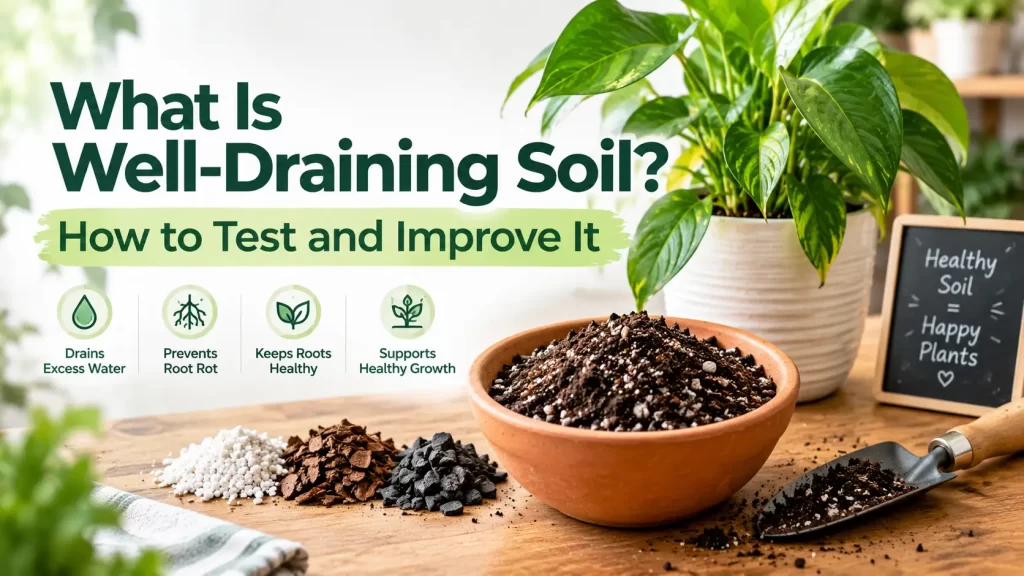
“Plant in well-draining soil” appears on countless plant labels and care guides, but the phrase is often left unexplained. Well-draining soil is not soil that becomes dry immediately. It is soil that allows excess water to move away from the root zone while still holding enough moisture for the plant to use.
The goal is balance: roots need access to both water and air. Soil that remains saturated for too long can lose much of its air-filled pore space, while soil that drains extremely fast may not hold enough water for plants that prefer steady moisture. The right drainage level also depends on the plant, climate, container or garden setting, and the soil itself.
Quick Answer: What Does Well-Draining Soil Mean?
Well-draining soil lets excess water move through the root zone instead of remaining saturated for long periods, while retaining enough moisture to support plant growth. It usually has a useful mix of pore sizes: larger pores help move water and air, while smaller pores hold some water for roots.
For garden soil, a simple percolation test can help measure drainage. Iowa State University Extension describes a practical test in which a saturated hole is refilled and the drop in water level is measured. Its guidance says that a drainage rate of about 1 to 3 inches (2.5 to 7.6 cm) per hour is desirable for many plants, while less than 1 inch (2.5 cm) per hour indicates poor drainage. This is a useful general benchmark, not a universal requirement for every species.
Why Soil Drainage Matters
Plant roots need more than water. They also need oxygen. Soil contains spaces, or pores, between mineral particles and organic matter. Some of those pores hold water and some contain air. When excess water drains away, air can return to larger pore spaces.
If soil stays saturated, water fills spaces that would otherwise contain air. The Iowa State University Extension guide to soil drainage explains that excess soil water can displace oxygen and that low oxygen levels can harm root health.
The Royal Horticultural Society guidance on waterlogging similarly notes that prolonged saturation reduces oxygen around roots and can contribute to yellow leaves, root damage, stunted growth and root rot.
This is why a plant can sometimes look wilted even when the soil is very wet. Damaged or oxygen-starved roots may not function normally, so the leaves can show water-stress symptoms even though water surrounds the root zone.
What Well-Draining Soil Looks and Feels Like
There is no single color, ingredient list or texture that proves soil is well-draining. Drainage is a behavior, not a brand of soil.
In a garden bed, well-draining soil generally accepts water without leaving the root zone saturated for an excessive period. After rain or irrigation, the soil may remain moist, but it should not behave like a long-lasting puddle unless the plants are adapted to wet conditions.
Good soil structure often feels crumbly rather than densely packed. Stable aggregates create spaces through which water and air can move. However, appearance alone is not enough. A soil surface may look dry while deeper layers remain saturated, and a sandy-looking soil may drain so quickly that plants struggle to stay hydrated.
| Drainage condition | Typical behavior | Possible plant effect |
|---|---|---|
| Slow or poor drainage | Water remains in the root zone for a long time; puddling or persistent saturation may occur | Low root-zone oxygen, weak roots, yellowing, rot or poor growth in sensitive plants |
| Moderate, well-drained conditions | Excess water moves away while some moisture remains available | Suitable for many common garden plants, depending on species |
| Very fast drainage | Water moves through quickly and the soil dries rapidly | Frequent water stress for moisture-loving plants; useful for some drought-adapted plants |
How to Test Drainage in Garden Soil
If you are preparing a bed, planting a shrub, or repeatedly seeing water sit in the same area, a simple percolation test can give you more information than guessing from soil texture alone.
Simple percolation test
- Choose a representative spot where you intend to grow plants.
- Dig a hole at least 12 inches (about 30 cm) deep and roughly 4 to 12 inches (10 to 30 cm) wide.
- Fill the hole with water and allow it to drain completely. This first filling helps saturate the surrounding soil.
- Refill the hole with water.
- Measure the water depth.
- After 15 minutes, measure how far the water level has dropped.
- Multiply the 15-minute drop by four to estimate the drainage rate per hour.
This method follows the approach described by Iowa State University Extension. Avoid testing soil when it is already unusually saturated after heavy rainfall, and avoid smearing or compacting the sides of the hole while digging, because that can distort the result.
How to interpret the result
| Approximate drainage rate | General interpretation | What it may mean |
|---|---|---|
| Less than 1 inch (2.5 cm) per hour | Slow / poorly drained | Consider improving drainage or choosing plants tolerant of wetter soil |
| About 1 to 3 inches (2.5 to 7.6 cm) per hour | Desirable for many plants | A useful general range for many garden situations |
| More than 4 inches (10 cm) per hour | Very fast / sharply drained | Moisture may disappear quickly; plant choice and organic matter become important |
Do not treat the numbers as a pass-or-fail rule for every plant. Wetland plants, Mediterranean plants, succulents, vegetables, woodland perennials and fruit trees can have very different tolerances. The test tells you about the site. Plant selection tells you whether that drainage suits what you want to grow.
How Drainage Works in Pots and Containers
Container drainage is related to garden drainage, but it is not identical. A container is a small, enclosed root zone, so both the pot and the growing medium matter.
Drainage holes are essential for most container plants
A pot with no way for excess water to escape can remain saturated even if the potting mix itself is fairly porous. University of Illinois Extension states that a hole at the bottom of a container is critical because it lets excess water drain and helps maintain air around roots.
Decorative cachepots can still be used, but it is usually safer to keep the plant in an inner nursery pot with drainage holes, remove it for watering, allow excess water to drain, and then return it to the decorative outer pot. Do not let the inner pot stand in collected water unless the plant is one that specifically tolerates those conditions.
Use a container growing medium, not ordinary garden soil
Ordinary garden soil can become dense and poorly aerated in a pot. Container mixes are designed to provide a more suitable balance of water retention and air space in a confined root zone. The exact mix should match the plant. A cactus or succulent generally needs a more freely draining medium than a fern or many tropical foliage plants.
Signs Your Soil May Drain Too Slowly
No single symptom proves poor drainage. Look for a pattern involving the soil, the site and the plant.
- Water remains pooled long after normal rain or irrigation.
- Soil stays saturated several days while comparable areas have begun to dry.
- The planting area is a low spot that receives runoff from surrounding ground.
- The ground feels dense, compacted or difficult to penetrate.
- Plants repeatedly develop yellowing, weak growth or dieback during wet periods.
- Roots are dark, soft or decaying rather than firm and healthy.
- A sour or unpleasant smell develops in chronically saturated soil or potting mix.
- Several plants that normally prefer good drainage struggle in the same location.
These clues should lead to investigation, not an automatic diagnosis. Yellow leaves, wilting and stunted growth can have many causes. Check soil moisture and drainage before assuming the plant needs more water, fertilizer or a pesticide.
Can Soil Drain Too Fast?
Yes. “Good drainage” does not mean “the faster the better.”
Sandy or highly porous soils can lose water quickly. That may suit drought-adapted species, but plants that need consistent moisture may wilt frequently or require much more irrigation. Nutrients can also move through a very freely draining root zone more readily, depending on the soil and management.
Organic matter can help at both extremes. In heavier soil it can improve structure and pore development. In very sandy soil it can increase the soil’s ability to hold water and nutrients. The objective is not to turn every garden into the same soil type. It is to create or select conditions that suit the plants you are growing.
What Causes Poor Drainage?
1. High clay content
Clay particles are much smaller than sand particles, and clay-rich soils commonly contain smaller pore spaces and hold water for longer. Clay is not “bad soil.” It can be fertile and productive, but its drainage and workability may be challenging for plants that dislike prolonged wetness.
2. Soil compaction
Foot traffic, vehicles, construction equipment and working soil when it is too wet can compress soil and reduce the pore spaces through which air and water move. Compaction can create drainage problems even where the underlying soil texture would otherwise be workable.
3. Hardpan or an impermeable layer
A dense layer below the surface can prevent water from moving deeper into the profile. The surface may appear reasonable while water accumulates above the restrictive layer.
4. Low spots and site grading
Drainage is partly a landscape problem. A depression can collect runoff even when the soil itself is not exceptionally heavy. Downspouts, paved surfaces and slopes can also direct large amounts of water toward a planting area.
5. High water table or shallow rock
Sometimes water has nowhere to go because the site has a naturally high water table or an underlying rock layer. Soil amendments alone may not correct this type of problem.
6. Containers without effective drainage
In pots, blocked drainage holes, no drainage holes, dense old potting mix, oversized containers and pots left standing in water can all keep the root zone wetter than intended.
How to Improve Poorly Drained Garden Soil
The best solution depends on why the site drains poorly. Do not automatically buy sand, gravel or a bag labeled “soil conditioner.” Diagnose the site first.
Add organic matter where appropriate
For many garden beds, compost and other well-decomposed organic matter can improve soil structure over time. Iowa State University Extension recommends organic matter rather than sand for poorly drained soils and explains that improved aggregation creates pore space for air and water.
For a new garden bed, its guidance suggests spreading roughly 2 to 4 inches (5 to 10 cm) of compost and incorporating it into the upper 6 to 12 inches (15 to 30 cm) of soil. This is a general garden recommendation, not a prescription for every planting situation. Established trees, sensitive native soils and individual planting holes may need different treatment.
Prevent further compaction
Avoid repeatedly walking or driving over planting areas. Permanent paths can keep traffic away from cultivated beds. Do not aggressively work heavy soil when it is wet, because that can damage structure and create dense, smeared surfaces.
Correct a restrictive layer when practical
If testing reveals a compacted layer or hardpan, physically loosening or breaking through that layer may improve movement of water and roots. Deep drainage or site-engineering problems can require professional assessment.
Use raised beds or berms
If the underlying ground remains wet, raising the root zone can be more practical than trying to transform the entire site. Raised beds are particularly useful for vegetables, annuals, perennials and smaller shrubs when native soil is compacted or poorly drained.
Redirect excess water responsibly
Where runoff is the real cause, improving soil alone may accomplish little. Downspouts, grading, hard surfaces and neighboring slopes can send more water into an area than the soil can handle. Redirect water only where it can be managed safely and legally, and never create a drainage problem for a neighboring property.
Choose plants adapted to the site
Sometimes the most sustainable answer is not to “fix” wet soil at all. If a location is naturally moist, choose species that tolerate or prefer those conditions. Matching the plant to the site can require less intervention and less maintenance than forcing a dry-soil plant to survive in a wet root zone.
How to Improve Drainage in Containers
- Make sure the pot has drainage holes. If excess water cannot leave, changing the soil mix may not solve the main problem.
- Use a quality container mix. Avoid filling ordinary houseplant pots with dense garden soil.
- Match the mix to the plant. Succulents and many Mediterranean plants generally need more air-filled pore space and faster drainage than moisture-loving tropical plants.
- Do not let the pot sit in drained water. Empty saucers or cachepots after watering when necessary.
- Replace compacted or broken-down mix when needed. Organic components can decompose over time, causing some mixes to become denser and hold water differently.
- Adjust watering to the actual drying rate. A well-draining mix can still stay wet too long if the plant is watered more frequently than it uses water.
Drainage and watering cannot be separated. The same potting mix may dry quickly in a hot, bright, windy location and much more slowly in a cool, dim room.
Common Soil Drainage Myths
Myth 1: Adding a little sand to clay always improves drainage
This is not a reliable fix. Purdue Extension advises against adding small amounts of sand to clay soil because it may impede drainage rather than improve it. Iowa State University Extension also recommends adding organic matter, not sand, when trying to improve poorly drained soil.
Changing soil texture substantially requires very large quantities of mineral material. For a home gardener, improving structure with organic matter, reducing compaction, using raised beds or choosing suitable plants is usually more practical.
Myth 2: Put rocks or gravel in the bottom of a pot for drainage
A gravel layer inside the bottom of an individual pot does not create the drainage improvement many people expect. University of Illinois Extension explains that water can remain in the finer growing medium above the coarse gravel layer, so the gravel does little to prevent saturation from overwatering.
Use the space for an appropriate potting medium and make sure the container itself has functioning drainage holes.
Myth 3: If water disappears from the surface quickly, drainage must be good
Not necessarily. Surface infiltration and deeper drainage are different. Water may move through the top layer and then collect above compacted subsoil, rock or a hardpan. A percolation test provides better information about the root zone.
Myth 4: All plants need the same “well-draining soil”
Plant labels often use the same phrase for species with very different moisture tolerances. A rosemary plant, a blueberry, a hosta and a cactus do not have identical root-zone preferences. “Well-drained” should always be interpreted alongside the plant’s moisture needs.
Different Plants Need Different Drainage
The correct question is not simply “Does my soil drain?” It is “Does this soil drain at a rate that suits this plant?”
| Plant type | General drainage preference | Important note |
|---|---|---|
| Cacti and many succulents | Fast-draining, well-aerated root zone | Prolonged saturation can be especially damaging |
| Many vegetables and ornamentals | Moist but well-drained soil | Usually need both moisture availability and good root aeration |
| Moisture-loving woodland or tropical plants | Even moisture with drainage | “Well-drained” does not mean they should dry out completely |
| Wetland and bog-adapted plants | Can tolerate or prefer wetter conditions | Standard drainage advice may not apply |
Whenever a plant guide says “well-draining soil,” read the rest of the care requirements too. Words such as dry, evenly moist, drought-tolerant, moisture-retentive and wet-soil tolerant change what good drainage means in practice.
A Practical Drainage Checklist
Before changing your soil, work through these questions:
- Does water remain pooled for an unusually long time after ordinary rain or watering?
- Is the problem limited to one low spot?
- Has the soil been compacted by construction, vehicles or frequent foot traffic?
- Does a percolation test confirm slow drainage?
- Is there a hard layer, shallow rock or high water table?
- Are your chosen plants actually intolerant of the existing moisture level?
- Would improving structure with compost be appropriate for this bed?
- Would a raised bed or berm be more practical?
- In a pot, are drainage holes open and is the container sitting in water?
- Are you using a potting mix suited to the plant?
This diagnostic approach prevents unnecessary amendments and helps you solve the actual problem instead of treating every wet-looking soil the same way.
Frequently Asked Questions
Does well-draining soil mean the soil should dry out quickly?
No. Well-draining soil allows excess water to move away while retaining some usable moisture. How quickly it should dry depends on the plant, weather, container size, soil composition and growing environment.
How can I tell if my garden soil drains well?
Observe how long water remains after rain, check the soil below the surface, and use a percolation test if drainage is uncertain. A measured test is more reliable than judging the surface alone.
Is clay soil always poorly drained?
No. Clay-rich soils commonly drain more slowly, but soil structure, compaction, slope, organic matter and subsoil conditions also affect drainage. Some clay soils can support excellent gardens when managed well and matched with appropriate plants.
Should I add sand to clay soil to improve drainage?
Generally, do not add a small amount of sand as a quick fix. University extension guidance warns that small additions of sand can make clay soil denser or impede drainage. Organic matter, reducing compaction, raised beds and appropriate plant selection are usually more practical strategies.
Should I put gravel in the bottom of plant pots?
Not as a drainage layer inside the pot. University of Illinois Extension advises that gravel at the bottom of an individual pot does not improve drainage in the way commonly claimed. A suitable potting mix and functioning drainage holes are more important.
Can a plant still be overwatered in well-draining soil?
Yes. Good drainage reduces the risk of prolonged saturation, but frequent watering can still keep the root zone too wet, especially in cool or low-light conditions. Watering frequency must match how quickly the plant and environment use water.
What is the best soil for drainage?
There is no single best soil for every plant. The best root-zone conditions provide the balance of drainage, aeration, moisture retention, nutrients and pH required by the particular plant.
The Bottom Line
Well-draining soil is not simply loose soil or dry soil. It is a root environment where excess water can leave and air can return, without losing moisture so quickly that the plant is constantly stressed.
When drainage is poor, identify the reason before trying to fix it. Texture, compaction, hard layers, low spots, runoff and container design can all create different problems. In many garden beds, organic matter and reduced compaction can improve soil structure over time. In difficult sites, raised beds or plants adapted to wet conditions may be the smarter solution.
Most importantly, match drainage to the plant. “Well-draining” is useful shorthand, but healthy gardening comes from understanding what that particular plant needs in that particular root zone.
Sources and Further Reading


