
Why Are My Plant Leaves Turning Black? 8 Causes and What to Do

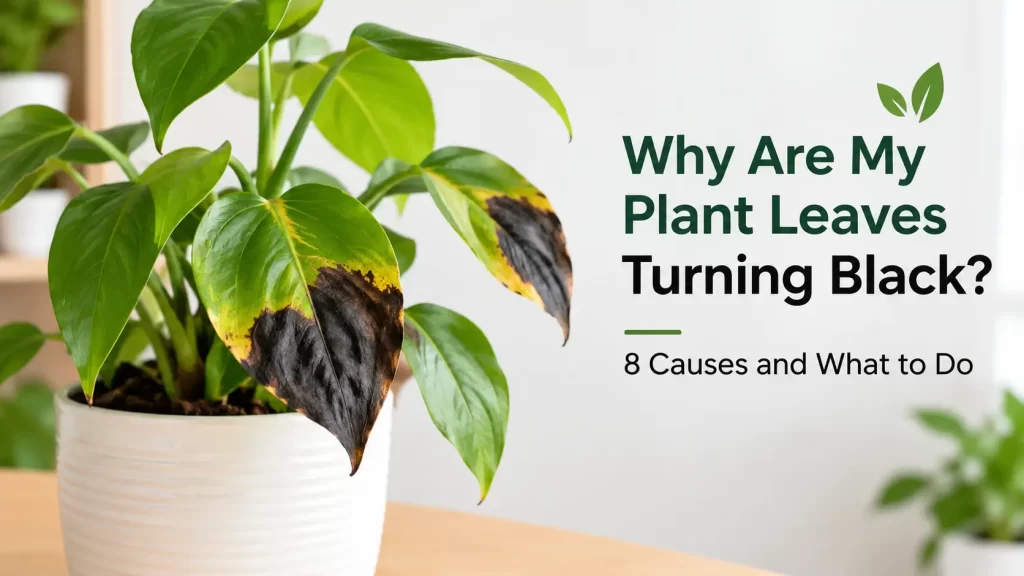
Black leaves can look like an emergency, but “turning black” describes several very different problems.
Sometimes the leaf tissue itself has died and become dark or blackened. Sometimes only small black lesions are developing. In other cases, the leaf is still alive underneath a removable black coating such as sooty mold.
The most useful first step is therefore to identify what kind of blackening you are actually seeing. Check whether the tissue is soft or dry, whether the black area starts at the edges, veins, stem base, or isolated spots, whether the root zone is wet, and whether the black material wipes off the leaf surface.
Common causes include frost or chilling injury, prolonged waterlogging, root and crown rot, bacterial or fungal leaf spots, sooty mold associated with sap-feeding pests, severe environmental scorch, and chemical injury.
Quick Answer: Why Are My Plant Leaves Turning Black?
Black or near-black leaves can result from:
- frost or chilling injury,
- prolonged waterlogging or overwatering,
- root or crown rot,
- bacterial leaf spot or blight,
- fungal leaf spot or blight,
- sooty mold growing on insect honeydew,
- severe sun, drought, wind, or other environmental scorch, and
- fertilizer, pesticide, salt, or other chemical injury.
The Royal Horticultural Society notes that leaf blackening can occur with waterlogging and frost injury, while University of Maryland Extension describes black to brown lesions in bacterial and fungal leaf-spot diseases. UC Statewide IPM also lists chilling injury, chemical spray injury, overwatering, excess light, and fungal or bacterial infection among causes of dark spots and blemishes on houseplant foliage.
Black color alone cannot identify the cause.
Black Tissue, Black Spots, or a Black Coating?
This distinction can eliminate several wrong diagnoses immediately.
Blackened Plant Tissue
If the leaf itself has become black, soft, dry, collapsed, or necrotic, the cells in that area have been severely damaged or killed.
Possible causes include frost, waterlogging, root disease, leaf-spot disease, scorch, or chemical injury.
Black Spots or Lesions
Discrete black spots may point toward fungal or bacterial leaf spot, chemical injury, physical damage, or a species-specific disease.
The shape and texture matter. A water-soaked angular lesion differs from a dry circular spot or a bleached patch that later becomes dark.
Black Material Sitting on the Leaf
If the black substance looks dusty, sooty, or fuzzy and can be rubbed from the surface, the leaf may be covered with sooty mold rather than turning black internally.
University of Maryland Extension explains that sooty mold grows on sugary honeydew produced by sap-feeding insects. It does not directly infect plant tissue.
Black-Leaf Diagnostic Table
| What you see | Possible cause | What to check next |
|---|---|---|
| Leaves suddenly become dark, limp, or black after cold weather | Frost or chilling injury | Recent minimum temperature and exposed foliage |
| Blackening begins along veins or inside leaves while soil stays saturated | Waterlogging | Drainage and root condition |
| Black or brown roots are soft and mushy | Root rot | Root texture, smell, moisture, stem or crown condition |
| Black water-soaked spots with yellow margins | Possible bacterial leaf spot | Angular shape, humidity, leaf wetness, spread |
| Multiple dark circular spots that enlarge or merge | Possible fungal leaf spot | Humidity, leaf wetness, nearby affected leaves |
| Black soot-like film wipes from the surface | Sooty mold | Sticky honeydew, aphids, scale, whiteflies, mealybugs |
| Dry black or very dark patches on exposed leaves | Severe scorch or environmental injury | Sun, heat, drought, wind, recent relocation |
| Blackened or near-black spots after spraying or fertilizing | Phytotoxicity or chemical burn | Recent pesticide, fertilizer, cleaner, salt, or herbicide exposure |
These are diagnostic clues rather than guarantees. Several stresses can overlap.
1. Frost or Chilling Injury
Cold injury is one of the clearest causes of sudden leaf blackening.
RHS notes that foliage exposed to frost can initially appear water-soaked and dark green before turning black. Tender perennials can have foliage blackened by the first frost, and sensitive houseplants can develop blackened leaves, drooping, and collapse after exposure to low temperatures.
Cold injury is more likely when:
- damage appeared soon after a cold night,
- the plant is tropical or frost-tender,
- leaves touching a cold window are affected first,
- damage is concentrated on the most exposed part of the plant,
- tissue looks water-soaked before turning black, or
- soft stems collapse after freezing.
Why frost turns tissue dark
Freezing can damage or destroy plant cells. Once the tissue collapses and dies, it may darken dramatically.
Not all cold damage appears instantly. RHS notes that symptoms on some woody plants can take much longer to become visible.
What to do
Protect the plant from additional cold and avoid forcing rapid new growth while conditions remain risky. On outdoor perennials and woody plants, wait until the extent of damage is clear before making major pruning decisions, particularly if further frost is possible.
Dead black tissue will not become green again, but the plant may still recover from healthy buds, stems, crowns, or roots.
2. Waterlogging and Prolonged Overwatering
Blackening can also begin below ground.
When soil or potting mix remains saturated for too long, water fills air spaces around the roots. Oxygen becomes limited and roots lose the ability to function normally.
RHS specifically describes blackening within leaves, sometimes beginning along the veins, as a symptom associated with waterlogging in woody plants. It also notes that waterlogged roots can become blue-black, break apart easily, and develop a sour or rotting smell.
Waterlogging is more plausible when:
- the soil remains saturated for days,
- the plant wilts even though the root zone is wet,
- yellowing and leaf drop occur along with dark patches,
- the container has poor drainage,
- the garden site stays wet after rain, or
- roots are dark and structurally weak.
Do not respond to wet-soil wilting by automatically adding more water.
See Overwatering vs Underwatering: How to Tell the Difference if moisture symptoms are confusing.
If the site or pot drains poorly, see What Is Well-Draining Soil? How to Test and Improve It.
3. Root or Crown Rot
Waterlogging and root rot are related, but they are not identical.
Waterlogging is a physical root-zone condition. Root rot involves damaged or decaying root tissue and can include infection by organisms such as Pythium, Phytophthora, or Rhizoctonia.
University of Maryland Extension describes root-rot symptoms that include yellowing, browning, leaf dieback, wilting, poor growth, and browning or blackening of roots and crowns. With some root rots, roots become brown to black and soft or mushy, and lower stem tissue can also darken and collapse.
Root rot becomes more likely when:
- roots are soft rather than firm,
- root tissue pulls apart easily,
- the crown or lower stem becomes black or mushy,
- the plant wilts in moist soil,
- growth has slowed dramatically,
- leaves are yellowing or dropping, and
- the root zone has remained excessively wet.
Do not diagnose root rot from root color alone. Healthy root color varies between plant species. Texture, integrity, smell, moisture history, and the condition of the whole plant are more useful.
For a detailed root diagnosis, see Root Rot: Signs, Causes, Treatment, and Prevention.
4. Bacterial Leaf Spot or Blight
Black spots can result from bacterial disease rather than root stress.
University of Maryland Extension describes bacterial leaf spots on indoor plants as black to brown lesions that are often watery. Some stay localized, while others can progress into broader tissue collapse.
Possible bacterial clues include:
- dark water-soaked spots,
- black or brown lesions with yellow margins,
- angular spots limited by leaf veins,
- V-shaped lesions,
- soft or mushy collapsed tissue,
- spots beginning along leaf margins, and
- leaf drop as disease becomes severe.
Bacterial diseases often spread more easily when leaves remain wet and water splashes between plants.
What to do
- Remove heavily affected leaves when appropriate.
- Keep foliage drier where the plant allows it.
- Reduce splashing between plants.
- Improve spacing and air circulation.
- Clean pruning tools when removing affected tissue.
- Separate severely affected plants from healthy plants when practical.
A black spot with a yellow halo does not prove bacterial disease. Fungal leaf spots can produce similar symptoms.
For a broader spot-pattern diagnosis, see Why Are There Brown Spots on My Plant Leaves?.
5. Fungal Leaf Spot or Blight
Many fungi can cause dark brown to black lesions on leaves.
University of Maryland Extension describes fungal leaf spots on indoor plants as tan, reddish-brown, or black roughly circular lesions. Spots can enlarge, merge into irregular areas, and eventually blight large portions of a leaf.
Fungal leaf spot is more plausible when:
- multiple small spots appear rather than one isolated injury,
- spots gradually enlarge,
- lesions merge into larger dead areas,
- several leaves become affected over time,
- the environment is humid or leaves stay wet, and
- new spots continue appearing on previously healthy foliage.
Severe infections can lead to leaf drop and dieback.
What to do
Reduce prolonged leaf wetness, improve air movement, avoid unnecessary splashing, and remove badly infected tissue when practical. In many home situations, University of Maryland notes that sanitation and correcting humid, wet conditions can be more important than automatically reaching for a fungicide.
If a fungicide is being considered, identify the disease as accurately as possible and use only products labeled for the plant and disease in your location.
6. Sooty Mold From Sap-Feeding Pests
Sooty mold is an important exception because the black material may not be dead leaf tissue at all.
University of Maryland Extension explains that sooty mold is a group of dark fungi that grow on honeydew, the sugary waste produced by sap-feeding insects.
The mold does not directly infect the plant.
Signs of sooty mold
- a black, soot-like coating sits on the leaf surface,
- the black material can often be rubbed or washed away,
- leaves or stems feel sticky,
- ants are active on the plant,
- aphids, soft scale, mealybugs, or whiteflies are present, or
- objects underneath the plant are sticky with honeydew.
Heavy sooty mold can reduce the amount of light reaching the leaf and indirectly stress the plant, but the mold itself is not feeding on plant tissue.
Treat the source, not only the black coating
The priority is identifying and managing the honeydew-producing pest. Once honeydew production stops, the sooty mold gradually declines and new growth remains cleaner.
Washing the leaves without controlling the pest may improve appearance temporarily but does not solve the underlying problem.
7. Severe Environmental Scorch
Environmental stress usually causes brown or tan scorch, but severely damaged tissue can become very dark and may appear nearly black.
Possible triggers include intense direct sun after a sudden move, extreme heat, severe drought, hot drying wind, salt-laden coastal wind, and combined root and weather stress.
RHS describes leaf scorch as occurring when water is lost from leaves faster than roots can replace it. Drought, waterlogging, wind, hot sun, frost, and salt exposure can all contribute.
Scorch is more plausible when:
- damage is dry and crispy rather than soft,
- the most exposed leaves are affected first,
- the plant was recently moved into stronger light,
- damage follows a heatwave or severe drying event, or
- the root zone was too dry or unable to supply water normally.
If stronger light is involved, see Full Sun vs Partial Sun vs Shade.
If damage begins mainly at the tips or margins, see Why Are My Plant’s Leaf Tips Turning Brown?.
8. Fertilizer, Pesticide, or Other Chemical Injury
Plants can develop dark scorch, spots, blotches, deformed growth, or near-black tissue after exposure to damaging chemicals.
University of Maryland Extension describes phytotoxicity as chemical injury caused by factors such as overdosing, inappropriate pesticide use, fertilizer salts, cleaning products, and chemical drift. Symptoms can include leaf spots, blotches, scorch, distortion, sudden leaf shedding, and color changes approaching black.
Chemical injury becomes more plausible when:
- symptoms begin soon after a spray or fertilizer application,
- damage is concentrated where droplets landed,
- several different species were affected after the same treatment,
- only one side of outdoor plants is affected after nearby spraying,
- leaves are both scorched and distorted, or
- the plant was sprayed during hot or otherwise stressful weather.
Possible sources include:
- over-concentrated fertilizer,
- fertilizer granules left on wet foliage,
- pesticides used at the wrong concentration,
- insecticidal soap or horticultural oil used under unsuitable conditions,
- window cleaners or other household sprays,
- de-icing salts, and
- herbicide drift.
Do not assume every chemical injury will look black. Symptoms vary with the chemical, plant, dose, and environmental conditions.
If herbicide exposure is possible on an edible crop or valuable landscape plant, contact a local extension service, agronomist, plant diagnostic lab, or pesticide authority when a precise diagnosis matters.
Why Are Only the Leaf Tips Turning Black?
When blackening begins specifically at the tips, the pattern often overlaps with the causes of brown leaf tips.
Possible explanations include severe dehydration, fertilizer or soluble-salt buildup, root damage, waterlogging, cold injury, and species-specific sensitivity to water chemistry.
The tip is far from the roots and is a common location for water-balance and salt problems to become visible.
Use the dedicated guide Why Are My Plant’s Leaf Tips Turning Brown? if the rest of the leaf remains mostly healthy.
Why Are the Leaf Edges Turning Black?
Dark leaf margins can develop after severe scorch, salt stress, drought, cold damage, or root problems.
Check whether the edges are:
- dry and crisp: drought, heat, sun, wind, or salt stress becomes more plausible,
- soft and spreading: consider disease or severe root problems,
- associated with saturated soil: investigate waterlogging and root health, or
- associated with a recent spray: consider phytotoxicity.
Do not diagnose an edge pattern without checking the root zone.
Why Are My Plant’s Leaves Black and Soft?
Soft or mushy black tissue points toward a different group of problems than dry black tissue.
Possible causes include frost or chilling injury, bacterial tissue collapse, root or crown rot, severe waterlogging, and stem or leaf rot.
University of Maryland describes bacterial lesions as sometimes becoming soft and mushy, while root rots can produce dark soft roots and lower stem tissue. RHS describes frost-damaged tender foliage as becoming blackened and collapsed.
If the root zone is wet, inspect the roots before adding more water.
Why Are My Plant’s Leaves Black and Crispy?
Dry, brittle dark tissue is more consistent with tissue that has died from dehydration, scorch, frost after the damaged tissue dries, or chemical burn.
Look at the events immediately before the damage:
- Did the plant dry severely?
- Was it moved into stronger direct sun?
- Was there a heatwave or drying wind?
- Did frost occur?
- Was a fertilizer or pesticide recently sprayed?
If the whole plant is also wilting or dropping leaves, see Why Is My Plant Dropping Leaves?.
Why Are My Houseplant Leaves Turning Black?
Indoor plants are especially vulnerable to combinations of watering, temperature, and root problems.
Common causes include overwatering as indoor light decreases, poor drainage, root rot, cold windows or unheated rooms, bacterial or fungal leaf spots, sooty mold from aphids, scale, mealybugs, or whiteflies, strong direct sun after relocation, and chemical sprays or fertilizer injury.
RHS identifies blackened leaves, drooping, and collapse as symptoms of cold damage in houseplants. University of Maryland also notes that winter overwatering can lead to root and crown rots with darkened root or crown tissue.
Start with four checks
- Check the potting mix below the surface.
- Make sure drainage holes are functioning.
- Inspect roots if the plant is wilting in wet soil.
- Look closely for sticky honeydew or sap-feeding pests.
If the plant was recently moved into a larger container, also review How to Know When a Plant Needs Repotting.
Why Are Outdoor Plant Leaves Turning Black?
Outdoor plants face additional weather and disease pressures.
Important possibilities include frost, prolonged rain and waterlogging, root diseases, bacterial or fungal leaf spots, severe drought or heat scorch, salt exposure, herbicide or pesticide drift, and sooty mold associated with aphids or scale insects.
When many unrelated plants are affected after the same weather or chemical event, investigate the shared environment before assuming multiple separate diseases.
RHS notes that weather injury from drought, flooding, frost, snow, hail, wind, and heat can easily be mistaken for pest or disease damage.
What to Do First When Leaves Turn Black
- Determine whether the black material is inside the leaf or sitting on the surface. If it wipes off like soot, inspect for honeydew-producing pests.
- Check the texture. Soft and mushy or dry and crisp?
- Check the root-zone moisture. Dry, appropriately moist, or saturated?
- Review recent weather. Frost, heat, drought, heavy rain, or wind?
- Look at the pattern. Whole leaf, margins, veins, isolated spots, or lower stem?
- Inspect the roots if the plant is declining.
- Check for yellow halos, water-soaked lesions, or spreading spots.
- Inspect for honeydew and pests.
- Review recent sprays and fertilizer use.
- Correct the strongest cause first. Avoid making several major changes at once.
If the plant is also growing slowly, see Why Is My Plant Growing Slowly?.
If the plant was recently planted or repotted, Transplant Shock may help you separate ordinary adjustment from a serious root problem.
Should You Remove Black Leaves?
Remove leaves when they are fully dead, heavily diseased, mushy, rotting, or acting as a source of spreading infection.
For fungal and bacterial leaf spots, University of Maryland recommends removing affected plant material as part of management.
However, do not strip a stressed plant of every partially damaged leaf automatically. A leaf with a small stable dead patch may still contain a large amount of green photosynthetic tissue.
If frost caused the damage on an outdoor perennial or shrub, waiting until the risk of additional frost has passed can be safer than immediately pruning every darkened shoot.
Use clean tools when cutting diseased tissue and clean them between plants when transmission is a concern.
Can Black Leaves Turn Green Again?
No. Once plant tissue is dead and blackened, that tissue cannot become healthy green tissue again.
The plant itself may recover if enough healthy roots, stems, buds, or leaves remain.
Signs of recovery include:
- new black areas stop appearing,
- existing lesions stop expanding,
- new leaves emerge normally,
- roots produce firm healthy growth,
- wilting decreases,
- leaf drop slows, and
- normal growth resumes.
Judge recovery by new growth rather than the appearance of already damaged tissue.
Common Mistakes When Plant Leaves Turn Black
Mistake 1: Assuming Black Means Root Rot
Root rot is important, but frost, leaf spots, sooty mold, scorch, and chemical injury can also create black symptoms.
Mistake 2: Watering a Wilted Plant Without Checking the Soil
A waterlogged plant can wilt because damaged roots cannot supply the leaves normally.
Mistake 3: Treating Sooty Mold as a Leaf Infection
Sooty mold grows on insect honeydew. Find and manage the pest producing the honeydew.
Mistake 4: Spraying Fungicide on Every Black Spot
Bacteria, frost, chemicals, scorch, and root stress will not be fixed by a fungicide.
Mistake 5: Ignoring Recent Cold Exposure
Sudden blackening after cold weather is a major clue, especially on tropical or frost-tender plants.
Mistake 6: Assuming a Black Coating Means Dead Tissue
Try gently wiping the surface. Sooty mold is a coating, not blackened leaf tissue.
Mistake 7: Repotting Automatically
Repot only if root conditions justify it. A cold-damaged or chemically injured plant may not benefit from additional root disturbance.
Mistake 8: Fertilizing a Severely Stressed Plant
Fertilizer cannot reverse dead tissue and may worsen salt or root stress if used inappropriately.
Mistake 9: Removing All Foliage Immediately
Partially damaged leaves can still function. Remove tissue strategically based on disease risk and the amount of healthy leaf remaining.
Mistake 10: Diagnosing by Color Alone
Black is simply the final appearance of several types of damaged tissue. Texture, pattern, roots, weather, pests, and recent events provide the real diagnosis.
Frequently Asked Questions
Do Black Leaves Mean My Plant Is Dying?
Not necessarily. Black tissue is dead, but the entire plant may still recover if healthy roots, stems, buds, or leaves remain. The prognosis depends on the cause and how much of the plant is affected.
Can Overwatering Turn Leaves Black?
Yes. Prolonged saturated conditions can damage roots and are associated with dark areas inside leaves, blackened roots, wilting, yellowing, and decay. Overwatering can also increase the risk of some root diseases.
Why Are My Plant Leaves Black and Mushy?
Soft black tissue can occur after frost, bacterial tissue collapse, severe waterlogging, or root and crown rot. Check recent temperature exposure and root-zone moisture first.
Why Are My Plant Leaves Black and Crispy?
Dry black tissue can follow severe drought, intense sun, heat, wind, frost after tissue dries, or chemical burn. Review the plant’s recent environmental history.
Why Are There Small Black Spots on My Leaves?
Small black spots can be caused by fungal or bacterial leaf spots, chemical injury, or other species-specific problems. Look for yellow halos, water-soaked tissue, spot shape, and whether lesions are spreading.
What Is the Black Stuff on My Plant Leaves?
If it looks like soot and wipes from the surface, it may be sooty mold. Check for sticky honeydew and sap-feeding pests such as aphids, scale, whiteflies, or mealybugs.
Can Cold Weather Turn Leaves Black?
Yes. Frost can damage plant cells and cause tissue to appear water-soaked before darkening or turning black. Tender plants are particularly susceptible.
Should I Cut Off Black Leaves?
Remove fully dead, rotting, or heavily diseased leaves when appropriate. Do not automatically remove every leaf with a small stable damaged area, because remaining green tissue can still photosynthesize.
Will Black Leaves Become Green Again?
No. Dead black tissue does not recover. Focus on stopping new damage and producing healthy new growth.
Can Root Rot Cause Black Leaves?
Root rot can lead to wilting, yellowing, browning, dieback, and blackening of roots or crowns. Foliage may also darken as the plant declines, but black leaves alone are not enough to diagnose root rot.
Can Fertilizer Burn Turn Leaves Black?
Severe fertilizer or salt injury can produce scorch, spots, tissue death, and near-black discoloration. Check recent fertilizer use and look for additional tip, margin, or root damage.
Can a Plant Recover After Frost Turns Its Leaves Black?
Yes, depending on the species and the depth of injury. The damaged foliage will not recover, but healthy buds, stems, crowns, or roots may produce new growth after conditions improve.
Sources and Further Reading
- Royal Horticultural Society: Brown and blackened leaves on woody plants
- Royal Horticultural Society: Frost damage
- Royal Horticultural Society: How to help a poorly houseplant
- Royal Horticultural Society: Waterlogging and flooding
- University of Maryland Extension: Root rots of indoor plants
- University of Maryland Extension: Bacterial leaf spots on indoor plants
- University of Maryland Extension: Fungal leaf spots on indoor plants
- University of Maryland Extension: Honeydew and sooty mold
- University of Maryland Extension: Phytotoxicity and chemical damage
- UC Statewide IPM: Diagnosing houseplant problems
Bottom Line
Black leaves are not one diagnosis.
First decide whether the plant tissue itself is black, whether you are looking at spreading black spots, or whether a black coating is sitting on top of otherwise living foliage. Then check texture, root-zone moisture, temperature history, leaf-wetness conditions, pests, recent sprays, and the pattern of damage.
Soft black tissue after frost requires a different response from blackened roots in waterlogged soil, black bacterial lesions, dry scorch, or sooty mold from aphids or scale. Diagnose the pattern first, correct the underlying cause, and judge recovery by healthy new growth rather than expecting black tissue to turn green again.


