
Potting Soil vs Potting Mix: What’s the Difference and Which Should You Use?

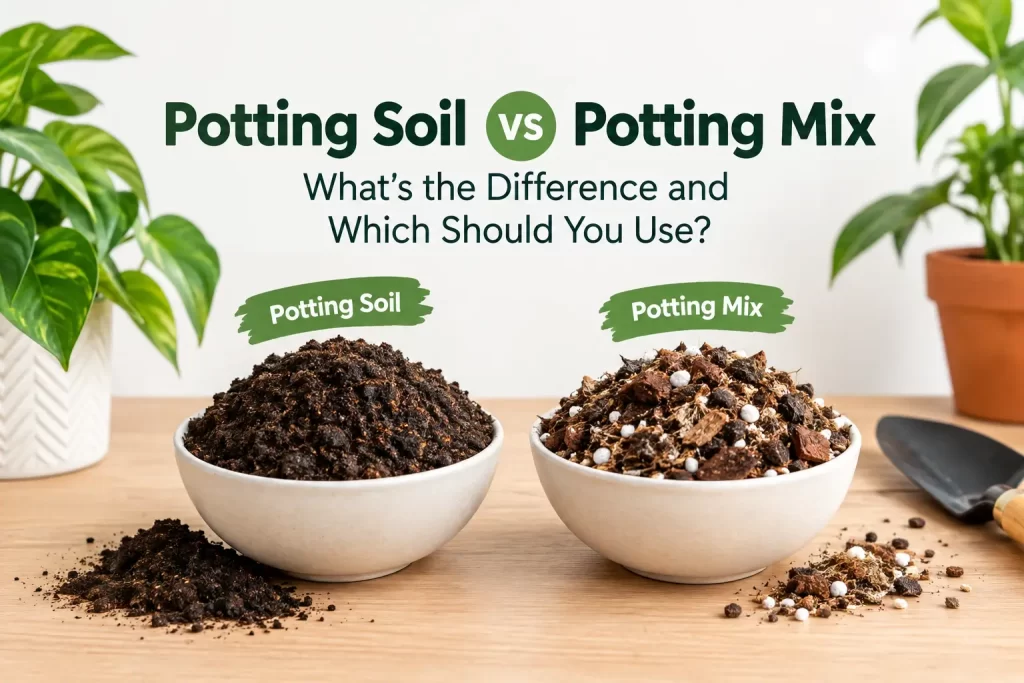
“Potting soil” and “potting mix” sound like two clearly defined products. In practice, the labels are often inconsistent.
A bag called potting mix is usually a lightweight container-growing medium made from materials such as peat or coir, bark, perlite, vermiculite, compost, and sometimes fertilizer. It may contain no true mineral soil at all.
A product called potting soil may contain actual soil, but many commercial products use that name for soilless growing media too. University of Maryland Extension specifically notes that container media are marketed under several names, including “potting soil,” even when they do not contain mineral soil.
So the most useful rule is not “always buy the bag with the word mix.” It is: read the ingredients and choose a growing medium designed for the plant and container you are using.
Quick Answer: Potting Soil vs Potting Mix
The traditional distinction is:
- Potting mix: usually a soilless growing medium designed for containers.
- Potting soil: may contain mineral soil such as loam, sand, silt, or clay along with organic and aeration ingredients.
But commercial naming is inconsistent. A product labeled “potting soil” may still be completely soilless.
University of Maryland Extension explains that commercial container media have many alternate names, including “potting soil,” “potting mix,” and “container substrate.” These products should not be confused with true soil, which contains mineral particles such as sand, silt, and clay.
For most ordinary houseplants and container plants, a purpose-made container medium with good air space, drainage, and moisture retention is usually more important than the exact wording on the front of the bag.
Potting Soil vs Potting Mix: What Is the Real Difference?
Technically, the clearest dividing line is the presence or absence of mineral soil.
A true soilless potting mix gets its physical structure from materials such as peat moss or peat alternatives, coconut coir, composted bark, wood fiber, compost, perlite, vermiculite, grit, and similar growing-medium ingredients.
A soil-based potting medium includes some actual mineral soil or loam in addition to organic and aeration materials.
Colorado State University Extension describes purchased potting soil as potentially containing pasteurized soil together with peat, vermiculite, perlite, and composted manure, while soilless mixes contain similar lightweight ingredients without the heavy soil fraction.
That distinction can affect weight, drainage, water storage, nutrient buffering, and how stable the medium remains over time.
Why “Potting Soil” and “Potting Mix” Labels Can Be Misleading
One of the most useful things to know before shopping is that the product name is not always a reliable description of the ingredients.
University of Maryland Extension states that soilless growing media may be marketed as “potting soil,” “planting mix,” “potting mix,” or “container substrate.” Its Ask Extension service also notes that products called potting soil often contain no mineral soil at all.
Virginia Tech similarly uses terms such as potting soils, potting media, potting mixes, and soilless substrates for commercially available container-growing products.
So instead of assuming that “soil” always means heavy and “mix” always means light, use a more reliable sequence:
- Read the intended use on the bag.
- Check the ingredient list.
- Feel how heavy and fine the material is when possible.
- Match its drainage and moisture retention to your plant.
- Check whether fertilizer or wetting agents have already been added.
Potting Soil vs Potting Mix Comparison
| Feature | Typical soilless potting mix | Typical soil-based potting medium |
|---|---|---|
| Mineral soil | Usually none | Contains some soil or loam |
| Weight | Usually lighter | Usually heavier |
| Aeration | Often high when properly formulated | Depends on soil fraction and amendments |
| Drainage | Designed for container drainage | Can drain well when correctly formulated, but may be denser |
| Water retention | Adjusted through peat, coir, bark, vermiculite and similar materials | Influenced by soil and organic components |
| Nutrients | May contain little naturally unless compost or fertilizer is added | Soil fraction can contribute buffering and mineral nutrients |
| Long-term stability | Organic components can break down over time | Mineral soil fraction can remain stable longer |
| Common use | Houseplants, annual containers, vegetables, seedlings, specialty crops | Some long-term containers and specialty soil-based systems |
This table describes typical properties, not guaranteed properties. The formulation of the actual product matters more than its category name.
What Is Potting Mix?
Potting mix is a manufactured or blended growing medium designed to support roots inside a container.
University of Maryland Extension describes soilless media as typically containing ingredients such as peat moss, perlite, vermiculite, composted bark, compost, and coconut coir, often with smaller amounts of lime or fertilizer.
A good potting mix must hold enough water for roots, drain excess water, retain enough air after watering, physically support the plant, hold or supply nutrients, and remain structurally useful for an appropriate period.
University of New Hampshire Extension emphasizes that air space is one of the most important properties of a container medium. Roots need both water and oxygen.
This is why a good container mix is not simply “something that drains fast.” It must balance drainage with usable moisture.
For a deeper explanation of this balance, see What Is Well-Draining Soil? How to Test and Improve It.
What Is Potting Soil?
In technical gardening language, a soil-based potting medium contains a mineral soil component, often loam, mixed with organic and aeration materials.
But the commercial term potting soil is used much more loosely.
Some bags contain actual mineral soil. Others contain no true soil and are essentially potting mix under a different product name.
That is why it is better to ask, “What is in this product, and what was it designed to grow?” rather than relying on the front-of-bag name.
Soil-based media are not automatically bad
Soilless mixes are convenient and widely used, but soil-based container media have legitimate horticultural uses.
RHS notes that soil-based John Innes-type potting media can be useful for long-term container plants because their mineral soil fraction is structurally stable and provides weight and buffering against rapid fluctuations in water and nutrients.
So the real problem is not “soil exists in a pot.” The problem is using an unsuitable soil or unsuitable proportion of soil for the container.
Why Garden Soil Behaves Differently in a Pot
One of the most common container mistakes is filling a pot with ordinary soil dug directly from the garden.
Soil that works well in the ground can behave very differently when confined inside a shallow container.
Illinois Extension explains that ordinary garden soil used alone in a container has severely reduced drainage and aeration. University of Maryland similarly notes that true soil is much denser than typical container media and can restrict the movement of air and water around roots.
Garden soil in pots can compact, hold too much water, leave too little air around roots, become very heavy, and introduce weed seeds or organisms from the garden.
This does not mean mineral soil can never be used in container formulations. It means garden soil should not simply be scooped into a typical pot and treated as equivalent to a formulated container medium.
Common Ingredients in Potting Mix
Peat moss
Peat has traditionally been used because it is lightweight and can retain significant moisture while contributing structure. It can become difficult to rewet after drying severely, which is one reason some commercial media contain wetting agents.
Coconut coir
Coir is made from coconut-husk material and is commonly used as a peat alternative or partial substitute. It can contribute water retention while remaining relatively lightweight.
Composted bark
Bark can increase structure and air space. Particle size matters, because coarse bark behaves differently from finely decomposed material.
Perlite
Perlite is a lightweight expanded mineral commonly used to create larger pore spaces and improve aeration and drainage.
Vermiculite
Vermiculite can help retain water and nutrients. It is often used in seed-starting and general potting media, although the amount depends on the purpose of the mix.
Compost
Compost can contribute organic matter and nutrients, but its physical and chemical properties vary depending on feedstock and processing.
Loam or mineral soil
Some soil-based growing media contain loam or another mineral-soil component for weight, buffering, nutrient retention, and long-term stability.
Sand, grit, and other coarse materials
Coarse materials can change weight, drainage, and physical structure. Fine sand can make some mixes denser instead of improving aeration.
Lime, fertilizer, and wetting agents
Commercial products may also contain lime to adjust pH, starter nutrients, controlled-release fertilizer, or wetting agents. Always read the bag before adding more fertilizer.
Which Should You Use?
Choose based on plant type, container size, watering conditions, climate, and how long the plant will remain in the container.
The best medium for a cactus is not necessarily the best medium for a fern, orchid, tomato, seedling, or long-term potted shrub.
Best Choice for Houseplants
For most ordinary houseplants, start with a good-quality container potting medium rather than raw garden soil.
Penn State Extension recommends choosing a good-quality soilless potting mix for indoor containers, noting that these mixes may contain peat, coir, perlite, vermiculite, fertilizer, and other ingredients.
Then adjust for the plant. Some tropical aroids, succulents, epiphytes, and species with thick roots often benefit from a coarser structure, while moisture-loving foliage plants may perform better in media that hold water more evenly.
Do not buy a mix only because the front says “houseplant.” Check whether its physical behavior suits your actual plant and watering habits.
Best Choice for Outdoor Containers
Outdoor containers usually require a medium that drains well but does not dry so rapidly that the plants become impossible to keep watered.
Illinois Extension advises against using garden soil alone and notes that container media must provide aeration and drainage while retaining enough moisture for plant growth.
RHS similarly recommends purpose-made potting compost for container planting and notes that the best formulation depends on the plant.
A container in full summer sun and wind may need more moisture retention than the same plant indoors. Large containers also dry differently from small pots.
See How Often Should You Water Plants? for a condition-based approach.
Best Choice for Starting Seeds
Seed-starting media are usually finer and more uniform than general potting mixes.
University of Maryland Extension explains that seed-starting media are designed to provide water, air, support, and close contact around small seeds. UGA Extension recommends soilless seed-starting media with low weed and pathogen risk and warns against ordinary garden soil because it is heavy and can contain weed seeds or plant pathogens.
A good seed-starting mix should be fine enough for small seeds, evenly textured, well aerated, able to hold consistent moisture, and free from large chunks that interfere with germination.
General potting mix can work for larger seeds, but chunky bark-heavy media may be awkward for very small seeds.
Best Choice for Succulents and Cacti
Succulents and cacti generally need more air and faster drying around the roots than many moisture-loving foliage plants.
University of New Hampshire Extension notes that general potting mixes may hold too much moisture for orchids, succulents, or cacti, which is one reason specialty mixes are widely sold.
The exact formulation should still match the species and environment. A cactus growing outdoors in a hot, dry climate may tolerate a different mix from the same plant in a cool indoor room with low evaporation.
Do not judge the mix only by how quickly water exits the drainage hole. The amount of water retained around roots after drainage matters too.
Best Choice for Orchids and Epiphytes
Many commonly grown orchids are epiphytes in nature, with roots adapted to much greater air exposure than ordinary potting mix provides.
A fine, moisture-retentive general mix can keep those roots too wet. Specialty orchid media often contain coarse bark and other large particles that create substantial air space.
Not every orchid has identical needs, so use species-specific guidance rather than treating “orchid mix” as universally interchangeable.
Best Choice for Long-Term Container Plants
Plants that may remain in the same large container for years require a medium that maintains useful structure over time.
RHS highlights soil-based media such as John Innes-type formulations for long-term container plants because the soil fraction is relatively stable and buffers changes in water and nutrients.
For a heavy shrub, small tree, or long-term patio plant, weight can also be useful because it makes the container less likely to tip.
This does not mean every long-term container needs a soil-based medium. It means stability becomes more important as the expected life of the planting increases.
Can You Use Potting Mix in Raised Beds?
You can, but filling a large raised bed entirely with bagged potting mix is not always the best use of the material.
Container media are designed for confined pots where drainage and aeration need to be engineered carefully. Raised beds have much greater soil volume and interact with the ground differently.
UGA Extension notes that commercial soilless mixes can be used in raised beds but that commercial products vary widely. Clemson Extension also warns that pure potting-style soilless media can dry quickly, break down, and require more frequent watering and fertilization when used as the main material in large outdoor raised beds.
For a permanent raised bed, a well-designed blend of mineral soil and organic matter is usually more appropriate than simply filling the entire structure with houseplant potting mix.
Can You Use Compost Instead of Potting Mix?
Compost and potting mix are not the same thing.
Compost is decomposed organic material used primarily to improve soil and contribute nutrients and organic matter. A container growing medium must also maintain the physical air and water balance roots need.
RHS makes an important terminology distinction: garden compost is decomposed organic material used as a soil improver, while potting compost in UK gardening language means a formulated medium used for plants in containers.
For a global audience, this difference matters because the word “compost” can mean different products in different countries.
Pure garden compost may be too nutrient-rich, too variable, too dense, or physically unstable for some container plants. It is often more useful as one component of a formulated growing medium rather than the only ingredient.
Does Potting Mix Already Contain Fertilizer?
Sometimes.
Commercial mixes may contain no added fertilizer, a small starter nutrient charge, controlled-release fertilizer, or compost and other materials that contribute nutrients.
Penn State advises gardeners to read the ingredient information because not every plant needs the same fertilizer treatment and specialty mixes vary.
Do not automatically fertilize a newly potted plant without checking the product. Too much fertilizer can increase soluble salts around roots and damage the plant.
What About Peat-Free Potting Mix?
Peat-free container media are increasingly available and can be made from combinations of coir, composted bark, wood fiber, compost, and other materials.
RHS recommends choosing peat-free composts and notes that peat-free products vary by intended use, just as peat-based products do.
The important practical point is that peat-free is not one single recipe.
Different products can differ substantially in water retention, air space, particle size, nutrient content, and how quickly they dry. You may need to adjust watering when changing from one formulation to another.
How to Read a Bag of Potting Soil or Potting Mix
1. Intended use
Check whether the product is intended for indoor containers, outdoor pots, seed starting, succulents, orchids, acid-loving plants, vegetables, or raised beds.
2. Ingredients
Look for the main structural ingredients such as coir, peat, bark, perlite, vermiculite, compost, or loam.
3. Added fertilizer
Check whether fertilizer is included and how long the manufacturer says it is intended to last.
4. Moisture-control additives
Some products contain wetting agents or water-retaining additives. These can change how the medium behaves.
5. Texture
A general container mix should not feel like heavy clay or fine compacted mud. Maryland Extension advises avoiding products that feel excessively heavy, gritty, very fine, or clumped.
6. Match it to your conditions
A mix that works well for one gardener may stay too wet for another because pot size, temperature, humidity, plant species, light, and watering habits all affect drying speed.
Can You Reuse Old Potting Mix?
Sometimes, but first ask why the previous plant left the pot.
Do not casually reuse mix from a diseased plant
If the previous plant had root rot, a serious soilborne disease, a major pest infestation, or an unexplained decline, replacing the medium is generally safer than immediately transferring it to another valuable plant.
Old mix also changes physically
Organic ingredients break down over time. The medium can become finer, denser, and less aerated.
If the mix is structurally degraded, refreshing it with new material may be more useful than simply adding fertilizer.
If you are deciding whether a plant needs fresh medium or a new container, see How to Know When a Plant Needs Repotting.
Should You Make Your Own Potting Mix?
You can, but a good homemade mix should be designed around function rather than copied from a random fixed recipe.
RHS provides guidance for creating homemade potting media and emphasizes that a useful mixture should drain well while still holding enough moisture. Illinois Extension also gives examples of both soil-based and soilless container media.
When adjusting a mix, think about how much water the plant needs, how quickly your climate dries containers, the size of the pot, how much air the roots require, whether the planting is short-term or long-term, and how nutrients will be supplied.
A universal recipe cannot be ideal for every plant.
Common Potting Soil and Potting Mix Mistakes
Mistake 1: Assuming “potting soil” always contains soil
Many products carrying that label are actually soilless growing media. Read the ingredients.
Mistake 2: Assuming potting mix is always better than any soil-based medium
Properly formulated soil-based media can be useful, particularly for long-term container plants.
Mistake 3: Filling ordinary pots with unmodified garden soil
Garden soil can compact and leave too little air around roots when confined in containers.
Mistake 4: Buying one universal mix for every plant
Orchids, succulents, seedlings, tropical foliage plants, and long-term woody plants have different root-zone requirements.
Mistake 5: Choosing only by how fast the mix drains
Roots need both drainage and usable water. A mix that dries immediately may be just as difficult to manage as one that stays saturated.
Mistake 6: Ignoring fertilizer already in the bag
Adding more fertilizer immediately can be unnecessary and may increase salt stress.
Mistake 7: Treating compost as identical to potting mix
Garden compost is a soil amendment. A potting medium must also provide suitable structure, drainage, and aeration.
Mistake 8: Using a very fine seed-starting mix forever
Fine seed media are optimized for germination. Larger established plants may benefit from a coarser, more structurally stable medium.
Mistake 9: Assuming peat-free mixes all behave the same
Peat-free products can have very different ingredients and water-holding characteristics.
Mistake 10: Trying to fix a poor mix only by changing watering frequency
If the root zone is structurally unsuitable, perfect watering becomes unnecessarily difficult. Sometimes the medium itself needs to change.
Frequently Asked Questions
Is Potting Mix Better Than Potting Soil?
Not automatically. A well-formulated soilless potting mix is excellent for many containers, but soil-based media can be useful for certain long-term plants. Choose by ingredients and intended use rather than the name alone.
Are Potting Soil and Potting Mix the Same Thing?
The terms are often used interchangeably in retail products. Technically, a potting mix may be completely soilless while a soil-based potting medium contains mineral soil, but product naming is inconsistent.
Does Potting Soil Actually Contain Soil?
Sometimes. Many commercial products called potting soil contain little or no true mineral soil, which is why reading the ingredient label is important.
Can I Use Garden Soil in Pots?
Using unmodified garden soil alone is generally not recommended for ordinary containers because it can become dense, poorly aerated, and slow draining. Formulated soil-based media use soil in controlled proportions with other ingredients.
Can I Use Potting Mix for Houseplants?
Yes. A good container potting mix is the normal starting point for many houseplants. Adjust texture and moisture retention for the species.
Can I Use Potting Mix for Vegetables?
Yes, if the product is suitable for edible container crops and provides appropriate drainage, water retention, and nutrition. Check the label for intended use and fertilizer content.
Can I Use Potting Mix for Seed Starting?
General potting mix can work for some seeds, but dedicated seed-starting media are usually finer and more uniform, which is especially useful for small seeds.
Can I Use Potting Mix in Raised Beds?
You can use it as part of a raised-bed blend, but filling a large permanent bed entirely with lightweight potting mix is not always ideal because the material can break down, dry quickly, and require more frequent nutrient management.
Is Potting Mix Sterile?
Do not assume it is sterile unless the product specifically states that. Commercial media are generally designed to have lower weed and pathogen risk than raw garden soil, but terminology and processing vary.
Does Potting Mix Have Nutrients?
Some does and some does not. Products may include compost, starter fertilizer, or controlled-release fertilizer. Check the label before feeding newly potted plants.
Why Does My Potting Mix Stay Wet for So Long?
The mix may be too moisture-retentive for the plant or conditions, the pot may be oversized, drainage may be restricted, light may be low, or temperatures may be cool. See Overwatering vs Underwatering if the plant is showing stress.
Why Does My Potting Mix Dry Out So Fast?
Fast drying can result from a coarse mix, a small pot, high temperatures, strong light, wind, a root-bound plant, or a medium that has become difficult to rewet. Diagnose the container and environment together.
Sources and Further Reading
- University of Maryland Extension: Growing media for containers
- University of Maryland Extension: Growing vegetables in containers
- University of Maryland Extension: Starting vegetable seeds indoors
- Penn State Extension: Repotting houseplants and choosing potting mix
- Illinois Extension: Soil and growing media for container gardens
- Illinois Extension: Potting mixes, soil, and houseplants
- Colorado State University Extension: Container gardens and soil mixes
- Royal Horticultural Society: Growing plants in containers
- Royal Horticultural Society: Soil-based John Innes potting media
- Royal Horticultural Society: Peat-free compost choices
- Royal Horticultural Society: Making potting mix
- University of New Hampshire Extension: Choosing soil for potted plants
- Virginia Tech Extension: Indoor plant culture and potting media
Bottom Line
The words “potting soil” and “potting mix” are useful only up to a point because commercial naming is inconsistent.
For most container plants, focus on what the medium actually contains and how it behaves around roots. A good container medium must hold enough moisture while still maintaining drainage and air space. It should also suit the plant, pot size, climate, watering habits, and expected life of the planting.
Soilless potting mix is an excellent default for many houseplants and annual containers, but properly formulated soil-based media also have legitimate uses, especially in long-term containers. Read the bag, match the medium to the plant, and do not assume that ordinary garden soil, pure compost, or one universal potting product will work equally well everywhere.


