
What Is Soil pH? How to Test It and When to Adjust It

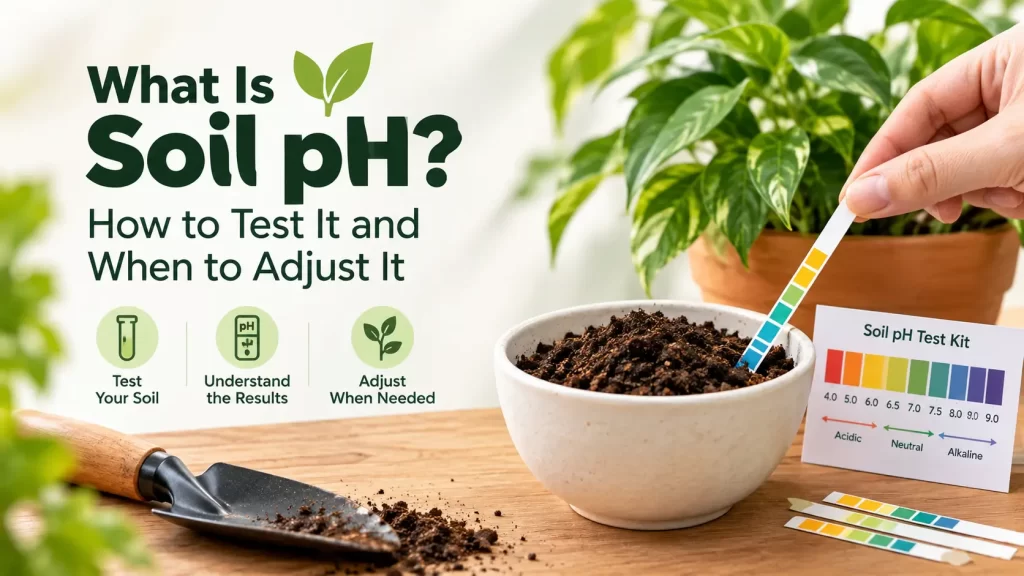
Soil pH tells you how acidic or alkaline your soil is. It matters because pH affects nutrient availability, soil biology, and which plants are likely to grow well in a particular site.
But soil pH is often misunderstood. A pH of 7 is neutral, yet neutral is not automatically the goal. Many garden plants grow well in moderately acidic to neutral soil, while blueberries, rhododendrons, azaleas, and other acid-loving plants prefer a lower pH. Some plants tolerate alkaline conditions better than others.
The most reliable way to manage pH is to test first, choose a target based on what you are growing, and adjust only when the result and plant requirements justify it. Adding lime, sulfur, or other amendments without testing can push the soil in the wrong direction.
Quick Answer: What Is Soil pH?
Soil pH is a measure of how acidic or alkaline the soil solution is on a scale from 0 to 14:
- below 7: acidic,
- 7: neutral,
- above 7: alkaline or basic.
For many garden plants, a moderately acidic to neutral soil is suitable. University of Maryland Extension notes that vegetables, grasses, and many native and ornamental plants perform well roughly between pH 5.5 and 7.0, while RHS describes about pH 6.5 as a useful general-purpose garden pH.
That does not mean every plant should be grown at 6.5. Blueberries and other ericaceous plants prefer distinctly acidic conditions.
Use a soil test before trying to raise or lower pH. Laboratory testing is especially useful because it can provide both the current pH and amendment recommendations.
What Does Soil pH Mean?
Soil pH describes the acidity or alkalinity of the water solution around soil particles and plant roots.
Plants take up mineral nutrients from this soil solution, so pH affects the chemical forms those nutrients take and how available they are to roots.
A pH reading does not directly tell you:
- how much nitrogen is in the soil,
- how much phosphorus or potassium is present,
- whether the soil drains well,
- how much organic matter is present, or
- whether roots are healthy.
That is why a complete laboratory soil test can be much more informative than a pH reading alone.
Why the pH Scale Is Logarithmic
The pH scale is logarithmic rather than linear.
University of Georgia Extension and Oregon State University Extension both explain that a soil at pH 5 is about ten times more acidic than a soil at pH 6, and about one hundred times more acidic than a soil at pH 7.
So a change from pH 7 to pH 6 is much more significant than the single-number difference makes it appear.
This is also one reason pH adjustment should be gradual and based on testing rather than guesswork.
Why Soil pH Matters to Plants
Soil pH strongly influences nutrient availability.
University of Maryland Extension notes that phosphorus becomes less available at both low and high pH because it can combine with other soil elements into forms that roots cannot use efficiently.
RHS likewise explains that:
- very acidic soils can lose calcium, potassium, magnesium, and other nutrients more readily,
- phosphorus availability can decline under strongly acidic conditions,
- iron and manganese can become less available in alkaline soil, and
- soil biological activity also changes with pH.
pH can create a nutrient deficiency even when the nutrient is present
This is an important gardening concept.
A soil may contain iron, for example, but high pH can convert it into forms that certain plants cannot absorb efficiently. Colorado State University Extension describes iron chlorosis as a common problem in alkaline soils even when the soil contains adequate total iron.
Adding more general fertilizer may not correct a pH-related availability problem.
For general nutrient guidance, see How to Fertilize Plants: When to Feed, How Much, and What to Avoid.
Common Soil pH Ranges
| Soil pH | General description | Practical meaning |
|---|---|---|
| Below 5.0 | Very acidic | Suitable for relatively few garden plants; nutrient imbalances become more likely |
| 5.0 to 5.5 | Acidic | Useful for acid-loving plants such as blueberries and many ericaceous plants |
| 5.5 to 6.5 | Moderately acidic | Suitable for many vegetables and ornamentals |
| 6.5 to 7.0 | Slightly acidic to neutral | Suitable for a broad range of garden plants |
| 7.0 to 7.5 | Neutral to mildly alkaline | Many plants tolerate this, but acid-loving species may show nutrient problems |
| Above 7.5 | Alkaline | Iron and some other micronutrients can become less available to sensitive plants |
These are broad gardening ranges, not universal plant requirements.
What Is the Best Soil pH for Plants?
There is no single ideal pH for every plant.
RHS describes about pH 6.5 as a useful general-purpose garden pH because many major nutrients are readily available in this range.
University of Maryland Extension gives a broader practical range of about pH 5.5 to 7.0 for many vegetables, grasses, native plants, and ornamentals.
But the correct target should be based on what you plan to grow.
Examples of different preferences
Oregon State University Extension lists target ranges that illustrate how plant needs differ:
- blueberries: strongly acidic,
- potatoes: moderately acidic,
- tomatoes: mildly acidic,
- many grain and forage crops: mildly acidic to neutral.
The lesson is not to memorize one pH number. It is to match the soil to the crop.
Which Plants Prefer Acidic Soil?
Acid-loving plants are often called ericaceous plants.
Common examples include:
- blueberries,
- rhododendrons,
- azaleas,
- camellias,
- heathers, and
- some other plants adapted to acidic soils.
University of Minnesota Extension recommends roughly pH 4.0 to 5.5 for blueberries, depending on the specific guidance used.
When these plants are grown in soil that is too alkaline, they may develop pale or yellow leaves because micronutrients such as iron become difficult to absorb.
It can be easier to choose the right plant than rebuild the soil
If your site is naturally very alkaline or contains free limestone, permanently lowering the pH over a large area may be difficult or impractical.
In that situation, choosing alkaline-tolerant plants or growing acid-loving plants in a controlled container medium may be more realistic.
What Happens When Soil Is Too Alkaline?
In alkaline soil, some nutrients become less available even when the soil contains them.
Iron deficiency is a classic example.
Possible signs include:
- yellow young leaves with greener veins,
- slow growth,
- poor performance of acid-loving plants, and
- persistent chlorosis despite ordinary fertilization.
RHS notes that iron and manganese become less available in alkaline soils and that phosphorus availability can also decline.
However, yellow leaves do not prove the pH is high.
Overwatering, root rot, nutrient deficiency, drought, pests, and natural leaf aging can create similar symptoms. See Why Are My Plant Leaves Turning Yellow? before diagnosing from color alone.
What Happens When Soil Is Too Acidic?
Very acidic soil can also create nutrient problems.
RHS notes that under strongly acidic conditions:
- calcium, magnesium, potassium, and some other nutrients can be lost more easily,
- phosphorus can become less available, and
- soil biological processes can be reduced.
In some soils, very low pH also increases the solubility of aluminum and manganese to levels that can damage sensitive roots.
Again, the correct action depends on the plant. A pH that is too low for a vegetable bed may be appropriate for blueberries.
How to Test Soil pH
You have two main options:
- a home pH test kit, or
- a laboratory soil test.
Home pH kits
RHS notes that simple home testing kits can provide a useful indication of whether garden soil is acidic, neutral, or alkaline.
They are practical when you mainly need a rough pH reading.
Laboratory soil tests
University of Maryland Extension recommends laboratory testing because it provides more complete and accurate information than a simple home kit.
Depending on the laboratory, a report can include:
- soil pH,
- phosphorus,
- potassium,
- calcium,
- magnesium,
- organic matter,
- soluble salts, and
- fertilizer or lime recommendations.
This is especially valuable when you plan to change pH rather than merely measure it.
How to Collect a Useful Soil Sample
A laboratory can only analyze the soil you send, so sampling quality matters.
1. Divide the garden into meaningful areas
Do not mix clearly different areas into one sample.
For example, keep separate samples for:
- vegetable beds,
- lawns,
- flower borders,
- orchards,
- areas with obviously different soil, and
- areas managed differently in the past.
2. Take multiple subsamples
Collect small amounts from several points across the area rather than testing one handful from one location.
3. Sample at an appropriate depth
Follow the instructions provided by the laboratory because recommended depth depends on the crop and test.
4. Mix the subsamples
Combine them in a clean container to create a representative composite sample.
5. Avoid unusual spots
Do not let a compost pile location, fertilizer spill, animal waste patch, burn pile, or construction debris dominate a sample unless that specific area is what you want tested.
6. Follow the laboratory’s preparation instructions
Different laboratories have different requirements for sample volume, drying, packaging, and submission.
Home Soil pH Test vs Laboratory Test
| Feature | Home pH kit | Laboratory soil test |
|---|---|---|
| Basic pH reading | Yes | Yes |
| Nutrient levels | Usually limited or absent | Usually available |
| Organic matter | Usually no | Often available |
| Lime recommendation | No reliable site-specific recommendation | Often included |
| Crop-specific interpretation | Usually no | Often available |
| Best use | Quick approximate check | Management decisions and pH adjustment |
If you are planning to apply lime or significant amounts of sulfur, a laboratory test is the better basis for the decision.
When Should You Test Soil pH?
Testing is especially useful:
- before starting a new vegetable or flower garden,
- before planting fruit trees or shrubs,
- before growing acid-loving plants,
- when several plants in the same area grow poorly,
- when unexplained chlorosis persists,
- before applying lime or sulfur,
- after years of repeated fertilizer or compost applications, and
- when you do not know the site’s management history.
University of Maryland recommends testing before establishing major garden areas, and RHS recommends checking pH before planting a new garden or when growth is disappointing.
Do not test immediately after major amendments
RHS notes that testing within roughly three months of applying lime, fertilizer, or organic matter can give misleading results.
Follow your laboratory’s timing instructions if they differ.
How to Raise Soil pH
Low soil pH is commonly raised with agricultural lime.
Lime contains calcium carbonate or related liming materials that neutralize soil acidity.
Do not choose the amount from pH alone
Two soils can have the same measured pH but require different amounts of lime because their buffering capacity differs.
Soil texture, organic matter, mineral composition, and the target pH all influence how much amendment is needed.
This is why a laboratory lime recommendation is more useful than a universal “cups per square metre” recipe.
Lime works gradually
RHS notes that lime can take considerable time to alter soil pH, especially when simply applied at the surface around established plants.
Where possible, correcting strongly acidic soil before planting makes incorporation easier and gives the reaction time to occur.
Do not lime acid-loving plants
Blueberries, rhododendrons, azaleas, and other acid-loving plants can be damaged by pushing their root zone toward neutral or alkaline conditions.
How to Lower Soil pH
Elemental sulfur is commonly used to acidify soils that can realistically be acidified.
Soil microorganisms gradually convert elemental sulfur into acidic compounds, which means the process takes time.
Colorado State University Extension notes that the reaction depends on factors such as:
- soil temperature,
- soil moisture,
- microbial activity,
- soil texture,
- starting pH, and
- the amount of free lime in the soil.
Do not use a universal sulfur rate
Clay soils can require substantially more sulfur than sandy soils to produce the same pH change.
Use soil-test recommendations and product directions rather than guessing.
Elemental sulfur is not instant
University of Minnesota Extension notes that sulfur can take several months to change soil pH, which is why acidification is often started well before planting acid-loving crops such as blueberries.
Gypsum does not lower pH
Colorado State University Extension specifically warns that gypsum is not a soil-acidifying material.
Be cautious with aluminum sulfate
Some sources recommend aluminum sulfate for rapid acidification, but Colorado State advises against using it as a general soil acidifier because excessive aluminum can be toxic to roots.
Elemental sulfur is generally the more widely recommended long-term amendment when soil conditions allow acidification.
Why Some Alkaline Soils Are Very Hard to Acidify
High pH does not always mean the soil can be easily pushed downward.
Some alkaline soils contain large amounts of free calcium carbonate, often called free lime.
Colorado State University Extension explains that these soils resist acidification because added acid reacts with the carbonate reserve. In strongly calcareous soils, lowering the pH of a large garden area may be impractical or prohibitively expensive.
RHS gives similar guidance for chalky or lime-rich soils, noting that they are generally difficult to acidify successfully.
What to do instead
Options include:
- choose plants adapted to alkaline soil,
- grow acid-loving plants in containers with suitable acidic growing media,
- create a small controlled raised growing area where practical, or
- use species-specific micronutrient management when recommended by a qualified source.
Trying to convert an entire naturally alkaline landscape into blueberry soil can become an endless amendment cycle.
Soil pH vs Potting-Mix pH
Garden soil and container growing media should not be treated as identical systems.
RHS specifically notes that ordinary garden-soil pH test guidance is not intended for potting media, fertilizers, or manures.
Commercial potting mixes are formulated products. Their pH may already have been adjusted using lime or other ingredients.
If you are growing a houseplant or container crop:
- choose a medium designed for the plant,
- read the product label,
- use a test method designed for container media if precise pH management is needed, and
- do not automatically add garden lime or sulfur to a pot because a general soil article suggested it.
For more on container media, see Potting Soil vs Potting Mix: What’s the Difference?.
Can Fertilizer Change Soil pH?
Some fertilizers can gradually influence soil pH, but fertilizer should not be used as a substitute for a proper pH-management plan.
Certain ammonium-based nitrogen fertilizers have an acidifying effect over time.
Colorado State notes that products such as ammonium sulfate can contribute to gradual acidification in soils without large free-lime reserves.
But applying extra nitrogen simply to reduce pH can overfertilize the crop.
Use fertilizer at the rate needed by the plant and use soil-test recommendations for major pH correction.
Can Compost Change Soil pH?
Compost can influence soil chemistry, but it is not a precise pH-adjustment product.
Different composts have different feedstocks, maturity, nutrient content, salt levels, and pH.
Well-made compost is usually more useful for:
- adding organic matter,
- supporting soil structure,
- improving water management, and
- contributing nutrients.
Do not add large amounts of compost solely because you want to move pH by a specific number.
Our upcoming compost guide will cover compost use in detail.
Can You Diagnose Soil pH From Plant Symptoms?
Symptoms can raise suspicion, but they cannot confirm pH.
High-pH symptoms can resemble:
- iron deficiency,
- manganese deficiency,
- root damage,
- overwatering,
- poor drainage, and
- other nutrient problems.
Low-pH problems can resemble:
- nutrient deficiency,
- root injury,
- poor growth,
- fertilizer problems, and
- disease.
If a whole garden bed shows similar symptoms, a soil test can be much more informative than treating each plant independently.
If drainage is poor, also review What Is Well-Draining Soil?, because saturated roots can create symptoms that look like nutrient deficiency.
Common Soil pH Mistakes
Mistake 1: Assuming neutral pH is best for every plant
Many plants prefer mildly acidic soil, and acid-loving species can require a much lower pH.
Mistake 2: Adding lime without testing
If the soil is already at or above the plant’s target pH, lime can create new nutrient-availability problems.
Mistake 3: Adding sulfur without knowing the soil type
The amount required depends heavily on soil texture, starting pH, target pH, and whether free lime is present.
Mistake 4: Expecting pH to change overnight
Lime and elemental sulfur act gradually. Sulfur may take months to produce a significant change.
Mistake 5: Trying to acidify naturally calcareous soil aggressively
Large reserves of free lime can make major pH reduction impractical.
Mistake 6: Using gypsum to lower soil pH
Gypsum supplies calcium and sulfur but is not an effective general acidifier for ordinary alkaline soil.
Mistake 7: Treating yellow leaves with fertilizer before checking pH
A nutrient can be present but chemically unavailable because pH is unsuitable.
Mistake 8: Using garden-soil pH advice directly in houseplant pots
Container media are different systems and should be tested and managed accordingly.
Mistake 9: Testing one handful from one odd corner of the garden
A representative composite sample is much more useful than a single isolated scoop.
Mistake 10: Changing pH to match one plant while harming everything else
In mixed beds, it can be easier to choose plants suited to the existing soil or grow highly specialized plants separately.
Frequently Asked Questions
What Is a Good Soil pH?
Many garden plants grow well in moderately acidic to neutral soil, roughly pH 5.5 to 7.0. The ideal target depends on the plant, so use crop-specific guidance rather than one universal number.
Is pH 7 Good for Plants?
It can be suitable for many plants, but it is not ideal for every species. Blueberries, rhododendrons, azaleas, and other acid-loving plants generally prefer distinctly acidic conditions.
How Do I Know My Soil pH?
Use a home pH kit for a rough reading or send a representative soil sample to a laboratory for a more complete analysis and amendment recommendations.
Can I Test Soil pH With Vinegar and Baking Soda?
Household fizz tests may suggest that a soil contains carbonates or is strongly acidic or alkaline, but they do not provide the reliable numeric pH or amendment recommendation needed for precise garden management. Use a proper pH kit or laboratory test.
How Do I Raise Soil pH?
Agricultural lime is commonly used. The amount should be based on soil testing, the crop, the starting pH, and the soil’s buffering capacity.
How Do I Lower Soil pH?
Elemental sulfur is commonly used in soils that can realistically be acidified. The correct amount depends on soil texture, current pH, target pH, and carbonate content.
How Fast Does Sulfur Lower Soil pH?
It is gradual. Microorganisms must convert elemental sulfur into acidic compounds, and the process depends on temperature, moisture, and biological activity. Meaningful change can take several months or longer.
How Fast Does Lime Raise Soil pH?
Lime also works gradually. Reaction speed depends on particle size, soil moisture, incorporation, soil type, and the liming material. Surface applications around established plants can take a long time to influence deeper soil.
Does Coffee Ground Lower Soil pH?
Used coffee grounds are not a reliable way to precisely acidify garden soil. Their chemistry changes during brewing and decomposition, and their effect varies. Use a soil test and a recommended amendment if pH correction is actually necessary.
Does Compost Lower Soil pH?
Not predictably enough to use compost as a precise acidifier. Compost varies widely and is better used primarily for organic matter and soil improvement.
Does Epsom Salt Lower Soil pH?
No. Epsom salt is magnesium sulfate and is not an appropriate general treatment for lowering garden-soil pH.
Can Fertilizer Lower Soil pH?
Some nitrogen fertilizers can gradually acidify soil, but they should be applied according to crop nutrient needs, not overdosed as a pH treatment.
Why Are My Leaves Yellow Even Though I Fertilize?
High or low pH can make some nutrients less available, but yellowing can also come from watering, root, light, pest, disease, or aging problems. Test rather than assuming the plant needs more fertilizer.
Should I Change My Soil pH Before Planting?
If testing shows that the pH is substantially outside the target range for your crop, before planting is often the easiest time to make corrections because amendments can be incorporated and given time to react.
Sources and Further Reading
- Royal Horticultural Society: Soil pH and testing soil
- Royal Horticultural Society: Lime and liming
- Royal Horticultural Society: Acidifying soil
- University of Maryland Extension: Understanding your soil test report
- University of Maryland Extension: Soil testing and laboratories
- University of Maryland Extension: Garden fertilizer basics
- Colorado State University Extension: Soil pH
- Colorado State University Extension: Changing soil pH
- Oregon State University Extension: Managing soil pH
- Oregon State University Extension: Why soil pH matters
- University of Minnesota Extension: Blueberry soil pH
- Penn State Extension: Interpreting soil test results
Bottom Line
Soil pH is important because it changes how nutrients behave and which plants can use them effectively, but there is no universal “perfect” pH.
Test first, choose a target based on the plants you want to grow, and adjust only when the result justifies it. Lime can raise acidic soil pH, while elemental sulfur can lower pH in soils that are realistically acidifiable, but both processes take time and the correct amount depends on the soil.
If your soil is naturally very alkaline and rich in free lime, changing the entire site may be impractical. In that case, choosing adapted plants or using containers with a controlled growing medium can be a better solution than repeatedly trying to force the soil into a range it naturally resists.


