
Why Are My Plant Leaves Turning Yellow? 9 Common Causes and What to Do

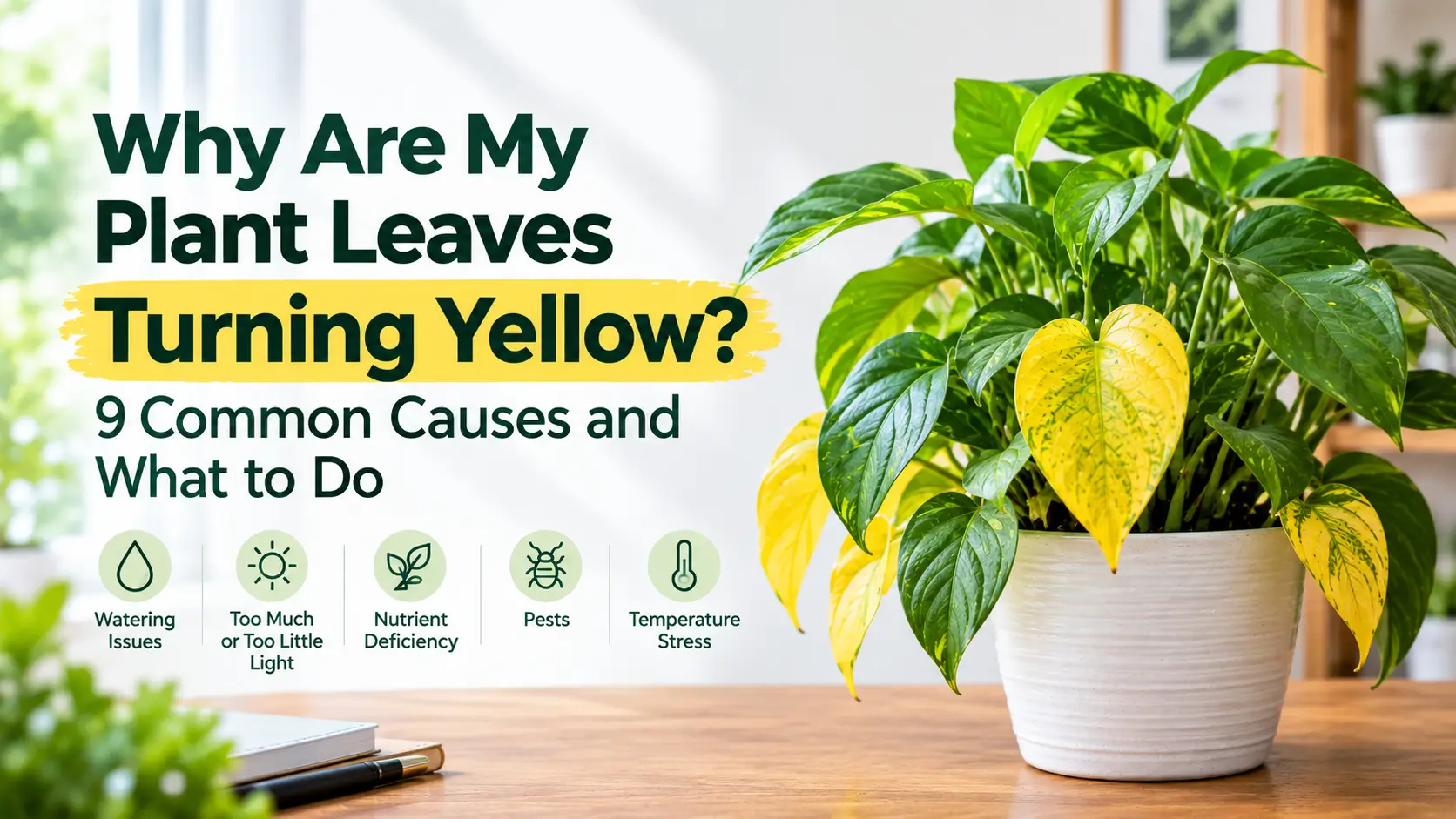
Yellow leaves can mean something is wrong with a plant, but they do not point to one single problem. A plant may yellow because of too much or too little water, poor drainage, unsuitable light, nutrient problems, temperature stress, pests, disease, root damage, or simply because an old leaf is reaching the end of its life.
The most useful question is not just “Why is this leaf yellow?” but “Which leaves are yellowing, what pattern do they show, and what else changed?” The location and pattern of yellowing can provide important diagnostic clues.
Quick Answer: Why Do Plant Leaves Turn Yellow?
Leaf yellowing is often called chlorosis. It happens when a leaf loses or fails to develop its normal green coloration. Chlorosis can result from many different causes, including nutrient shortages, water stress, root problems, pests, diseases, unsuitable growing conditions, and normal leaf aging.
A single old lower leaf turning yellow is often normal. Widespread yellowing, rapidly increasing yellow leaves, wilting, stunted growth, unusual spots, or signs of root decay deserve closer investigation.
How to Diagnose Yellow Leaves Before Trying to Fix Them
Before fertilizing, repotting, moving the plant, or changing the watering routine, inspect it carefully. The pattern of yellowing often matters more than the color alone.
- Which leaves are affected? Older lower leaves, young upper leaves, or the entire plant?
- How is the leaf yellowing? Uniformly, between the veins, along the edges, in spots, or in a mottled pattern?
- What does the root zone feel like? Wet, waterlogged, evenly moist, or very dry?
- Is the plant wilting? Wilting can occur with both dry soil and waterlogged roots, so do not diagnose it from appearance alone. See why plants wilt and how to diagnose the cause.
- Has anything recently changed? Repotting, transplanting, moving the plant, cold weather, heat, heavy rain, or a change in watering can all matter.
- Are pests visible? Check the undersides of leaves, stems, leaf joints, and growing tips.
- Are there spots, rings, mildew, lesions, or other unusual markings? Those clues may point toward a pest or disease rather than a simple cultural problem.
1. Too Much Water or Poor Drainage
Waterlogged soil is one of the most important causes to check because roots need both water and oxygen. When soil remains saturated for too long, water fills many of the air spaces around the roots. Prolonged waterlogging can reduce root function and contribute to yellow leaves, poor growth, root damage, and plant decline.
Clues that excess water may be involved
- The potting mix or soil stays wet for a long time.
- The container has poor drainage or no drainage hole.
- Several leaves yellow rather than one isolated old leaf.
- The plant looks limp even though the root zone is wet.
- Roots are soft, decaying, or otherwise unhealthy.
- The problem started after heavy rain or more frequent watering.
What to do
Do not water again simply because leaves are yellow. First check moisture around the root zone. For container plants, make sure excess water can escape freely. If the growing medium remains saturated for long periods, review both your watering habits and the physical drainage of the potting mix.
If you are unsure whether the plant is receiving too much or too little water, use the diagnostic clues in Overwatering vs Underwatering: How to Tell the Difference.
If water routinely drains too slowly or stays trapped around the roots, see what well-draining soil actually means and how to improve it.
If the roots are already decaying, the problem may have progressed beyond simple water stress. See Root Rot: Signs, Causes, Treatment, and Prevention.
2. Too Little Water
Drought can also cause leaves to yellow. When roots cannot supply enough water to the foliage, leaves may wilt, become yellow, develop dry or brown areas, and eventually fall.
Clues that the plant may be too dry
- The growing medium is dry well below the surface.
- The plant wilts before or alongside the yellowing.
- Leaf margins or tips may become dry or brown.
- A container feels unusually light compared with when the mix is adequately moist.
- The plant improves after thorough watering, provided its roots are still healthy.
Do not diagnose underwatering from a dry-looking soil surface alone. The upper layer can dry while deeper soil remains moist, especially in large containers.
If yellowing is accompanied by crispy brown tips or margins, the causes may overlap. See why plant leaf tips turn brown for a more focused diagnosis.
3. Too Little or Too Much Light
Plants differ greatly in their light requirements. A plant receiving too little light may become pale, weak, or stretched, and lower leaves may yellow and drop. At the other extreme, intense direct sunlight can bleach or scorch foliage.
Possible low-light clues
- Pale leaves combined with weak or elongated growth.
- Long gaps between leaves on new stems.
- Poor flowering.
- Lower leaves yellowing and falling.
Possible excessive-light clues
- Pale or bleached-looking areas.
- Scorched brown patches.
- Damage concentrated on the side receiving the strongest sun.
Before moving a plant, identify the species and its preferred light level. “More light” is not automatically better. If poor flowering is also part of the problem, see why a plant may not be flowering.
4. Nutrient Problems
Nutrient deficiencies can cause yellow foliage, but the pattern often differs depending on which nutrient is unavailable. A deficiency does not always mean the soil contains none of that nutrient. Root stress, unsuitable soil pH, very dry soil, waterlogging, and other growing conditions can reduce nutrient availability or uptake.
Common yellowing patterns linked with nutrients
- Nitrogen: general paling or yellowing often starts on older leaves and may be accompanied by weak growth.
- Iron: interveinal yellowing, where tissue between the veins becomes yellow while veins remain greener, often appears first on younger leaves.
- Magnesium: interveinal yellowing tends to affect older leaves first.
- Potassium: yellowing may be more noticeable toward leaf margins.
These patterns are clues rather than laboratory diagnoses. Similar symptoms can be produced by root damage, watering problems, and unsuitable pH.
Do not fertilize automatically
Adding fertilizer to a stressed plant without knowing the cause can fail to solve the problem and may create additional stress. Check watering, drainage, roots, plant species, and growing conditions before assuming the plant needs feeding.
5. Root Problems
A leaf may be yellow even when the real problem is underground. Roots supply water and mineral nutrients to the rest of the plant. Anything that interferes with root function can appear as yellow foliage above the soil.
Possible root-related causes include:
- waterlogged soil,
- root rot,
- compacted or poorly aerated soil,
- severe drought,
- damaged roots after transplanting or repotting,
- a container that no longer provides suitable root conditions, and
- root-feeding pests or root diseases.
If a plant is yellowing, wilting, and declining despite apparently adequate watering, inspect root-zone conditions carefully. Dark root color alone is not always diagnostic because healthy root color varies by species, but soft, collapsing, decaying, or foul-smelling tissue is more concerning.
For a deeper explanation of the difference between simple waterlogging and disease-related root decay, read the root rot guide.
6. Temperature or Environmental Stress
Sudden environmental changes can cause yellow leaves even when watering and nutrition are adequate. Cold temperatures, abrupt temperature changes, drafts, drought, waterlogging, and poor establishment after planting can all contribute to chlorosis in susceptible plants.
For houseplants, think about recent changes such as:
- moving closer to a cold window,
- air-conditioning or heating drafts,
- a sudden change in sunlight,
- bringing the plant indoors or outdoors, and
- a seasonal decline in indoor light levels.
For outdoor plants, frost, heat, drought, prolonged rain, and newly disturbed roots may be relevant. The important condition is what the plant actually experienced, not simply the month on the calendar.
7. Pests
Some pests damage leaves or roots in ways that cause yellowing. On houseplants, sap-feeding pests such as spider mites, mealybugs, scale insects, aphids, and whiteflies are worth checking for when yellowing is accompanied by speckling, sticky residue, webbing, distorted growth, or visible insects.
Where to inspect
- undersides of leaves,
- leaf joints and stems,
- new growth, and
- around the base of the plant.
A magnifying glass can help with very small pests. Avoid applying pesticides simply because foliage is yellow. First identify the pest if possible, then use a treatment appropriate to the plant, pest, product label, and local regulations.
8. Disease
Plant diseases can also cause chlorosis. Some viral diseases create mottled, mosaic, streaked, or ring-like yellow patterns. Fungal and other diseases may produce yellowing together with spots, mildew, lesions, dieback, or root decay.
Suspect disease more strongly when yellowing is accompanied by symptoms such as:
- unusual rings or mosaic patterns,
- dark or expanding leaf spots,
- visible fungal growth,
- stem lesions,
- rapid dieback,
- rotting roots, or
- severe loss of vigor.
Because disease symptoms vary substantially by plant species, a species-specific diagnosis is usually more reliable than treating “yellow leaves” as the disease itself.
9. Natural Leaf Aging
Not every yellow leaf needs fixing. Older leaves eventually age, lose chlorophyll, and fall. On an otherwise healthy plant, an occasional lower or older leaf turning yellow can be a normal part of the plant’s growth cycle.
Natural aging is more likely when:
- only one or a few older leaves are affected,
- new growth looks healthy,
- the plant is otherwise vigorous, and
- there are no signs of pests, root problems, or widespread stress.
The more widespread, rapid, or unusual the yellowing becomes, the less likely it is to be simple natural aging.
Yellow-Leaf Pattern Guide
| What you see | Possible explanations | What to check next |
|---|---|---|
| One old lower leaf turns yellow | Natural aging | Whether new growth and the rest of the plant look healthy |
| Many leaves yellow while soil stays wet | Overwatering, poor drainage, or root stress | Root-zone moisture, drainage, and root condition |
| Yellowing plus wilting in dry soil | Drought stress | Moisture deeper in the root zone |
| Young leaves yellow between green veins | Possible iron-related chlorosis | Plant species, soil or potting-medium pH, and root health |
| Older leaves become generally pale or yellow | Possible nitrogen shortage or other stress | Growth rate, feeding history, roots, and soil conditions |
| Older leaves yellow between veins | Possible magnesium-related chlorosis | Plant species, nutrient balance, and root conditions |
| Yellow leaves with weak, stretched growth | Insufficient light | Species light requirement and current location |
| Yellow mottling, rings, or unusual patterns | Possible virus or another disease | Species-specific disease symptoms and other signs |
| Yellowing with webbing, speckling, sticky residue, or visible insects | Pest damage | Undersides of leaves, stems, and growing tips |
Important: These are diagnostic clues, not guarantees. Different problems can produce similar symptoms.
What Should You Do First When Leaves Turn Yellow?
- Identify the plant. Different species have different requirements.
- Look at which leaves are affected. Old or young? Lower or upper?
- Study the yellowing pattern. Uniform, interveinal, spotted, marginal, or mottled?
- Check root-zone moisture. Do not judge only by the surface.
- Check drainage. Make sure water is not remaining trapped around the roots.
- Inspect roots when appropriate. Especially if the plant is declining despite wet soil.
- Check light and temperature. Compare the location with the plant’s actual requirements.
- Inspect for pests and disease symptoms.
- Consider nutrients only after the basics. Avoid reflexively adding fertilizer.
- Change one major variable at a time when possible. If you repot, fertilize, relocate, and radically change watering on the same day, it becomes harder to know what helped or harmed the plant.
Common Mistakes When Trying to Fix Yellow Leaves
Assuming yellow leaves always mean overwatering
Overwatering is common, especially with container plants, but drought, nutrient problems, light, pests, diseases, and natural aging can all produce yellow foliage.
Adding fertilizer immediately
A plant with damaged roots may be unable to take up nutrients properly. Feeding does not automatically solve chlorosis and can distract from the actual cause.
Watering on a fixed calendar
Plant water use changes with species, container size, soil, season, temperature, humidity, light, and growth rate. A schedule is better used as a reminder to check the plant than as an automatic instruction to water. See how often you should water plants for a condition-based approach.
Removing every yellow leaf before diagnosing the plant
It is fine to remove fully dead or unsightly foliage when appropriate, but first observe where the yellowing occurs. The pattern can contain useful diagnostic information.
Treating all plants the same
A cactus, fern, tomato plant, and azalea do not have identical needs. Species identification should come before treatment.
Frequently Asked Questions
Can a yellow leaf turn green again?
Sometimes mild chlorosis can improve if the underlying problem is corrected early, but a leaf that has significantly deteriorated often will not return to its original appearance. The more important goal is healthy new growth and stopping the problem from spreading.
Should I cut yellow leaves off?
You can usually remove fully yellow or dead leaves if they are no longer contributing useful foliage, but removal does not fix the underlying cause. Diagnose the plant first if yellowing is widespread or increasing.
Do yellow leaves always mean too much water?
No. Excess water is only one possibility. Too little water, nutrient problems, unsuitable light, temperature stress, pests, diseases, root problems, and natural aging can also cause yellowing.
Do yellow leaves mean a plant needs fertilizer?
Not necessarily. Some nutrient deficiencies cause yellowing, but watering problems, root stress, and unsuitable soil conditions can produce similar symptoms or prevent nutrient uptake. Diagnose the growing conditions before feeding.
Why are only the bottom leaves turning yellow?
Older lower leaves naturally yellow on many healthy plants, but lower-leaf yellowing can also accompany nutrient shortages, insufficient light, watering stress, or other problems. Look at how many leaves are affected and whether the plant’s new growth remains healthy.
Why are the newest leaves turning yellow?
Yellowing that begins on young leaves can point toward certain nutrient-availability problems, including iron-related chlorosis, but the plant species, soil or potting medium, pH, root health, and other symptoms need to be considered before drawing a conclusion.
Sources and Further Reading
- Royal Horticultural Society: Chlorosis
- Royal Horticultural Society: Leaf damage on houseplants
- Royal Horticultural Society: Nutrient deficiencies
- Royal Horticultural Society: Waterlogging and flooding
Bottom Line
Yellow leaves are best treated as a clue, not a diagnosis. Start with the pattern: which leaves are yellow, whether the root zone is wet or dry, whether roots appear healthy, and whether the plant is also wilting, spotting, stretching, or declining. Correct the underlying cause rather than treating the color itself.
When in doubt, identify the plant first and compare its specific water, light, soil, and temperature requirements with the conditions it is actually receiving.


