
Why Are My Plant Leaves Sticky? Causes and What to Do

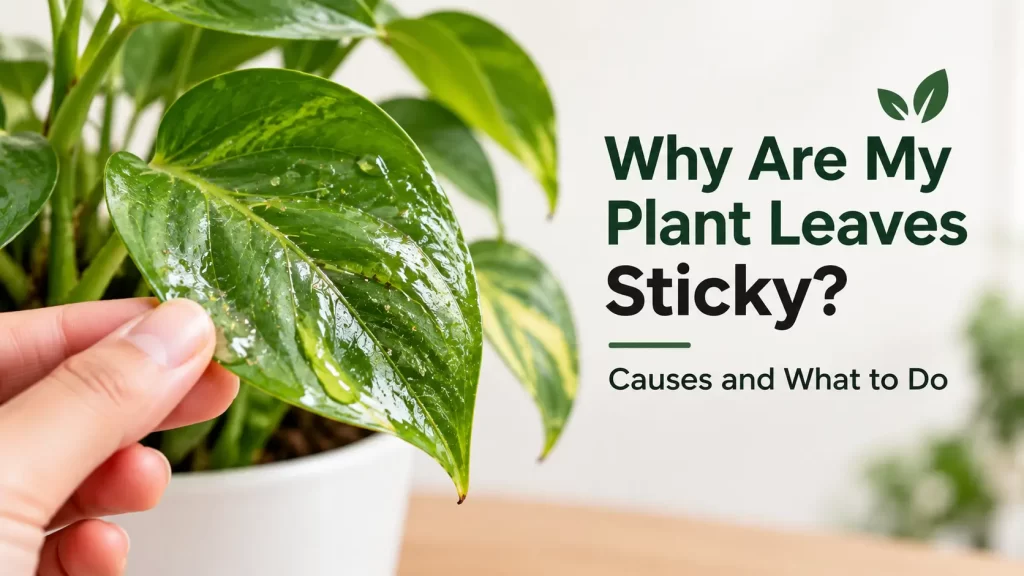
Sticky plant leaves usually point to one of two broad explanations: a sugary substance has fallen onto the leaf from somewhere else, or the plant itself has produced a sticky secretion.
The most common source is honeydew, a sugar-rich waste produced by sap-feeding insects such as aphids, soft scale, mealybugs, and whiteflies. Honeydew can coat lower leaves, stems, floors, furniture, cars, and anything else beneath the insects.
However, sticky leaves do not always mean pests. Some plants release droplets through guttation, some produce naturally sugary exudates, and damaged plant tissue can sometimes leak sap.
The key is to follow the pattern. Is the whole leaf coated in a shiny film? Are only the tips producing clear droplets? Is the stickiness directly below brown scale bumps, white cottony insects, or aphid colonies? Is there black sooty mold growing on top of the residue?
Quick Answer: Why Are My Plant Leaves Sticky?
The most likely causes are:
- aphids producing honeydew,
- soft scale insects producing honeydew,
- mealybugs producing honeydew,
- whiteflies or other honeydew-producing sap feeders,
- guttation or naturally sugary plant secretions, and
- sap leaking from damaged plant tissue.
The Royal Horticultural Society identifies aphids, scale insects, and mealybugs as common causes of sticky leaves because these sap-feeding insects excrete excess sugars as honeydew. University of Minnesota Extension similarly advises looking for shiny sticky honeydew on leaves and nearby surfaces when checking indoor plants for aphids, mealybugs, and scale insects.
If the residue is widespread, shiny, and appears on leaves or objects below other growth, honeydew is a strong possibility. If only clear droplets appear at predictable leaf tips or margins and there are no pest clues, a plant secretion such as guttation becomes more plausible.
What Is the Sticky Substance on Plant Leaves?
Before treating anything, determine what the residue is likely to be.
Honeydew
Honeydew is a sugary waste produced by certain insects while they feed on plant sap. Aphids, many soft scale insects, mealybugs, and whiteflies are common examples.
The sticky leaf may not be the leaf carrying the insects. Honeydew falls downward, so pests feeding on an upper leaf, stem, or branch can make lower foliage sticky.
This also explains why a patio, windowsill, shelf, floor, or parked car can become sticky beneath an infested plant or tree.
Guttation or other plant secretions
RHS describes guttation as the release of sap droplets through specialized pores, usually at leaf margins. It can occur when active growth and water pressure cause the plant to release excess fluid.
RHS also notes that some plants naturally produce sugary or sticky exudates. These secretions can occasionally support sooty mold even when insects are not the source.
Sap from a wound
Plants can leak sap after stems, leaves, or branches are cut or damaged. If that sap drips onto foliage below, those leaves can feel sticky even though they are not producing the substance themselves.
Sticky-Leaf Diagnostic Table
| What you see | Most likely explanation | Where to look next |
|---|---|---|
| Sticky new growth with clusters of small insects | Aphids | Shoot tips, buds, young stems, leaf undersides |
| Sticky leaves plus brown or tan bumps | Soft scale | Stems, veins, petioles, leaf undersides |
| Sticky foliage plus white cottony material | Mealybugs | Leaf joints, stem crevices, roots on some species |
| Sticky leaves and tiny white insects fly up when disturbed | Whiteflies | Undersides of leaves |
| Black soot-like coating on sticky leaves | Sooty mold growing on honeydew | Search above for honeydew-producing pests |
| Clear droplets mainly at leaf tips or margins | Possible guttation | Watering, humidity, temperature, pest evidence |
| Sticky secretion appears consistently on a particular healthy species | Possible natural sugary exudate | Species-specific behavior and absence of pests |
| Sticky patch directly below a cut or damaged stem | Leaking plant sap | Recent pruning, breakage, or wound |
Use several clues together. One shiny spot is not enough to prove an infestation.
1. Aphids
Aphids are among the most common honeydew-producing plant pests.
University of Minnesota Extension describes aphids as small, soft-bodied insects that usually feed on tender growth, buds, young leaves, stems, bark, or roots depending on the species. As they feed, they excrete shiny, sticky honeydew.
Signs of aphids
- clusters of small green, black, gray, yellow, pink, or reddish insects,
- colonies concentrated on new growth,
- curled or distorted young leaves,
- yellowing or stunted shoots in heavier infestations,
- white cast skins left behind as aphids molt,
- sticky honeydew below the colony,
- ants visiting the affected shoots, and
- black sooty mold growing on the honeydew.
The sticky residue can be easier to notice than the aphids themselves.
Where to inspect
Start with:
- new shoot tips,
- flower buds,
- the undersides of young leaves, and
- soft developing stems.
If the leaves are also curling, see Why Are My Plant Leaves Curling? for the broader diagnostic picture.
2. Scale Insects
Scale is one of the easiest honeydew-producing pests to overlook because many scale insects do not look like insects at all.
RHS describes scale insects as small shell-like bumps attached to stems or leaves. UC Statewide IPM notes that soft scale insects suck plant juices and can produce enough honeydew to make leaves, pavement, cars, and other surfaces underneath the plant sticky.
Signs of scale
- small brown, tan, gray, yellow, or whitish bumps,
- bumps concentrated along stems or major leaf veins,
- sticky upper leaf surfaces,
- black sooty mold,
- yellow leaves,
- poor growth or dieback in heavier infestations, and
- ants feeding on the honeydew.
Why scale is often missed
Adult scale may remain attached in one place and can resemble bark, a scab, or part of the stem. University of Maryland Extension notes that their small size and inconspicuous colors make scale difficult to detect, and that honeydew or sooty mold may be noticed before the insects themselves.
Look above the sticky leaf
If one leaf is sticky but apparently pest-free, inspect stems and foliage directly above it. Honeydew can drip from a scale colony that is several leaves higher.
3. Mealybugs
Mealybugs are sap-feeding insects covered in white waxy material.
They often hide in protected parts of the plant, so honeydew can accumulate before the insects become obvious.
UC IPM and RHS both describe mealybugs as honeydew producers capable of making foliage sticky and supporting black sooty mold.
Signs of mealybugs
- white cottony or powdery-looking insects,
- waxy material in leaf joints,
- colonies hidden along veins or stem crevices,
- sticky honeydew,
- sooty mold,
- yellowing, wilting, or reduced vigor in heavier infestations, and
- ants attracted to the sugary residue.
Where to look
Check:
- where leaf stalks join stems,
- leaf undersides,
- tight folds and crevices,
- around flowers or fruit, and
- the root zone for plant species susceptible to root mealybugs.
RHS notes that some mealybug species live on roots, so persistent problems do not always remain above the potting mix.
4. Whiteflies and Other Honeydew-Producing Sap Feeders
Whiteflies are another important source of sticky honeydew.
University of Minnesota Extension describes adult whiteflies as tiny white insects that fly up when the plant is disturbed. Their immature stages are flatter and remain on leaf undersides while feeding.
Signs of whiteflies
- tiny white insects flying when leaves are moved,
- flat immature stages on leaf undersides,
- sticky honeydew,
- yellowing foliage,
- premature leaf drop in heavier infestations, and
- reduced plant vigor.
RHS notes that several groups of sap-feeding insects can produce honeydew. Depending on the plant and region, other honeydew producers can include certain psyllids, planthoppers, leafhoppers, and related insects.
Do not identify the pest from stickiness alone. Inspect the plant and use the insect’s appearance and location to narrow the diagnosis.
5. Guttation and Natural Plant Secretions
Sticky leaves do not always mean an insect infestation.
RHS describes guttation as a process in which some plants release droplets through specialized pores, commonly along leaf margins. It may occur when water pressure in the plant is high, especially under conditions that favor water uptake while transpiration is relatively low.
RHS also notes that some houseplants produce sugary exudates during certain growing conditions, and some species naturally produce sticky substances.
Guttation is more plausible when:
- droplets appear mainly at leaf tips or margins,
- the liquid is clear rather than a widespread film,
- droplets appear overnight or in the morning,
- there is no honeydew on surfaces beneath the plant,
- no aphids, scale, mealybugs, or whiteflies can be found, and
- the pattern occurs repeatedly in the same predictable positions.
Do not use “guttation” as an excuse to ignore pests
Honeydew remains a common explanation for widespread sticky foliage. If leaves, shelves, and nearby surfaces are broadly tacky, search carefully for insects before deciding the plant is merely secreting fluid.
Some plant exudates are normal
RHS notes that sugary sticky exudates can occasionally be produced by the plant itself and can even support sooty mold. That is why sooty mold is usually, but not absolutely always, evidence of honeydew-producing insects.
Species identification matters when no pest can be found.
6. Sap From Damaged Plant Tissue
A damaged stem, branch, petiole, or leaf can release sap.
RHS refers to the leakage of sap from wounds or pruning cuts as bleeding. Depending on the plant, that fluid may contain enough dissolved material to feel sticky after it reaches nearby foliage.
Wound-related stickiness is more plausible when:
- the sticky patch is directly below a fresh cut,
- a stem has recently snapped or cracked,
- only a small localized area is affected,
- there are no pests or honeydew elsewhere, and
- the residue stops appearing as the wound heals.
If sticky residue continues to appear away from the wound, investigate honeydew-producing insects as well.
Why Are My Plant Leaves Sticky but I Cannot See Any Bugs?
This is common, especially with scale and mealybugs.
Check the plant more closely
Inspect:
- the underside of leaves,
- along major veins,
- leaf axils,
- stem joints,
- buds and flower clusters,
- bark or woody stems,
- the pot rim and crevices, and
- the foliage directly above the sticky leaf.
University of Minnesota recommends inspecting both leaf surfaces, stems, containers, rims, crevices, and the bottoms of pots when searching for indoor plant pests.
Scale may not look alive
A brown scale insect can resemble a fixed bump on the stem rather than an insect.
Mealybugs can hide
Mealybugs commonly occupy tight plant crevices where they are difficult to see.
The pest may be above the plant
For outdoor plants, honeydew can fall from an infested tree or shrub onto healthy plants underneath. RHS specifically notes that the honeydew source may occur on overhanging growth rather than on the sticky plant itself.
It may genuinely be a plant secretion
If repeated careful inspections reveal no insects and clear droplets consistently form only at leaf tips, margins, flowers, or species-specific secretory sites, guttation or natural exudation becomes more plausible.
Why Do Sticky Leaves Develop a Black Coating?
Sticky honeydew provides a food source for sooty mold fungi.
RHS explains that sooty molds grow on sugar-rich honeydew rather than directly feeding on the plant. University of Maryland Extension likewise describes sooty mold as a dark fungal coating growing on insect honeydew.
Signs of sooty mold
- black or dark brown powdery coating,
- the coating sits on the leaf rather than being dead internal tissue,
- leaves are sticky underneath or around the black material,
- the coating can often be wiped away, and
- honeydew-producing insects are present somewhere above.
Heavy coatings can reduce the amount of light reaching the leaf, but the main problem is usually the insect infestation producing the honeydew.
If you are trying to distinguish sooty mold from genuinely blackened leaf tissue, see Why Are My Plant Leaves Turning Black?.
Why Are Ants an Important Clue?
Ants are attracted to honeydew because it is rich in sugar.
University of Minnesota Extension notes that aphid honeydew attracts ants and other insects. UC IPM also explains that ants can protect honeydew-producing insects such as aphids, scale, and mealybugs from their natural enemies.
So if ants are repeatedly traveling up and down stems or trunks, follow their route.
They may lead you directly to:
- aphid colonies,
- soft scale,
- mealybugs, or
- other honeydew-producing insects.
The ants themselves are usually not the source of the sticky leaves.
Why Are My Houseplant Leaves Sticky?
On houseplants, honeydew-producing pests are particularly important because they can reproduce year-round indoors.
Common indoor culprits include:
- soft scale,
- aphids,
- mealybugs, and
- whiteflies.
RHS notes that indoor sap feeders can occur at any time of year, and University of Minnesota recommends checking houseplants regularly for honeydew, insects, webbing, eggs, and discoloration.
Inspect new plants before grouping them with others
Newly acquired plants can introduce pests into an indoor collection. University of Minnesota recommends isolating new plants for one to two weeks so pest problems have time to become visible.
Do not confuse sticky droplets with watering problems alone
Guttation can be associated with abundant water uptake, but widespread sticky honeydew requires a pest search. If the plant is also yellowing or wilting, diagnose the root zone separately rather than assuming the sticky residue explains every symptom.
See Why Are My Plant Leaves Turning Yellow? if yellowing is widespread.
Sticky Leaves on Outdoor Plants, Trees, and Shrubs
Honeydew can be much more noticeable outdoors because it drips onto surfaces below large plants.
University of Minnesota notes that aphid honeydew can coat bark, leaves, cars, lawn furniture, and other objects under an infested tree.
RHS similarly notes that sticky leaves on woody plants are often caused by aphids, mealybugs, or scale insects feeding on shoots above the sticky area.
Look up, not just at the sticky surface
If a patio plant, chair, car, or groundcover is sticky, inspect the tree canopy above it.
Not every outdoor infestation needs aggressive treatment
RHS emphasizes that aphids are part of normal garden biodiversity and that predators often reduce populations naturally on established outdoor plants.
Management should therefore depend on plant health, pest abundance, the level of damage, and whether the honeydew is creating a practical problem.
How to Clean Sticky Plant Leaves
Cleaning removes honeydew and helps you tell whether fresh residue is still being produced.
For sturdy leaves
- Use lukewarm water and a soft cloth or sponge.
- Support the leaf while wiping so it is not torn.
- Clean both surfaces when practical.
- Rinse away loose residue.
- Let the foliage dry in suitable conditions.
RHS recommends wiping or sponging sooty mold and honeydew from leaves with water and warns against strong soaps or detergents because they can scorch foliage.
For delicate plants
A gentle rinse may be safer than rubbing. Hairy, waxy, or fragile foliage can be damaged by aggressive cleaning, so use species-specific care where necessary.
Cleaning alone is not pest control
If honeydew returns after the leaves are cleaned, the source is still active.
How to Manage the Underlying Cause
The correct response depends on what is producing the residue.
Step 1: Identify the pest or non-pest cause
Do not spray a plant just because it is sticky.
Confirm whether you are dealing with:
- aphids,
- scale,
- mealybugs,
- whiteflies,
- another sap feeder,
- guttation,
- natural exudates, or
- a wound.
Step 2: Physically reduce pest numbers where practical
UC IPM and University of Minnesota Extension both include washing or physical removal among useful strategies for several indoor sap-feeding pests.
Depending on the pest, this may include:
- rinsing aphids from sturdy plants,
- removing heavily infested plant parts,
- physically removing scale where practical, or
- washing visible mealybugs from accessible surfaces.
Step 3: Keep infested houseplants separate
Isolation reduces the chance that mobile stages spread to nearby plants while you are still diagnosing and managing the problem.
Step 4: Use pesticides only when justified
Insecticidal soaps, horticultural oils, and other products may be appropriate for certain pests and plants, but product availability and legal uses vary by country.
Always:
- identify the pest first,
- confirm the product is labeled for the plant and pest,
- follow the label exactly,
- consider plant sensitivity, and
- avoid unnecessary treatment when physical or biological management is sufficient.
For outdoor plants, protect beneficial insects and avoid treating flowering plants in ways that expose pollinators to harmful products.
Step 5: Keep monitoring
A single cleaning or treatment does not prove that the infestation is gone. Eggs, hidden insects, or newly emerged stages may remain.
Inspect new growth, leaf undersides, stems, and crevices regularly until no fresh honeydew appears.
How to Know the Sticky-Leaf Problem Is Improving
Old honeydew can remain on leaves after the pests have been controlled, so judge progress by new residue.
Encouraging signs include:
- freshly cleaned leaves remain clean,
- no new sticky droplets appear on surfaces below,
- pest numbers decline,
- new growth develops without distortion,
- sooty mold stops returning after cleaning,
- leaf yellowing or drop slows, and
- normal growth resumes.
If growth remains poor after the stickiness is resolved, see Why Is My Plant Growing Slowly?.
If leaves continue dropping, see Why Is My Plant Dropping Leaves?.
Common Mistakes With Sticky Plant Leaves
Mistake 1: Assuming the sticky leaf contains the pest
Honeydew often falls from insects feeding higher on the plant. Inspect above the sticky area.
Mistake 2: Missing scale because it looks like part of the stem
Scale insects can resemble small fixed bumps rather than obvious insects.
Mistake 3: Cleaning the honeydew but ignoring the pest
The leaves will become sticky again while honeydew production continues.
Mistake 4: Assuming black coating means the leaf is dying
Sooty mold sits on the surface and can often be wiped away.
Mistake 5: Treating every clear droplet as honeydew
Predictable droplets at tips or margins with no pest evidence may be guttation or a natural plant secretion.
Mistake 6: Spraying pesticide before identifying the pest
Different pests require different management, and a non-pest secretion needs no insecticide.
Mistake 7: Using strong household detergent to clean leaves
RHS warns that strong soaps and detergents can scorch foliage.
Mistake 8: Ignoring ants
Ant traffic can lead you to hidden honeydew-producing insects.
Mistake 9: Forgetting to inspect newly purchased plants
A hidden scale or mealybug infestation can spread through a houseplant collection.
Mistake 10: Assuming the pest is on the sticky plant outdoors
Honeydew can fall from an infested tree or shrub overhead.
Frequently Asked Questions
What Is the Sticky Stuff on My Plant Leaves?
Most often it is honeydew, a sugary waste produced by sap-feeding insects such as aphids, soft scale, mealybugs, or whiteflies. Some plants can also produce sticky droplets through guttation or natural secretions.
Are Sticky Plant Leaves a Sign of Pests?
Often, yes. Widespread shiny stickiness on leaves and nearby surfaces strongly suggests honeydew. Inspect stems, leaf undersides, new growth, and foliage above the sticky area.
Why Are My Plant Leaves Sticky but I See No Bugs?
Scale insects may look like fixed brown bumps, mealybugs can hide in crevices, and honeydew can fall from pests feeding above the sticky leaf. If repeated inspections reveal no pests and clear droplets appear only at predictable tips or margins, guttation or natural plant secretions may be responsible.
Can Overwatering Cause Sticky Leaves?
Overwatering does not create insect honeydew, but high water uptake can contribute to guttation in plants that release excess fluid through leaf margins. Diagnose widespread sticky film separately from clear edge droplets.
Why Is There Black Stuff on My Sticky Leaves?
Black soot-like material is often sooty mold growing on sugary honeydew. The mold grows on the residue rather than directly infecting the leaf.
Do Spider Mites Make Leaves Sticky?
Spider mites are not a typical source of honeydew. They more commonly cause pale stippling, bronzing, and fine webbing. Sticky honeydew points more strongly toward aphids, soft scale, mealybugs, whiteflies, or related sap feeders.
Do Aphids Make Leaves Sticky?
Yes. Aphids excrete sugar-rich honeydew as they feed. It can coat foliage and objects below the plant and can support black sooty mold.
Do Scale Insects Make Leaves Sticky?
Many soft scale species produce honeydew. Sticky leaves and sooty mold may be among the first clues because adult scale can look like ordinary bumps on the plant.
Do Mealybugs Cause Sticky Leaves?
Yes. Mealybugs produce honeydew, especially when populations become large. Look for white waxy or cottony insects in protected crevices.
Can I Wash Sticky Residue Off the Leaves?
Yes. Lukewarm water and a soft cloth or gentle rinse can remove honeydew and sooty mold from many plants. Avoid harsh detergents and make sure the plant tolerates leaf washing.
Will Sticky Leaves Hurt My Plant?
Honeydew itself is mainly a symptom, but the insects producing it can weaken the plant. Heavy honeydew can support sooty mold, and a thick mold coating can reduce light reaching the leaves.
How Do I Know When the Pest Is Gone?
Clean the old residue and continue inspecting the plant. When no live pests are found and fresh honeydew stops appearing on leaves or nearby surfaces, the infestation is likely under control.
Sources and Further Reading
- Royal Horticultural Society: Indoor plant sap-feeding insects
- Royal Horticultural Society: Sooty moulds
- Royal Horticultural Society: Leaf damage and secretions on houseplants
- Royal Horticultural Society: Aphids
- Royal Horticultural Society: Scale insects
- Royal Horticultural Society: Mealybugs
- University of Minnesota Extension: Managing insects on indoor plants
- University of Minnesota Extension: Aphids in home yards and gardens
- UC Statewide IPM: Houseplant problems
- UC Statewide IPM: Scale insects
- UC Statewide IPM: Mealybugs
- University of Maryland Extension: Monitoring for scale insects
Bottom Line
Sticky leaves usually mean that a sugary substance has reached the leaf surface, but that substance can have more than one source.
Widespread shiny honeydew, sticky surfaces beneath the plant, ants, sooty mold, and hidden sap-feeding insects point strongly toward aphids, soft scale, mealybugs, whiteflies, or related pests. Clear droplets that appear consistently at leaf tips or margins without pest evidence may instead be guttation or a natural plant secretion.
Follow the stickiness upward, inspect stems and leaf undersides carefully, and identify the source before treating. Cleaning the leaves helps, but lasting control comes from stopping whatever is producing the sticky residue.


