
Why Is My Plant Wilting? Causes, Diagnosis and What to Do

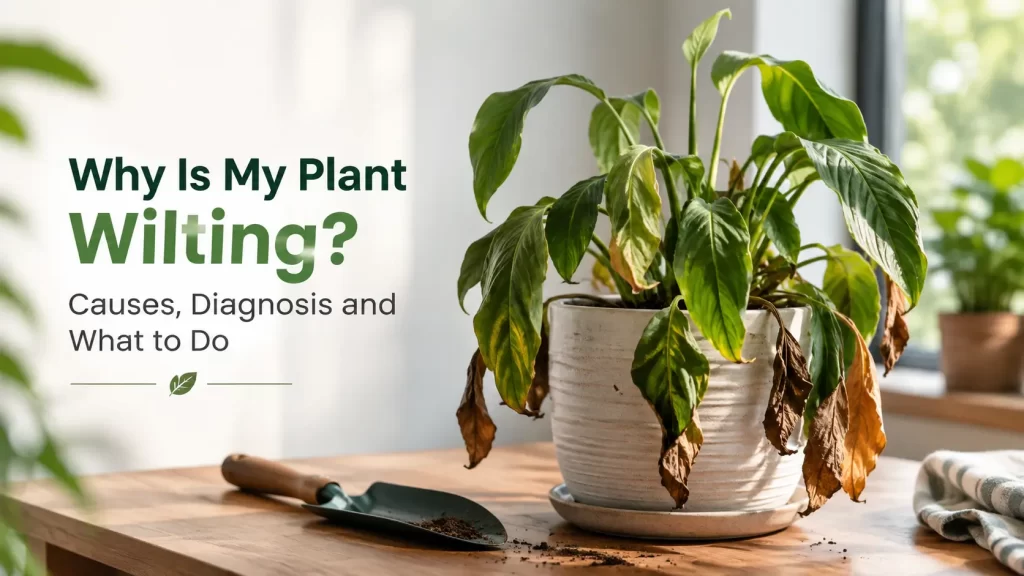
A wilted plant is telling you that its leaves and stems are not maintaining enough water pressure to stay firm. The difficult part is figuring out why. Dry soil is one possibility, but plants can also wilt when soil is too wet, roots are damaged, temperatures are extreme, or disease interferes with water movement.
The safest approach is to diagnose the root zone and recent growing conditions before reaching for the watering can. This guide explains the main causes of wilting, how to tell them apart, and what to do next.
Quick Answer: Why Do Plants Wilt?
Plants wilt when their cells lose enough water pressure, called turgor, that leaves or stems become limp. This can happen because the roots cannot find enough water, because roots cannot function properly in saturated or damaged conditions, or because the plant is losing water faster than the roots can replace it.
The Royal Horticultural Society explains how water moves through plants and notes that both dry soil and oxygen-starved, waterlogged roots can lead to wilting. That is why wilt alone does not tell you whether a plant needs more water.
| What you notice | Possible explanation | Best next check |
|---|---|---|
| Dry soil and limp or crisp foliage | Underwatering | Check moisture deeper in the root zone |
| Wet soil and limp, yellowing foliage | Overwatering or poor drainage | Check drainage and root condition |
| Wilting mainly during hot afternoons | Temporary heat or transpiration stress | See whether the plant recovers as conditions cool |
| Plant stays wilted despite moist soil | Root damage, root disease, excess salts, or vascular problems | Inspect roots, stems and recent care changes |
| Wilting soon after planting or repotting | Transplant or root disturbance stress | Review root disturbance, moisture and exposure |
What Wilting Actually Means
Plant cells contain water that presses outward against their cell walls. This pressure helps keep soft plant tissues firm. When cells lose enough water, that pressure drops and leaves, petioles or young stems begin to droop.
That sounds like a simple shortage-of-water problem, but the plant’s water balance depends on two sides of the equation:
- how much water the roots can absorb, and
- how quickly the leaves are losing water through transpiration.
A plant can therefore wilt while growing in dry soil, but it can also wilt while its roots sit in wet soil. Saturated soil contains less available oxygen, and oxygen-starved roots may no longer take up water effectively. Similarly, a plant can temporarily wilt on a hot, windy afternoon even if the root zone contains moisture, simply because water is leaving the foliage faster than the roots can replace it.
This is why the first question should not be, “How much water should I add?” It should be, “What is preventing this plant from maintaining its water balance?”
1. Underwatering
Underwatering is one of the most obvious causes of wilting. When the root zone becomes too dry, the plant cannot replace water lost from its leaves. Cells lose turgor and flexible tissues become limp.
Clues that point toward underwatering
- The growing medium is dry below the surface, not just on top.
- A container feels noticeably lighter than it does after watering.
- Leaf edges may feel dry, thin or crisp.
- Older leaves may yellow or drop as stress continues.
- The potting mix may have shrunk away from the sides of the container when severely dry.
- The plant often improves after the root ball is thoroughly rehydrated, provided damage has not become severe.
What to do
Water the root zone thoroughly rather than giving a small splash to the surface. For container plants, apply water slowly enough for the growing medium to absorb it and allow excess water to leave through drainage holes. If an extremely dry potting mix initially repels water, apply water gradually so the root ball can rewet instead of allowing all the water to run down the sides.
For garden plants, check moisture several centimetres into the soil and water the root area deeply enough to wet the active root zone. The correct frequency depends on the plant, soil, weather, root depth and stage of growth, so avoid watering by a fixed universal schedule.
2. Overwatering and Waterlogged Roots
A wilted plant in wet soil is an important warning sign. When water fills soil pores for too long, roots receive less oxygen. Root function declines, which can reduce the plant’s ability to absorb water even though water is physically present around the roots.
The RHS guidance on waterlogging describes this paradox: waterlogged plants can look as though they are short of water because oxygen-starved roots are unable to function normally.
Clues that point toward excess moisture
- The soil or potting mix remains wet for a long time.
- The plant wilts even though the root zone is already moist.
- Leaves may turn yellow before dropping.
- Growth may slow or stop.
- The container has poor drainage, blocked drainage holes, or frequently sits in collected water.
- Roots may become brown, black, soft or decayed if root rot develops.
What to do
Do not automatically add more water. First determine why the root zone is staying wet. Possibilities include watering too frequently, a pot with inadequate drainage, compacted or unsuitable growing medium, heavy garden soil, prolonged rain, or a container that is too large for the plant’s current root system.
Allowing the root zone to regain appropriate air space is more important than following a preset number of dry days. Different plants tolerate different moisture levels, so the goal is to restore conditions suitable for that species rather than forcing every plant to become completely dry.
3. Heat, Strong Sun and Wind Stress
Plants can lose water very quickly in hot, sunny or windy conditions. On some days, the leaves may lose water faster than the roots can supply it even when soil moisture is adequate.
This often produces temporary afternoon wilting. The plant droops during the hottest part of the day but becomes firm again later in the evening or overnight as temperatures fall and water loss slows. The University of Illinois Extension describes this temporary heat-related wilt and notes that recovery as conditions cool is an important clue.
How to distinguish heat wilt from dry-soil wilt
Check the root zone before watering. If the soil is still appropriately moist and the plant consistently recovers as the day cools, heat and transpiration may be the main cause. If the soil is dry and the plant remains wilted after temperatures fall, insufficient root-zone moisture becomes more likely.
What to do
- Check moisture rather than assuming the plant needs water.
- Water plants that are genuinely dry, preferably at the root zone.
- Protect newly planted or sensitive plants from abrupt exposure to intense sun and wind when practical.
- Use mulch around appropriate outdoor plants to reduce rapid soil-moisture loss, keeping mulch away from stems or trunks where necessary.
- For movable container plants, temporary shelter from extreme afternoon conditions can reduce stress.
Do not keep adding water to already wet soil simply because a plant droops for a few hours on a hot afternoon.
4. Root Rot and Other Root Problems
Roots are the plant’s water-absorbing system. If enough roots are damaged, diseased, compacted, cut off or deprived of oxygen, the foliage can wilt even when moisture is available.
University of California Statewide IPM guidance on houseplant problems specifically recommends inspecting the root system when wilting occurs because root decay can produce the same above-ground symptom as insufficient water.
Signs that roots may be involved
- The plant remains wilted despite appropriately moist soil.
- Watering does not restore firmness.
- Roots are dark, soft, decayed or easy to pull apart instead of firm.
- The base of the stem or crown is soft or discoloured.
- The plant has been growing in persistently wet or poorly drained conditions.
- Growth has stalled and leaves are yellowing as well as wilting.
Root rot is not one single disease
“Root rot” is a description of root decay, not a single universal pathogen or treatment. Several disease organisms can affect roots and crowns, and chronic excess moisture can predispose plants to root problems. For example, UC IPM notes that Phytophthora root and crown rot can cause wilting in well-watered plants, especially where root zones stay wet for prolonged periods.
For a valuable plant, a persistent landscape problem, or suspected infectious disease, accurate identification matters before applying a pesticide or fungicide. Product registrations and legal uses also vary by country and region.
5. Transplant Shock and Root Disturbance
A recently planted, repotted or transplanted plant may wilt because its root system was disturbed while the foliage continues to lose water. Fine absorbing roots can be damaged during moving, and the new root zone may have different moisture, temperature or aeration conditions.
Clues that point toward transplant stress
- Wilting began soon after planting, repotting or moving the plant.
- The plant was moved from a sheltered environment into stronger sun or wind.
- The root ball was disturbed or allowed to dry during transplanting.
- The plant is not showing obvious signs of prolonged waterlogging or severe root decay.
What to do
Keep root-zone moisture appropriate and consistent while the plant establishes, but do not compensate for transplant stress by keeping the soil saturated. Protect sensitive transplants from abrupt exposure to harsh conditions when appropriate for the species. Avoid piling on fertilizer as a general “rescue” response while roots are stressed.
For vegetable seedlings and similar transplants, gradual acclimation before planting outdoors can reduce stress. The University of Minnesota Extension recommends hardening transplants by introducing outdoor conditions gradually rather than moving them abruptly into full exposure.
6. Temperature Stress
Extreme heat can increase water loss, while chilling or frost can directly damage cells and disrupt normal water movement. Houseplants placed beside cold windows, air-conditioning outlets, heaters or very hot glazing can also experience sudden stress.
Temperature symptoms vary by species. Heat stress may cause drooping, rolling, bleaching or crisping. Cold damage can cause drooping, darkened tissue, water-soaked-looking areas or sudden collapse.
If wilting follows a sudden environmental change, compare the plant’s normal temperature requirements with what it has recently experienced. Moving a plant to a more suitable environment may be more useful than changing its watering routine.
7. Excess Fertilizer or Soluble Salts
More fertilizer does not automatically help a stressed plant. Fertilizer salts can accumulate in the root zone, especially in containers, heavily fertilized systems or situations where salts are not adequately leached. High soluble-salt concentrations make it harder for roots to take up water and can create drought-like stress even when the medium is moist.
Possible clues
- Wilting occurs despite adequate moisture.
- Leaf tips or margins appear scorched.
- A pale or whitish crust is visible on the growing medium or container in some cases.
- The problem began after a heavy fertilizer application or repeated feeding.
- Roots show damage without the classic pattern of simple dry-soil stress.
If excess fertilizer is suspected, stop adding more fertilizer while you diagnose the problem. For containers with suitable drainage, excess soluble salts can sometimes be reduced by leaching with good-quality water, but the correct response depends on the plant, growing medium, water quality and severity of the problem.
8. Wilt Diseases and Stem Problems
Some diseases interfere with roots, crowns, stems or the vascular tissues that transport water. These problems can cause persistent or sudden wilting that does not respond normally to watering.
Disease should move higher on the list of possibilities when:
- the soil moisture is appropriate but wilting continues,
- only one stem, branch or section of a plant wilts first,
- stems or crowns show dark, soft, sunken or discoloured tissue,
- roots are decayed,
- the plant declines progressively despite corrected care, or
- several susceptible plants develop similar symptoms in the same area.
Do not assume every persistent wilt is the same disease. “Wilt” appears in the names of several unrelated plant diseases. The affected plant species, pattern of symptoms, root and stem condition, weather and local disease pressure all matter.
For valuable plants or rapidly spreading problems, use a local plant diagnostic service, university extension office, horticultural adviser or other qualified plant-health professional where available. A correct diagnosis is especially important before using pesticides.
How to Diagnose a Wilted Plant Step by Step
Step 1: Check the soil below the surface
Do not judge moisture by appearance alone. The surface can be dry while the root zone is wet, particularly in larger containers. Check moisture where the active roots are likely to be. For a small pot this may be a finger check; for larger pots or garden beds, use an appropriate probe or carefully examine the soil deeper down.
Step 2: Ask when the plant wilts
Timing is diagnostic. A plant that droops only during hot afternoons and recovers overnight suggests a different problem from one that remains wilted continuously. Sudden wilt immediately after repotting also points toward different causes than a slow decline over several weeks.
Step 3: Look at the leaves as well as the droop
Notice whether leaves are soft, crisp, yellow, browned, spotted, curled or falling. Wilting plus yellow leaves in persistently wet soil raises concern about excessive moisture and root problems. Wilting plus dry, crisp margins and a dry root zone is more consistent with water deficit or severe heat stress.
Step 4: Check drainage
For containers, confirm that drainage holes are open and the pot is not standing in collected water. For garden plants, consider whether water pools after irrigation or rain, whether the soil is compacted, and whether the planting area stays saturated.
Step 5: Inspect the roots when appropriate
For a container plant that stays wilted despite moist soil, carefully removing the root ball can provide useful evidence. Healthy roots vary by species, but they should generally feel firm rather than mushy or decomposed. Dark, soft, foul-smelling or easily broken roots suggest decay.
Do not repeatedly pull an already stressed plant out of the ground just to inspect it. Root inspection is easiest and least disruptive with container plants.
Step 6: Review recent changes
Ask what happened before the wilting began:
- Was the plant repotted or transplanted?
- Did the weather suddenly become much hotter, colder or windier?
- Was the plant moved into stronger sunlight?
- Was fertilizer recently applied?
- Has rainfall been unusually heavy?
- Did the watering routine change?
- Was the root zone disturbed by digging, construction or pests?
Step 7: Decide whether the problem is environmental or potentially infectious
If correcting moisture or environmental conditions does not help, or if there are signs of root, crown or stem decay, investigate disease rather than repeatedly changing the watering schedule.
How to Help a Wilted Plant Recover
| Likely cause | Immediate priority | Avoid |
|---|---|---|
| Dry root zone | Rehydrate the root zone thoroughly | Repeated tiny surface splashes |
| Waterlogged soil | Restore drainage and appropriate aeration | Adding more water because leaves are drooping |
| Temporary heat wilt | Check moisture and reduce excessive stress where practical | Keeping already moist soil constantly saturated |
| Transplant stress | Maintain suitable moisture and gradual acclimation | Heavy fertilization as a rescue treatment |
| Root decay | Correct the root-zone problem and identify the cause | Assuming every root problem needs the same treatment |
| Possible disease | Identify the plant and obtain an accurate diagnosis | Applying pesticides without knowing the problem |
Give the plant time to respond
Once the likely cause is corrected, avoid making several major changes at once. A stressed plant may need time to rebuild roots or replace damaged foliage. New healthy growth is often a better long-term sign of recovery than whether every damaged leaf returns to normal.
Leaves or stems that have already suffered irreversible tissue damage will not necessarily become perfect again, even if the underlying problem has been corrected.
Common Mistakes When a Plant Wilts
Watering before checking the soil
This is the most important mistake to avoid. Because both dry and waterlogged conditions can produce wilting, watering first and diagnosing later can make an overwatering problem worse.
Following a rigid watering calendar
A plant’s water use changes with temperature, light, wind, humidity, pot size, soil, season and growth rate. “Every seven days” can be too often at one time and not often enough at another.
Fertilizing a severely stressed plant
Fertilizer does not correct every wilt. Excess salts can themselves interfere with water uptake. Diagnose the water and root problem first.
Assuming afternoon wilt always means drought
Some plants temporarily wilt during extreme daytime conditions and recover later. Check the root zone and recovery pattern before increasing irrigation.
Treating “root rot” without identifying why the roots failed
Root decay can involve excess moisture, unsuitable growing conditions and various pathogens. Fixing drainage and watering practices may be essential, but a valuable or severely affected plant may also need a specific diagnosis.
Frequently Asked Questions
Should I water a plant as soon as it starts wilting?
No. Check the root-zone moisture first. A dry plant may need water, but a plant in saturated soil can also wilt because its roots lack oxygen or are damaged. Adding more water in that situation can worsen the problem.
Why is my plant wilting even though the soil is wet?
Wet-soil wilting can occur when waterlogging reduces oxygen around the roots, when roots are decaying, when soluble salts interfere with water uptake, or when a disease damages roots or water-conducting tissues. Check drainage and root condition rather than assuming the plant is thirsty.
Why does my plant wilt in the afternoon but look normal in the morning?
On hot, sunny or windy days, leaves can temporarily lose water faster than roots replace it. If the soil is adequately moist and the plant recovers as conditions cool, temporary heat-related wilt is a likely explanation. Persistent wilting deserves further investigation.
Can an overwatered plant look dry?
Yes. Waterlogged roots may be unable to absorb water efficiently, so the foliage can droop even though the soil is wet. Yellowing, prolonged wetness and soft or decaying roots make excess moisture more likely.
Can a wilted plant recover?
Often, yes, if the cause is identified early and enough healthy root and stem tissue remains. Recovery depends on the plant, severity and duration of stress, and whether disease or irreversible tissue damage is present.
Why did my plant wilt after repotting?
Repotting can disturb fine roots and temporarily reduce water uptake. Differences in light, temperature, wind and moisture after moving the plant can add more stress. Keep conditions appropriate for the species and avoid both severe drying and waterlogging while roots re-establish.
The Bottom Line
A wilted plant is not automatically a thirsty plant. Wilting means the foliage is not maintaining enough water pressure, and the cause may be dry soil, excessive moisture, hot or windy conditions, damaged roots, transplant stress, soluble salts or disease.
Start with the simplest evidence: check the root-zone moisture, note when the wilting occurs, inspect drainage, look for accompanying leaf symptoms, and review recent changes. If soil is moist but the plant remains wilted, shift your attention from adding water to finding out why the roots or water-conducting tissues are not functioning normally.
Sources and Further Reading


