
Full Sun vs Partial Sun vs Shade: What Plant Light Requirements Really Mean

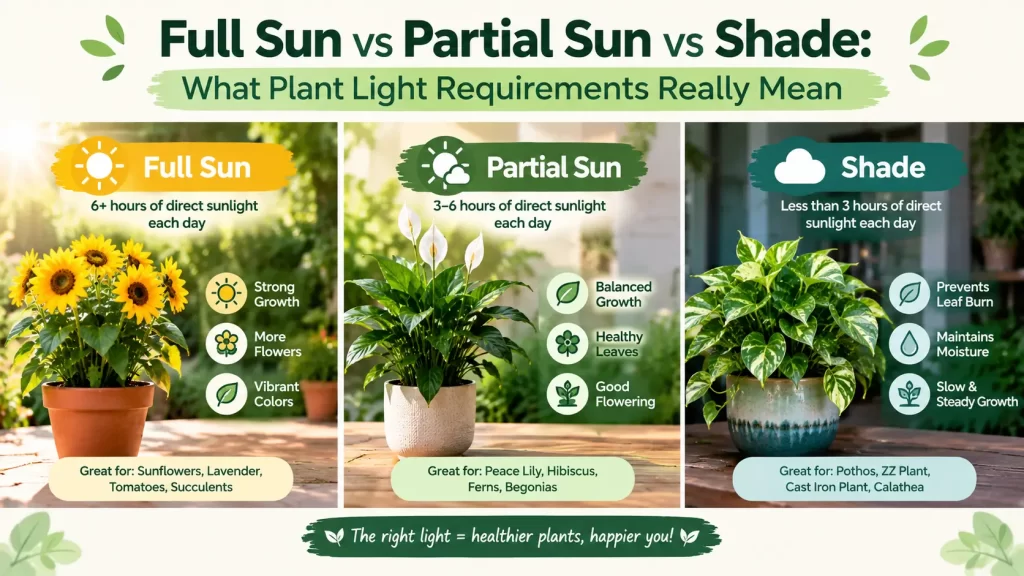
“Full sun,” “partial sun,” “partial shade,” and “full shade” look like simple plant-label instructions. In practice, they are only starting points.
Most gardening references agree that full sun usually means at least about six hours of direct sunlight per day. The categories below that are less consistent. Some sources use part sun and part shade almost interchangeably, while others use “part sun” for the brighter end of the range and “part shade” for plants that benefit from protection from stronger midday or afternoon sun.
That is why counting hours alone is not enough. A plant receiving four hours of gentle morning sun may experience a very different environment from the same species receiving four hours of intense afternoon sun. Season, climate, surrounding walls, tree canopy, reflected heat, soil moisture, and the plant’s own tolerance all affect how that light exposure works in the real garden.
This guide explains what the common light labels mean, where the definitions become fuzzy, how to measure the light in your own space, and how to tell when a plant is getting too much or too little.
Quick Answer: What Do Full Sun, Partial Sun and Shade Mean?
The following ranges are useful practical guides, but they are not universal legal or scientific standards. Different horticultural organizations use slightly different definitions.
| Light label | Practical interpretation | Important nuance |
|---|---|---|
| Full sun | About 6 or more hours of direct sun per day | Some full-sun plants may still benefit from afternoon protection in very hot conditions |
| Partial sun | Often about 3 to 6 hours of direct sun | Usually implies that receiving a meaningful amount of sun is important |
| Partial shade | Often about 3 to 6 hours of direct sun, or less intense/filtered exposure | Often implies some protection from strong midday or afternoon sun |
| Full shade | Little direct sun, often less than about 2 to 3 hours | Full shade does not mean total darkness |
| Dappled shade | Moving patches of sun and shade, often beneath an open tree canopy | Intensity changes constantly through the day |
| Deep or heavy shade | Very little direct sun and low overall light | Only genuinely shade-tolerant plants perform well |
The Royal Horticultural Society describes full sun as more than six hours of direct sun per day at midsummer, partial shade as roughly three to six hours, and heavy shade as less than about two hours of direct sun. University extension sources use similar but not identical ranges.
The most important lesson is this: use the number of hours as a starting point, then consider intensity, timing, season and the plant itself.
What Does Full Sun Mean?
A location described as full sun generally receives at least six hours of direct sunlight per day during the relevant growing season.
It does not need to be sunny from sunrise to sunset, and the hours do not always have to be continuous. A bed may receive several hours in the morning, temporary shade around midday, and more sun later while still accumulating enough direct light to function as a full-sun site.
Plants labeled for full sun often include many flowering perennials, herbs, fruiting vegetables, and plants adapted to open habitats. Adequate light supports photosynthesis, compact growth, flowering and fruit development.
However, “full sun” is not a promise that every full-sun plant will tolerate every sunny climate. Oklahoma State University Extension notes that some plants classified for full sun can struggle with intense summer afternoon exposure in hot conditions. A plant may therefore satisfy the hour requirement but still experience heat or light stress in a particularly intense site.
What Does Partial Sun Mean?
Partial sun usually describes a location receiving somewhere around three to six hours of direct sunlight per day.
In practice, the phrase often emphasizes that the plant still needs a meaningful amount of direct sun. A plant labeled “full sun to part sun” generally prefers the brighter end of its acceptable range but can tolerate some reduction in direct exposure.
Part-sun locations can include:
- a garden receiving direct sun for half of the day,
- a bed that becomes shaded by a building later in the day,
- the edge of an open tree canopy, or
- a site receiving morning or afternoon sun but not both.
What Does Partial Shade Mean?
Partial shade is one of the least standardized gardening terms.
Many sources place it in approximately the same three-to-six-hour range as partial sun, but the phrase often carries an additional message: the plant benefits from some protection from the strongest part of the day.
This is especially important for plants adapted to woodland edges, understories, or climates where intense afternoon sun can raise leaf and soil temperatures quickly.
What Does Full Shade Mean?
Full shade does not mean no light.
Plants still need light for photosynthesis. In gardening, full shade normally describes a location with little direct sunlight but still some diffuse, reflected or filtered daylight.
A bright north-side garden with open sky exposure may receive little direct sun yet still support many shade-tolerant plants. A dark space under a dense evergreen canopy or beneath a deep overhang is a very different environment even though both might casually be called “shade.”
That difference is why more precise terms such as light shade, dappled shade and deep shade can be useful.
Partial Sun vs Partial Shade: Are They the Same?
Sometimes they are treated as nearly the same category. Sometimes they are not.
University of California Master Gardeners notes that there are no universally accredited standard definitions for these light labels. Its guidance describes full sun consistently at six or more hours, but it also acknowledges variation in how partial sun and partial shade are defined.
A practical way to interpret the wording is:
- Part sun: the plant wants several hours of direct sun and generally performs better toward the brighter side of the range.
- Part shade: the plant tolerates or prefers several hours of sun but benefits from shade during the more intense part of the day.
This is not a botanical law. Always check species-specific guidance when the plant matters enough to justify a more precise placement decision.
Why Morning Sun and Afternoon Sun Are Not Equivalent
Two locations can receive the same number of direct-sun hours and still behave differently.
Morning sunlight is usually accompanied by cooler air and surface temperatures. Afternoon exposure often arrives after the garden, soil, walls and paving have already warmed. Oklahoma State University Extension specifically advises gardeners to note whether a site’s sun occurs in the morning or afternoon and describes morning summer sun as less intense for plants that prefer shade.
RHS guidance also notes that midday sun provides considerably more light than morning or evening sun.
This means a plant labeled “partial shade” may perform well with several hours of morning sun but scorch or dry rapidly in the same number of hours during a hot afternoon.
Conversely, some flowering or fruiting plants placed in gentle early light may technically receive several sun hours but still perform below expectations if total light energy is too low.
A useful rule of thumb
When a plant label specifically says part shade, morning sun plus later shade is often the safer starting point. When it says part sun, prioritize giving it a dependable period of direct sunlight.
Your Garden’s Light Changes With the Season
Do not assess a planting location once and assume the result applies all year.
The sun’s path changes seasonally. Buildings cast different shadows as the solar angle changes. Deciduous trees go from bare branches to full canopies. Vines, shrubs and neighboring plants grow and create additional shade.
Oklahoma State University Extension recommends evaluating sunlight during the growing season and notes that exposure changes through the season. This is especially important where deciduous trees, surrounding vegetation, or seasonal sun angles change the amount of direct light reaching the site.
A bed beneath a deciduous tree illustrates the problem well. It may receive abundant direct sun before the tree leafs out, then become dappled or heavily shaded later. That can be excellent for spring bulbs but unsuitable for a sun-loving plant that needs high light through summer.
Think in terms of the plant’s active season
The light that matters most is the light available while the plant is actively growing, flowering or producing fruit.
For a spring ephemeral that completes much of its growth before the canopy closes, early-season sun may be enough. For a tomato expected to flower and fruit through summer, the same location may become too shaded once overhead foliage develops.
Dappled Shade, Light Shade, Moderate Shade and Deep Shade
“Shade” describes several very different environments.
Dappled shade
Dappled shade occurs when direct sunlight filters through an open canopy, creating moving patches of sun and shadow. RHS describes it as mainly reflected or diffused light through fairly open tree canopies.
It can suit many woodland-edge and shade-tolerant plants, but the actual intensity depends on how dense the canopy is.
Light or open shade
A site may be open to the sky yet screened from direct sun by a wall, tree line, fence, or neighboring structure. It can feel bright even though direct sunlight is limited.
Moderate shade
RHS uses this term for sites receiving only a few hours of direct light. Many foliage plants tolerate this better than plants grown primarily for heavy flowering.
Deep or heavy shade
This occurs under dense evergreen trees, thick woodland canopies, deep building overhangs, or similarly obstructed locations. Plant choices become much more limited because both direct and diffuse light can be low.
How to Measure Sunlight in Your Garden
You do not need expensive equipment to make a useful garden-light map.
Method 1: Observe one representative clear day
- Choose a day during the plant’s active growing season.
- Start after sunrise and note whether the planting area is in direct sun, filtered light, or shade.
- Check again every one to two hours.
- Record when direct sun begins and ends.
- Add the periods of direct sunlight.
- Note whether those hours occur mainly in the morning, midday or afternoon.
A quick phone photo from the same location at each check can make the pattern easier to compare later.
Method 2: Repeat at different times of year
For permanent landscaping, repeat the observation after major seasonal changes, particularly when deciduous trees leaf out or when surrounding vegetation changes substantially.
Method 3: Use a light meter as a supplement
Light meters and suitable measuring tools can provide more detailed intensity information, but they are not necessary for most outdoor placement decisions. Hours of direct exposure plus time-of-day observations are usually easier for gardeners to use.
Do not rely only on compass direction
Statements such as “a south-facing garden is sunny” are region-dependent and incomplete. Hemisphere, latitude, season, rooflines, fences, nearby buildings, trees, slopes and reflective surfaces can all change the actual exposure.
For a global audience, the better method is simple: observe the actual light reaching the planting area.
How to Read a Plant’s Light Label
A label may list one exposure or a range:
- Full sun
- Full sun to part shade
- Part sun to part shade
- Part shade to full shade
A range tells you the species has some flexibility, but performance may still change across that range.
A flowering plant labeled “full sun to part shade” may survive in both locations but flower more heavily in the brighter one. RHS notes that many sun-loving plants can survive partial shade while flowering less strongly.
Similarly, a shade-tolerant foliage plant may survive brighter exposure but show scorched or bleached foliage if the sun is too intense.
Survival is not the same as best performance
Plant labels often describe an acceptable exposure range. They do not guarantee identical size, color, flowering, water use or stress tolerance throughout that range.
Use the label to choose a starting location, then watch how the plant performs.
Signs a Plant May Be Getting Too Little Light
Symptoms vary by species, but insufficient light can contribute to:
- weak or elongated growth,
- longer spaces between leaves,
- leaning toward the brighter side,
- smaller or paler new leaves,
- reduced flowering,
- poor fruit production,
- slower growth, and
- lower leaves yellowing or dropping in some plants.
RHS explains that shade reduces photosynthetic sugar production and can reduce growth and flowering in plants that are not adapted to low light.
If your plant looks healthy but refuses to bloom, light should be high on the diagnostic list. See Why Is My Plant Not Flowering?.
If yellowing is the main symptom, do not assume light is the only cause. Watering, roots, nutrients, pests and natural leaf aging can look similar. See Why Are My Plant Leaves Turning Yellow?.
Signs a Plant May Be Getting Too Much Sun
A plant receiving more direct light or heat than it can tolerate may show:
- bleached or washed-out patches,
- dry, scorched areas on exposed leaves,
- brown edges or tips,
- rapid afternoon wilting,
- leaf curling or stress,
- faster drying of the root zone, and
- damage concentrated on the side facing the strongest sun.
Sun stress can overlap with water stress because brighter, hotter conditions usually increase water loss from both foliage and containers.
If the plant is wilting, diagnose the root-zone moisture before automatically watering. See Why Is My Plant Wilting?.
If browning is concentrated at leaf tips or margins, see Why Are My Plant’s Leaf Tips Turning Brown?.
Microclimates Can Make the Same Sun Exposure Behave Differently
A “six-hour sun” location beside a pale wall can behave differently from a six-hour location surrounded by vegetation.
Local features can change both light and heat:
- brick, concrete and paving can store and radiate heat,
- light-colored walls can reflect additional light,
- dark surfaces can absorb heat,
- walls and fences can block wind,
- buildings can create sudden shade lines,
- slopes can alter exposure, and
- containers can heat and dry faster than garden soil.
Oklahoma State University Extension specifically highlights microclimates created by walls, buildings, wind protection and heat-radiating surfaces.
That is one reason a plant can succeed in “full sun” in one garden but struggle in another despite receiving a similar number of direct-sun hours.
Shade Under Trees Is a Special Case
Shade beneath trees is not only a light problem.
Tree roots also compete for water and nutrients. RHS notes that shade cast by trees is often associated with drier soil because of root activity.
This creates the familiar challenge of dry shade: plants receive less light while also competing with established roots for moisture.
Under an open deciduous canopy, the conditions may also change dramatically through the year. Spring may be bright before leaf-out, followed by dappled or heavier shade in summer.
When selecting plants for these sites, evaluate both:
- shade tolerance, and
- ability to cope with the soil-moisture conditions created by the tree.
Do not assume that every shade-loving plant automatically tolerates dry soil.
What Do These Light Labels Mean for Vegetables and Flowering Plants?
Plants grown for flowers or fruit often require more light than plants grown mainly for foliage, although species differ.
Oklahoma State University Extension notes that fruiting vegetables generally need full sun for successful production. RHS likewise notes that many sun-loving plants show reduced flowering when grown in partial shade.
This does not mean nothing edible grows in partial shade. RHS lists several vegetables, including leafy crops and some root crops, as relatively tolerant of light or partial shade.
A practical way to think about it is:
- fruiting crops: usually prioritize the sunniest suitable locations,
- flowering ornamentals: adequate light is often important for bloom quantity,
- leafy crops: some tolerate reduced direct sun better, and
- shade-adapted ornamentals: may perform best away from intense afternoon exposure.
Always check the individual species rather than applying this as a rigid rule.
Outdoor Sun Labels Are Not the Same as Houseplant Light Terms
Garden labels such as full sun and partial shade describe outdoor exposure. Indoor plant guidance often uses different language:
- bright direct light,
- bright indirect light,
- medium light, and
- low light.
These terms should not be treated as direct equivalents.
Iowa State University Extension points out that even a bright indoor location generally receives far less light than an outdoor location. It defines bright indirect light as a bright area where direct sun rays are not hitting the foliage.
Human eyes also adapt very effectively to different brightness levels, which makes visual judgment unreliable indoors. A location that looks bright to us can still be relatively dim for a plant.
If you move a houseplant outdoors, do not assume that a bright indoor window prepared it for several hours of direct outdoor sun.
Moving a Plant Into Stronger Sun: Acclimate It Gradually
Plants that developed their leaves in shade or indoor light may be damaged if moved abruptly into intense direct sun.
Iowa State University Extension warns against moving houseplants directly from indoor conditions into full sun because leaf burn, discoloration, and leaf drop can occur. It recommends beginning in full shade outdoors and gradually introducing more light.
A safer approach is to increase exposure gradually:
- Start in bright shade or filtered light.
- Introduce a short period of gentle direct sun.
- Increase exposure over several days or longer as the species tolerates it.
- Watch for bleaching, scorching, curling or rapid wilting.
- Keep checking soil moisture because outdoor conditions can increase water use.
The exact acclimation period depends on the plant, weather and difference between the old and new environment.
A Practical Guide for Choosing the Right Location
When you bring home a new plant, use this sequence:
- Read the light label. Note whether it says full sun, part sun, part shade, shade, or a range.
- Identify the species. Use a reliable species-specific source if the label is vague.
- Measure the proposed location. Track direct sun during the active growing season.
- Record the time of day. Four hours of morning sun and four hours of hot afternoon sun are not always equivalent.
- Consider local heat. Walls, paving, reflected light and containers can intensify exposure.
- Consider seasonal change. Trees and buildings may alter the exposure later.
- Consider water availability. Brighter, hotter locations often dry faster.
- Place the plant toward the safer end of its range. For a heat-sensitive part-shade plant, start with morning sun and afternoon protection.
- Observe new growth. Flowering, leaf color, stem strength and stress symptoms tell you whether the location is working.
Common Mistakes With Plant Light Requirements
Mistake 1: Treating the hour ranges as exact universal standards
The categories are horticultural shorthand. Reputable sources use slightly different cutoffs, especially for partial sun and partial shade.
Mistake 2: Counting hours but ignoring when they occur
The intensity of sunlight changes through the day. A part-shade plant may tolerate several hours of morning sun but struggle with the same duration of strong afternoon exposure.
Mistake 3: Measuring only once in early spring
A bed that is sunny before tree leaf-out may become shaded during the main growing season.
Mistake 4: Assuming “full shade” means a dark corner
Very few plants thrive with almost no usable light. Full-shade plants generally still need diffuse or filtered daylight.
Mistake 5: Assuming more light is always better
Excessive light and heat can scorch shade-adapted foliage and increase water stress.
Mistake 6: Assuming a plant that survives is in the ideal location
A plant can remain alive while flowering poorly, stretching, losing density or growing slowly because the light is below its preferred level.
Mistake 7: Treating indoor and outdoor light labels as interchangeable
Bright indirect indoor light is not the same environment as outdoor partial shade, and a sunny window is not equivalent to open full sun.
Mistake 8: Increasing watering on a fixed schedule after moving a plant into more sun
Higher light can increase water use, but watering should still follow the actual moisture conditions around the roots. See How Often Should You Water Plants? for a condition-based approach.
Frequently Asked Questions
Is six hours of sun always full sun?
Six hours is a widely used practical threshold for full sun, but plant performance still depends on light intensity, time of day, climate, season and species. A hot six-hour afternoon exposure can be more stressful than six hours of gentler light.
Does full sun mean direct sunlight?
Yes. In gardening, full sun refers primarily to direct sunlight rather than merely a bright location. Diffuse sky light can still be valuable, but it is not normally counted the same way as direct sun in plant-label definitions.
What is the difference between part sun and part shade?
There is no universal standard separating them. A useful interpretation is that part sun emphasizes receiving several hours of direct sunlight, while part shade emphasizes receiving some direct light with protection from the stronger part of the day.
Is morning sun better than afternoon sun?
For plants that prefer partial shade or are sensitive to heat, morning sun is often easier to tolerate because temperatures are generally lower. Sun-loving plants may perform well with stronger later exposure if heat and water stress remain within their tolerance.
Can a full-sun plant grow in partial shade?
Sometimes. Many full-sun plants survive with less light, but flowering, fruiting, density or growth may decline. Species-specific tolerance matters.
Can a shade plant grow in full sun?
Some shade-tolerant plants can handle brighter conditions, especially in cool climates or with morning sun, but others scorch or wilt in intense exposure. Start conservatively and watch the plant.
Does full shade mean zero direct sunlight?
Not necessarily. Definitions vary, but full shade usually means very little direct sun while still receiving diffuse or filtered daylight. Deep shade is a more severe low-light condition.
How often should I check my garden’s sunlight?
For annual beds and containers, one careful observation during the active season may be enough. For permanent beds, check again when tree canopies, seasonal sun angles or surrounding vegetation change substantially.
Can too little light cause yellow leaves?
Yes, insufficient light can contribute to pale or yellowing foliage in some plants, but yellow leaves have many possible causes. Check watering, roots, nutrients, pests and natural aging as well.
Can too much sun cause brown leaves?
Yes. Excess direct light or heat can bleach, scorch or dry exposed leaf tissue. Brown foliage can also have other causes, so consider the pattern and growing conditions before moving the plant.
Sources and Further Reading
- Royal Horticultural Society: Shade gardening
- University of California Master Gardeners: Definitions of light requirements
- Oklahoma State University Extension: Basic plant care and light requirements
- University of Vermont Extension: Shade-loving perennials
- Iowa State University Extension: How to care for houseplants
- Iowa State University Extension: Moving indoor plants outside for the summer
- UF/IFAS Extension: Partial shade vs partial sun
Bottom Line
Full sun, partial sun and shade are useful plant-selection labels, but they are not precise measurements of everything a plant experiences.
Start with the common ranges: roughly six or more hours for full sun, several hours for partial sun or partial shade, and little direct sun for full shade. Then improve the diagnosis by asking when the sun arrives, how intense the site becomes, how exposure changes through the growing season, and how the plant responds.
A plant label gives you the starting point. Your garden provides the real conditions.
