
Overwatering vs Underwatering: How to Tell the Difference

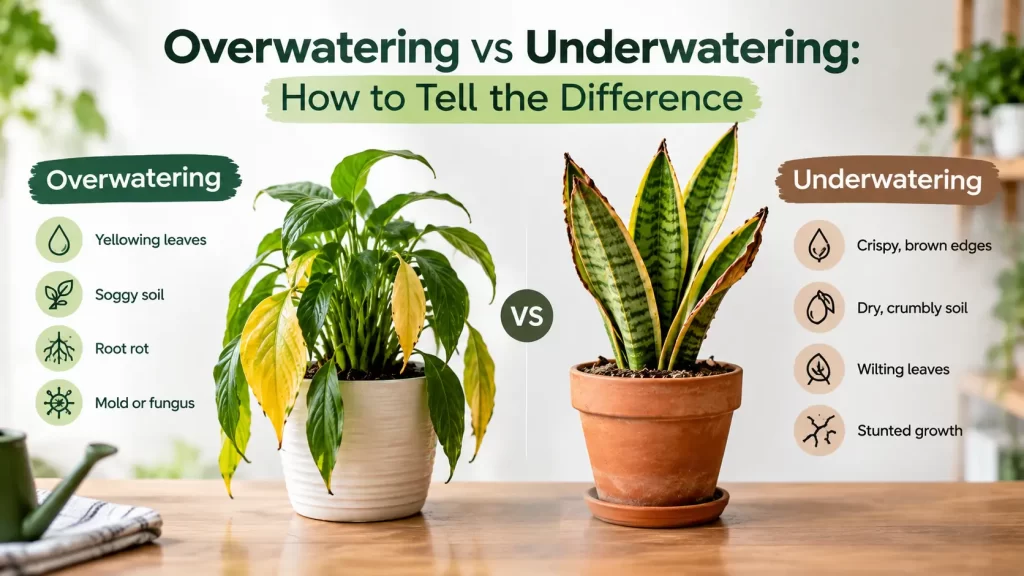
Overwatering and underwatering can look surprisingly similar. Both can cause wilting, yellow leaves, leaf drop, slow growth, brown areas, and an unhealthy-looking plant. That is why diagnosing a watering problem from the leaves alone is unreliable.
The most useful difference is usually found below the leaves: in the moisture level around the roots, the condition of the roots, how long the growing medium stays wet or dry, and how the plant responds after watering.
If a plant is wilting, do not automatically add water. First determine whether the roots are sitting in a dry root zone or a saturated one.
Quick Answer: Overwatered or Underwatered?
If the plant is wilted, check the root zone before watering.
- Very dry soil or potting mix: underwatering becomes more likely.
- Persistently wet or saturated soil: overwatering, poor drainage, or root damage becomes more likely.
- Wilted plant in wet soil: do not assume it needs more water. Waterlogged roots can be short of oxygen and may be unable to absorb water effectively.
- Soft, decaying roots: serious root stress or root rot may be involved.
- Dry, shrinking root ball: the plant may have been allowed to dry too far.
Use several clues together. A single yellow leaf, brown tip, or drooping stem is not enough to diagnose the problem.
Why Overwatering and Underwatering Can Look Similar
Roots need both water and oxygen. When a root zone becomes too dry, the plant cannot obtain enough water to replace what is being lost through the leaves. Cells lose turgor and the plant wilts.
But a plant can also wilt when the root zone contains too much water. In waterlogged soil or potting mix, water fills many of the air spaces around the roots. Prolonged saturation reduces oxygen availability, damages root function, and can eventually cause root death and decay. The roots may then struggle to move water into the plant even though the surrounding soil is wet.
This is why “the leaves are drooping” is not a sufficient reason to water again.
For a broader diagnosis of wilting that includes heat, root damage, disease and transplant stress, see Why Is My Plant Wilting?.
Overwatering vs Underwatering: Side-by-Side Comparison
| Clue | Overwatering / waterlogging | Underwatering |
|---|---|---|
| Root-zone moisture | Stays wet or saturated for a long time | Dry well below the surface |
| Wilting | Possible even when soil is wet | Common when root zone is dry |
| Leaves | May yellow, soften, drop, or develop water-related damage | May wilt, dry, become crispy, yellow, or brown |
| Roots | May become soft, weak, decayed, or unhealthy if the problem is prolonged | May be dry or stressed; severe drought can damage fine roots |
| Pot weight | Often feels heavy because the mix contains a lot of water | Often feels much lighter than after thorough watering |
| Drainage | Poor drainage, standing water, or an unsuitable mix may contribute | Water may be insufficient, irregular, or failing to wet the full root ball |
| After watering | More water may worsen the problem | A mildly wilted plant may recover after thorough watering if roots remain healthy |
This table is a guide, not a diagnosis. Species, temperature, light, humidity, container size, soil type, root health and disease can change how symptoms appear.
Signs a Plant May Be Overwatered
Overwatering is not simply “giving a plant a lot of water once.” The bigger problem is usually that the root zone remains excessively wet for too long relative to the plant’s needs and the amount of oxygen available to the roots.
1. The root zone remains wet for a long time
This is one of the strongest clues. If the soil or potting mix is still very wet long after watering, the plant may be receiving water too frequently, the container may drain poorly, or the growing medium may hold more water than the plant can use.
2. The plant wilts even though the soil is wet
This is a classic reason people accidentally make overwatering worse. A wilted plant looks thirsty, but if the root zone is already saturated, adding more water may further reduce aeration.
3. Leaves are yellowing
Waterlogging can contribute to yellow leaves because damaged roots are less able to support normal plant function. Yellowing by itself is not proof of overwatering, however. Nutrient problems, low light, drought, pests, disease and natural aging can produce similar symptoms.
For a fuller diagnosis, see Why Are My Plant Leaves Turning Yellow?.
4. Roots are deteriorating
Long periods of excessive moisture can damage roots and encourage root-rot problems. Concerning signs include soft, collapsing, slimy or decaying roots, especially when accompanied by a declining plant.
5. The container or growing medium does not drain properly
A plant can be watered carefully and still remain too wet if the growing medium drains too slowly or if excess water cannot leave the container.
If drainage is part of the problem, see What Is Well-Draining Soil? How to Test and Improve It.
6. Oedema or water-soaked corky areas appear
Some plants develop oedema when roots absorb water faster than the leaves can release it. It can appear as water-soaked areas that later become corky, particularly on susceptible plants and under excessively moist conditions.
Signs a Plant May Be Underwatered
Underwatering occurs when roots cannot supply enough water to meet the plant’s needs. This can happen because watering is too infrequent, too little water is applied, the growing medium dries very quickly, the root ball is not being wetted evenly, or environmental conditions increase water loss.
1. The root zone is genuinely dry
Do not judge only from the surface. Push a finger, wooden skewer, moisture probe, or other suitable tool deeper into the root zone where practical. In a large container, the top few centimetres can be dry while the lower root zone is still moist.
2. The plant wilts while the soil is dry
Wilting combined with a clearly dry root zone strongly supports drought stress, especially if the plant has recently experienced hot conditions, strong light, low humidity, or a long interval between waterings.
3. Leaves become dry, crisp, or brown
Underwatered foliage may develop dry edges or tips in addition to wilting. However, brown tips can also have other causes such as soluble salts, root stress or dry air.
See Why Are My Plant’s Leaf Tips Turning Brown? if browning is the main symptom.
4. The container feels unusually light
For container plants, weight can be a useful supporting clue. A thoroughly watered pot is usually noticeably heavier than the same pot after much of the available water has been used or lost.
5. The potting mix pulls away from the container
Some growing media shrink when allowed to become very dry. Water may then run quickly down the gap between the root ball and pot without fully rewetting the center. A plant can therefore appear to have been watered while the root ball remains partly dry.
How to Check Soil Moisture Properly
Moisture testing should focus on the root zone, not just the appearance of the soil surface.
For small and medium containers
Insert a finger into the potting mix as far as practical without damaging roots. Compare the moisture with what the plant normally prefers. Some plants should dry noticeably between waterings, while others perform better with more consistent moisture.
For larger containers
A wooden skewer or similar clean tool can help indicate deeper moisture. If it comes out cool, damp, or with moist growing medium attached, the lower root zone may still contain significant water.
For garden soil
Check below the immediate surface, ideally near but not directly against the stem. Rain, mulch, clay, sandy soil and recent irrigation all affect how surface appearance relates to deeper moisture.
Do not rely on one universal moisture percentage or one watering interval for every plant.
How to Check the Roots
If a container plant is declining and moisture clues are confusing, examining the root system may provide better information.
Gently remove the root ball when practical and look for:
- soft, collapsing or decayed roots,
- very wet growing medium around the root system,
- few healthy root tips,
- a sour or rotting smell,
- an extremely dry and shrunken root ball, or
- roots packed so densely that watering has become difficult.
Root color alone is not a perfect test because healthy roots vary by species. Texture, integrity and the overall condition of the plant are more useful than simply labeling every dark root as rotten.
Use Pot Weight as Another Clue
For houseplants and other container plants, learning the difference between a recently watered pot and a dry pot can be surprisingly useful.
Lift the container after a thorough watering and remember how heavy it feels. Check it again as the root zone dries. Over time, this gives you another way to judge whether significant water remains in the pot.
Pot weight should not replace checking the growing medium, but combining both methods can reduce guesswork.
What to Do if a Plant Is Overwatered
1. Stop automatic watering
Do not add water again until the root zone has dried to a level appropriate for that plant.
2. Make sure excess water can escape
For conventional container growing, drainage holes should allow excess water to leave the pot. Do not allow the container to sit indefinitely in drained water unless the plant is specifically adapted to those conditions.
3. Improve the cause, not just the symptom
If the potting mix remains wet for an unusually long time, consider whether the problem is:
- watering too frequently,
- a container that is too large for the active root system,
- poor drainage,
- a dense or unsuitable growing medium,
- low light or cool conditions reducing water use, or
- damaged roots that can no longer use water effectively.
4. Inspect the roots if the plant continues to decline
If the soil is wet and the plant continues to wilt, yellow or collapse, root damage should move higher on the diagnostic list.
If roots are clearly decaying, follow the more specific guidance in Root Rot: Signs, Causes, Treatment, and Prevention.
5. Do not compensate with fertilizer
A water-stressed or root-damaged plant does not necessarily need fertilizer. Nutrients will not correct a saturated root zone and may add another stress factor.
What to Do if a Plant Is Underwatered
1. Water the root zone thoroughly
For a container plant with healthy roots, apply enough water to moisten the root ball rather than adding only a small amount to the surface.
2. Rewet a severely dry root ball gradually if needed
If water immediately runs down the sides of the container, the growing medium may have become difficult to rewet. Apply water gradually so the root ball has time to absorb it. Depending on the plant and potting medium, more than one pass may be needed.
3. Allow excess water to drain
Correcting underwatering does not mean leaving an ordinary container permanently submerged.
4. Review why the plant dried too far
Possible reasons include:
- watering too infrequently,
- a small container,
- very porous growing medium,
- hot weather,
- strong light,
- low humidity,
- a plant with a large active root system, or
- water being applied only to part of the root ball.
When Does Overwatering Become Root Rot?
Overwatering and root rot are related, but they are not identical.
Overwatering or waterlogging describes an excessively wet root environment. That alone can injure roots by reducing oxygen.
Root rot refers to decay of the root system and may involve pathogens such as species of Pythium, Phytophthora, Rhizoctonia, and other organisms depending on the plant and growing conditions.
A plant can therefore be overwatered before extensive root rot has developed. Conversely, once roots are badly damaged, simply “watering less” may not be enough to restore the plant.
Read the full root rot guide if you see soft or collapsing roots, persistent decline, or wilting that continues in wet soil.
How to Avoid Overwatering and Underwatering
The best long-term strategy is to stop treating watering as a fixed calendar event.
A statement such as “water every seven days” ignores too many variables:
- plant species,
- plant size,
- container size and material,
- soil or potting medium,
- light level,
- temperature,
- humidity,
- air movement,
- season and active growth, and
- root health.
Use a schedule as a reminder to check the plant, not as automatic permission to water.
For a complete condition-based watering framework, see How Often Should You Water Plants?.
Common Mistakes When Diagnosing Watering Problems
Watering every wilted plant immediately
This is the biggest mistake. Wet roots can produce wilted foliage too. Check moisture first.
Judging moisture only from the soil surface
The surface often dries before the lower root zone. This is especially common in large pots.
Assuming yellow leaves always mean overwatering
Yellow leaves can result from multiple causes. Use the yellowing pattern and root-zone conditions together.
Repotting every stressed plant immediately
Repotting disturbs roots. It can be necessary when drainage or root decay is severe, but a mildly underwatered plant usually does not need emergency repotting simply because it wilted.
Using moisture meters as unquestionable proof
Consumer meters can be useful as supporting tools, but readings can be influenced by growing medium, salts, probe placement and device quality. Combine the reading with physical inspection.
Adding a little water very frequently
Small surface applications may fail to wet the full root ball while still keeping the upper layer continually damp. Watering should reach the active root zone appropriately for the plant and growing situation.
Trying several fixes at once
If you repot, fertilize, relocate, prune and radically alter watering simultaneously, it becomes difficult to know what caused improvement or further decline. Correct the strongest evidence-based problem first.
Overwatering vs Underwatering Decision Guide
- Is the plant wilted? If no, watering may not be the main issue. If yes, continue.
- Is the root zone dry? If clearly dry, underwatering becomes more likely.
- Is the root zone wet or saturated? If yes, overwatering, drainage problems or root damage become more likely.
- Are roots healthy? Firm, intact roots are more reassuring than soft or collapsing roots.
- Does the pot feel unusually light or heavy? Use this only as an additional clue.
- Are leaves also yellow, brown, spotted or dropping? Compare those symptoms with the plant’s moisture conditions.
- Has anything recently changed? Heat, cold, repotting, seasonal light changes and relocation can alter water demand.
Frequently Asked Questions
Can an overwatered plant look dry?
Yes. An overwatered plant can wilt because saturated roots may be short of oxygen and unable to function normally. The leaves may look thirsty even while the soil is wet.
Should I water a plant if its leaves are drooping?
Only after checking the root zone. Drooping or wilting can result from both dry soil and waterlogged roots.
Are yellow leaves a sign of overwatering or underwatering?
They can occur with either. Yellow leaves are not specific enough to diagnose watering by themselves. Check soil moisture, roots, leaf pattern and other symptoms.
How long should I wait between waterings?
There is no universal interval. Watering frequency depends on the species, root system, growing medium, container, temperature, humidity, light and season. Check conditions rather than following a fixed number of days.
Can a plant recover from overwatering?
Often yes if the roots have not been severely damaged and the cause is corrected. Recovery is less certain when extensive root decay has already occurred.
Can a severely underwatered plant recover?
It depends on how long and how severely the plant was dehydrated. A mildly wilted plant with healthy roots may recover quickly after watering, while severe drought can kill roots, leaves or entire growing points.
Should I repot an overwatered plant?
Not automatically. If the growing medium drains adequately and the roots are healthy, allowing the plant to return to an appropriate moisture level may be enough. Repotting becomes more relevant when drainage is poor, the medium is unsuitable, or roots are decaying.
Does putting gravel in the bottom of a pot prevent overwatering?
No. A gravel layer is not a substitute for suitable potting mix, drainage holes and appropriate watering. Focus on the physical properties of the growing medium and whether excess water can actually leave the root zone.
Sources and Further Reading
- Royal Horticultural Society: Waterlogging and flooding
- Royal Horticultural Society: How to help a poorly houseplant
- Royal Horticultural Society: How plants absorb water
- Royal Horticultural Society: Oedema
- Penn State Extension: Diagnosing poor plant health
- Penn State Extension: Fungal root rots
Bottom Line
The key difference between overwatering and underwatering is not simply what the leaves look like. Check the root zone. A wilted plant in dry soil is very different from a wilted plant in saturated soil.
Use moisture level, root condition, pot weight, drainage, leaf symptoms and recent growing conditions together. If the soil is already wet, resist the instinct to water a wilted plant again until you understand why the roots are not supplying the foliage properly.


