
How to Know When a Plant Needs Repotting: Signs, Timing, and What to Do

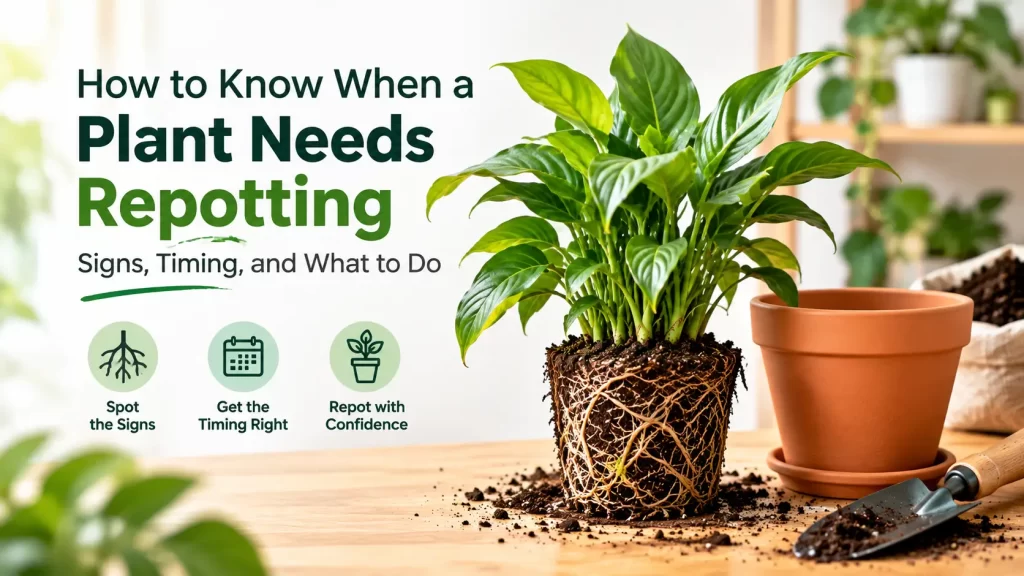
Repotting can help a container plant when its roots have genuinely run out of useful space, the potting mix has deteriorated, or the root system needs attention. But repotting too early, moving into a much larger pot, or disturbing healthy roots unnecessarily can create a new set of problems.
The best way to know whether a plant needs repotting is to look at the roots, how the potting mix behaves, how quickly the plant uses water, and whether growth has changed. A root coming through one drainage hole is a clue, not an automatic command to repot.
In many cases, you can confirm the decision by gently removing the root ball and examining it. If roots are densely circling the container and there is very little visible potting mix left, repotting is much easier to justify than if the root system still has plenty of usable space.
Quick Answer: How Do You Know When a Plant Needs Repotting?
A plant is more likely to need repotting when several of these signs occur together:
- roots densely circle the inside of the pot,
- roots occupy most of the root ball with little potting mix visible,
- roots are growing through drainage holes or appearing at the surface,
- the pot dries much faster than it used to,
- the plant repeatedly wilts between normal waterings,
- growth has slowed despite otherwise suitable care,
- new leaves are smaller than normal,
- the potting mix has compacted, decomposed, or lost useful structure,
- water no longer moves through the pot normally, or
- the plant has become physically unstable in its container.
Penn State Extension recommends removing the plant and inspecting the root ball when these clues appear. If the roots are tightly circling the root ball or so dense that little potting mix can be seen in the lower portion, the case for repotting is much stronger.
Repot because the plant or root environment needs it, not because a calendar says another year has passed.
Repotting Does Not Always Mean a Bigger Pot
“Repotting” can describe several different jobs:
- Potting on: moving a plant into a slightly larger container because the roots have filled the current one.
- Refreshing the same pot: replacing old potting mix while keeping the container size unchanged.
- Root pruning: reducing part of a congested root system so the plant can continue growing in the same container.
- Corrective repotting: replacing unsuitable or contaminated potting mix, removing rotten roots, or correcting a serious root-zone problem.
The Royal Horticultural Society specifically notes that container plants can be repotted into a larger pot or replanted into the same container after root pruning and refreshing the compost.
This distinction matters. If you want a plant to remain approximately the same size, continuously moving it into larger and larger containers may not be the best long-term strategy.
8 Signs a Plant May Need Repotting
No single sign is perfect. Use several clues together, then inspect the roots if practical.
1. Roots Are Densely Circling the Pot
This is one of the strongest signs.
A few roots touching the sides of a container are normal. A genuinely pot-bound or root-bound plant has a dense root system that has filled much of the available space and may be circling repeatedly around the inside of the pot.
Penn State describes a plant as ready for repotting when the roots are circling the root ball or have become so dense that little potting mix is visible in the lower part of the root mass. RHS likewise recommends lifting the plant from the container as the most useful way to assess root congestion.
What to look for
- thick mats of roots around the outside of the root ball,
- roots circling several times around the bottom,
- very little visible potting mix between roots,
- a root ball that holds the exact shape of the container, and
- roots that do not readily expand into fresh mix because they remain tightly coiled.
If slow growth is your main concern, remember that root restriction is only one possible cause. Light, watering, temperature, nutrition and root health can also limit growth. See Why Is My Plant Growing Slowly?.
2. Roots Are Growing Through the Drainage Holes
Roots emerging through drainage holes are a useful warning sign, but they should be interpreted in context.
A vigorous root can find a drainage hole before the entire pot is full. If one or two roots are visible but the plant grows normally, the mix holds water appropriately, and the root ball is not congested, immediate repotting may not be necessary.
Repotting becomes more convincing when drainage-hole roots occur together with dense circling roots, very fast drying, repeated wilting, slowed growth, or a root ball made up mostly of roots rather than potting mix.
Illinois Extension and Penn State both list roots emerging through drainage holes as an indicator that a plant may be ready for repotting, but examining the overall root system gives better information than using that sign alone.
3. The Pot Dries Much Faster Than It Used To
A container that once stayed appropriately moist for several days but now dries very quickly may contain a much larger root system and much less effective potting mix.
Penn State includes unusually rapid drying among the signs of a pot-bound houseplant. Illinois Extension likewise notes that a crowded plant may wilt between normal waterings.
Rapid drying does not automatically prove the pot is too small. It can also result from hotter weather, stronger light, lower humidity, wind, a porous container, a very free-draining mix, or the plant entering a period of rapid active growth.
Compare current drying behavior with the plant’s previous pattern under similar conditions.
If you are adjusting watering repeatedly, see How Often Should You Water Plants? for a condition-based approach.
4. Growth Has Slowed or New Leaves Are Smaller
A restricted root system can limit top growth because roots have less room to expand and less effective potting medium from which to obtain water and nutrients.
RHS notes that plant growth slows when roots lack sufficient space, while Illinois Extension lists smaller-than-normal new leaves among indicators that repotting may be needed.
However, slow growth is not enough by itself. A plant can stop growing because of insufficient light, a seasonal slowdown, cold temperatures, overwatering, root rot, nutrient problems, pests, disease, or recent transplant stress.
Check the roots before deciding that a bigger pot will fix the problem.
5. The Potting Mix Has Broken Down, Compacted or Lost Structure
A plant can need repotting even when the root system is not severely pot-bound.
Potting mixes change over time. Organic components break down, particles become finer, air space can decline, and the physical behavior of the root zone can change.
RHS notes that container compost can slump as organic materials decompose, reducing air space and affecting drainage, nutrient retention and water retention.
Possible signs of deteriorated mix
- the mix has become dense or muddy,
- water sits at the surface much longer than it used to,
- the root zone remains wet for excessive periods,
- the mix has shrunk substantially away from the sides,
- the mix no longer rewets evenly, or
- the plant has remained in the same aging mix for years.
Do not assume every old potting mix is automatically bad. Its condition matters more than its birthday.
6. Water No Longer Moves Through the Pot Normally
A change in watering behavior can reveal a root-zone problem.
Water runs through extremely quickly
This can happen when roots occupy much of the container or when the mix has become so dry that water channels around a shrunken root ball instead of wetting it evenly.
Do not immediately assume “root-bound.” Check whether the center of the root ball actually becomes moist.
Water sits on top for a long time
This may indicate compacted or degraded mix, blocked drainage, dense roots, or another physical problem.
If the root zone remains saturated, do not repot into a larger pot without understanding the cause. A larger volume of wet mix could make the problem worse.
For a deeper explanation of drainage, see What Is Well-Draining Soil? How to Test and Improve It.
7. The Plant Is Top-Heavy, Unstable or Being Pushed Upward
A large plant in a small pot may become physically unstable even before severe root restriction causes obvious foliar symptoms. The root mass may also push the plant upward as it becomes congested.
Possible clues include:
- the plant tips easily,
- the root ball appears to rise above the pot,
- large roots are visible near the surface, or
- the container is no longer proportionate to the plant’s size and weight.
Stability is a legitimate reason to choose a more suitable container, but do not solve top-heaviness with an enormous pot. A heavier pot of only modestly larger size may provide stability without creating excessive wet potting mix.
8. Roots or Potting Mix Need Corrective Attention
Sometimes repotting is necessary because the existing root environment is unhealthy rather than because the plant needs more space.
Examples include:
- root rot that requires removal of damaged roots and replacement of unsuitable mix,
- a pot with inadequate drainage,
- severe salt accumulation,
- contaminated or inappropriate potting medium,
- serious root damage, or
- a plant placed in ordinary garden soil that has become dense inside a container.
In these situations, the correct new pot may be the same size or even smaller after damaged roots are removed.
If roots are soft, collapsing or decayed, see Root Rot: Signs, Causes, Treatment, and Prevention. Moving a plant with a reduced root system into a much larger wet pot can prolong the problem.
Signs That Do Not Automatically Mean a Plant Needs Repotting
One root coming through a drainage hole
Inspect the whole root ball before deciding.
A plant has been in the same pot for one year
Repotting frequency varies widely. RHS notes that vigor, pot size and the type and condition of the growing medium all affect how often repotting is needed.
The plant is not flowering
Repotting may be irrelevant. Light, maturity, pruning, season, temperature and nutrition can all affect flowering. See Why Is My Plant Not Flowering?.
The plant is growing slowly in winter
Reduced light or seasonal growth patterns may be responsible. Do not disturb healthy roots just to force growth.
You just bought the plant
A new purchase often benefits from time to adjust to its new environment unless there is an urgent root, drainage or potting-medium problem.
The decorative pot looks too small
Aesthetic proportion is not the same as root congestion. Check the roots.
When Is the Best Time to Repot a Plant?
If you can choose the timing, repot when the plant is entering or already in active growth.
For many temperate and indoor plants, that often means late winter through spring or early summer. RHS, Penn State and Illinois Extension all identify active spring growth as a favorable repotting period.
This does not mean every plant worldwide should be repotted in March or April. Grow With Rajeev is written for a global audience, so use the plant’s actual growth cycle rather than a Northern Hemisphere month.
Repot outside the ideal season when the problem is urgent
Do not leave a plant in actively rotting, contaminated, severely waterlogged or structurally unsafe conditions for months just because it is not the preferred repotting season.
In an emergency, correcting the root problem can be more important than waiting for perfect timing.
Should You Repot a Plant Immediately After Buying It?
Usually not just because it is new.
Missouri Extension notes that recently purchased houseplants seldom need immediate repotting and that moving into a new indoor environment already requires adjustment. Repotting at the same time adds another stress.
Give a healthy new plant time to acclimate unless you find a specific reason to intervene, such as severe root congestion, actively rotting roots, a container with no practical drainage, a dangerously unstable plant, a clearly unsuitable potting medium, or a serious root-zone problem requiring treatment.
If a plant is already stressed after being moved or repotted, see Transplant Shock: Signs, Causes, and How to Help a Plant Recover.
How Much Bigger Should the New Pot Be?
Bigger is not automatically better.
For many houseplants, moving up approximately one pot size is a good starting point. Penn State, Illinois Extension and Mississippi State commonly recommend a container only about 1 to 2 inches (2.5 to 5 cm) wider for ordinary houseplants.
RHS gives similar guidance for smaller containers and recommends that the new pot generally be no more than about one-third larger than the current one.
Larger woody ornamentals and long-term outdoor container plants may justify a somewhat larger increase. UGA Extension, for example, recommends roughly 3 to 4 inches of additional diameter for many woody ornamentals and flowering perennials.
Why overpotting can cause problems
A small root system placed in a large volume of fresh mix cannot use that water quickly. The unused mix may remain wet for much longer, reducing aeration and increasing the risk of root problems.
RHS and Illinois Extension both warn against oversized pots for this reason.
Choose the new container based on the root ball and plant type, not a desire to avoid repotting forever.
Does the New Pot Need Drainage Holes?
For most ordinary container plants, a pot with functioning drainage holes is the safest choice.
Penn State recommends using a pot with a drainage hole inside a decorative cachepot when the decorative container itself cannot drain. Any water collected in the outer pot should be emptied so the inner container is not left standing in it.
Do not add a gravel layer to improve drainage
A thick layer of rocks or gravel at the bottom is not a substitute for suitable potting mix and drainage holes. Iowa State Extension specifically advises against this practice because it can create a wetter zone of potting medium above the coarse layer.
A small piece of mesh or another suitable cover can be used over an unusually large drainage hole when necessary to keep mix from escaping, but that is different from filling the bottom of the pot with gravel.
How to Choose the Right Potting Mix
Use a potting medium appropriate for the plant and container rather than assuming one mix works for every species.
A useful container medium should provide a suitable balance of:
- air space,
- water retention,
- drainage,
- physical support, and
- nutrient-holding capacity.
Succulents, epiphytic orchids, moisture-loving tropical plants and long-term woody container plants do not require identical root environments.
Penn State advises against using ordinary garden soil as the sole growing medium for indoor houseplants because it can create pest, disease and physical drainage problems. Missouri Extension likewise recommends porous mixes rather than ordinary garden soil for most houseplants.
If you are unsure what “well-draining” should mean in practice, see the full guide to well-draining soil and potting media.
How to Repot a Plant Step by Step
1. Prepare Before Removing the Plant
Have the new container, fresh potting mix, clean tools and a suitable work area ready first. This reduces the time roots spend exposed.
2. Remove the Plant Gently
Support the root ball and the base of the plant rather than pulling hard on delicate stems or leaves.
For flexible nursery pots, gently squeezing the sides can help release the root ball. For rigid containers, tipping the pot sideways and easing the root mass free is often safer than pulling upward forcefully.
3. Inspect the Roots
Look for dense circling roots, healthy firm roots, soft or decayed areas, pests, very dry sections of the root ball, and the amount of potting mix still present.
Root color varies among species, so do not diagnose rot from color alone. Texture, integrity, smell and the condition of the whole plant are more useful.
4. Loosen Tightly Circling Roots When Appropriate
Penn State, RHS and Illinois Extension recommend loosening or teasing apart tightly circling roots so they are better positioned to enter the new mix.
Do not aggressively tear apart every healthy root ball. The amount of correction should match the severity of root congestion and the plant’s tolerance of disturbance.
5. Add Fresh Mix and Position the Plant
Place enough mix in the new container so the plant sits at approximately the same depth it occupied before unless the species specifically requires a different planting depth.
Do not bury stems, crowns or trunks more deeply just because the new pot is larger.
6. Fill Around the Root Ball
Add potting mix around the roots and gently settle it. Avoid compressing the mix so firmly that air and water movement are restricted.
Leave enough space below the rim for practical watering.
7. Water Thoroughly
RHS and Penn State recommend watering after repotting so the new medium is moistened and settles around the roots. Allow excess water to drain.
After the initial watering, return to a moisture-based watering routine rather than keeping the new pot constantly wet.
When Should You Root-Prune Instead of Moving to a Bigger Pot?
If you want to keep a mature plant in the same container or prevent it from becoming much larger, root pruning and fresh potting mix can sometimes be used instead of continually increasing pot size.
RHS notes that many container plants can remain healthy in the same size pot when the roots are periodically pruned. Penn State similarly describes removing part of the outer root system when the goal is to maintain the plant at its current size.
Root pruning is more stressful than simple potting-on and is not equally suitable for every plant. If the plant is rare, valuable, highly sensitive to root disturbance, or difficult to replace, use species-specific guidance before cutting roots.
What Should You Do After Repotting?
The plant has just experienced root disturbance, so aftercare should focus on stability.
- Return the plant to a light level appropriate for the species.
- Avoid sudden exposure to stronger sun if roots or foliage have been disturbed.
- Keep the root zone appropriately moist, not saturated.
- Make sure drained water can leave the container.
- Avoid another major move unless a serious problem must be corrected.
- Watch new growth rather than expecting every old damaged leaf to recover.
Water demand can change after repotting. A larger container contains more growing medium and may dry more slowly, while a plant entering active growth may use more water. Check moisture rather than copying the old schedule.
When Should You Fertilize After Repotting?
Do not assume a freshly repotted plant needs fertilizer immediately.
Iowa State Extension recommends waiting roughly two to four weeks before resuming regular fertilizer for repotted houseplants, noting that many fresh potting mixes already contain some fertilizer.
The correct timing depends on the plant and the mix you used. Some commercial potting mixes contain controlled-release fertilizer, while others contain little or none.
Avoid feeding a visibly stressed or root-damaged plant simply to force new growth. Healthy root function comes first.
What if the Plant Wilts After Repotting?
Temporary wilting can occur after roots are disturbed, but do not automatically water again.
Check whether the new potting mix is too dry, appropriately moist, or staying saturated.
A plant can wilt in both dry and waterlogged conditions. If the pot is much larger than the old one, excess wet mix may be contributing to the problem.
Other possibilities include root damage during repotting, sudden stronger light, heat or wind, planting too deeply, and existing root disease that was already present before repotting.
See Transplant Shock for a full post-repotting diagnosis, and Overwatering vs Underwatering if moisture is confusing.
Common Repotting Mistakes
Mistake 1: Repotting on a Fixed Yearly Schedule
Some fast-growing plants need frequent repotting. Other species can remain healthy in the same container for years. Let roots, growth and potting-medium condition guide the decision.
Mistake 2: Choosing a Much Larger Pot
Excess unused potting mix can remain wet for too long. Move up gradually unless the plant type and root system justify a larger increase.
Mistake 3: Repotting Because One Root Is Visible
Inspect the entire root ball. One exploratory root does not prove severe congestion.
Mistake 4: Putting Gravel at the Bottom
Use functioning drainage holes and an appropriate potting mix instead.
Mistake 5: Using Dense Garden Soil in an Indoor Pot
Garden soil behaves differently when confined in a container and may not provide the air and drainage expected from a purpose-made potting medium.
Mistake 6: Packing the New Mix Too Tightly
Firm enough to support the plant is different from compressing the root zone into a dense mass.
Mistake 7: Burying the Plant Deeper Than Before
Maintain the appropriate crown, stem or trunk depth for the species.
Mistake 8: Fertilizing Heavily Immediately Afterward
Fresh mix may already contain nutrients, and stressed roots do not benefit from excessive fertilizer.
Mistake 9: Repotting a Healthy New Purchase Immediately
Allow acclimation first unless there is a specific problem requiring intervention.
Mistake 10: Assuming Repotting Fixes Every Plant Problem
A bigger pot cannot correct low light, pest damage, unsuitable temperature, viral disease, or an inappropriate watering routine.
Frequently Asked Questions
How Often Should You Repot a Plant?
There is no universal schedule. Fast-growing plants may need repotting relatively often, while slow growers can stay in the same container for years. Check the roots, drying rate, growth and condition of the potting mix rather than relying only on time.
Do Roots Coming Out of the Bottom Mean I Must Repot?
Not always. They are an important clue, but inspect the whole root ball. If roots are densely circling, little potting mix remains, growth has slowed or the pot dries extremely quickly, repotting is more clearly justified.
What Does Root-Bound Mean?
A root-bound or pot-bound plant has roots that have filled much of the available container space and become densely packed or repeatedly circled around the root ball. Severe restriction can affect water management and growth.
Should I Break Up the Roots When Repotting?
Tightly circling roots often benefit from being gently loosened so they can grow into the new medium. Do not aggressively tear apart a healthy, uncongested root ball. The amount of disturbance should match the problem and the species.
How Much Bigger Should a New Pot Be?
For many houseplants, choose a container roughly 1 to 2 inches (2.5 to 5 cm) wider than the current one. Larger outdoor container plants may justify a somewhat greater increase. Avoid a huge jump in pot size.
Can I Repot a Plant Into the Same Pot?
Yes. If you want to maintain the plant’s size, refreshing the potting mix and carefully root-pruning an appropriate plant can allow it to return to the same container.
Can I Repot a Plant While It Is Flowering?
If repotting is optional, it is often easier to wait for a less demanding growth stage or follow species-specific timing. If the roots are rotting, the pot is unsafe, or another urgent problem exists, correcting the problem can be more important than preserving flowers.
Should I Water Immediately After Repotting?
For most ordinary repotting, yes. Thorough watering helps moisten the fresh medium and settle it around the roots. Allow excess water to drain and then resume watering according to actual root-zone moisture.
Should I Fertilize Immediately After Repotting?
Usually not. Fresh potting mix may already contain fertilizer, and disturbed roots benefit from time to recover. Iowa State recommends waiting about two to four weeks before returning to regular fertilizer for typical houseplants.
Why Is My Plant Drooping After Repotting?
Root disturbance, excessive dryness, waterlogging, a much larger wet pot, stronger light or temperature stress can all contribute. Check the root-zone moisture before adding more water.
Can Repotting Cause Root Rot?
Repotting itself is not root rot, but moving a small root system into an oversized container with moisture-retentive mix can keep roots too wet. Poor drainage and excessive watering after repotting can increase the risk of root problems.
Is Spring Always the Best Time to Repot?
Active growth is generally a favorable time because roots can establish into fresh mix. For many plants that occurs in spring, but the relevant season depends on the species and your climate. Urgent root problems may need correction outside the ideal period.
Sources and Further Reading
- Royal Horticultural Society: How to repot a plant
- Penn State Extension: Repotting houseplants
- Iowa State University Extension: How to care for houseplants
- Illinois Extension: Repotting houseplants
- Illinois Extension: Choosing houseplant containers
- University of Missouri Extension: Caring for houseplants
- Mississippi State University Extension: Care and selection of indoor plants
- UGA Extension: Repotting container plants for long-term health
Bottom Line
A plant needs repotting when the current container or root environment is genuinely limiting healthy growth, water management or root function. Do not use one root at a drainage hole or a fixed yearly schedule as the only test.
The strongest evidence comes from the root ball itself: dense circling roots, little remaining potting mix, unusually fast drying, stalled growth, deteriorated mix, poor water movement or an unhealthy root zone.
When you do repot, choose a container only modestly larger, use an appropriate potting medium, maintain proper planting depth, water thoroughly and let the plant reestablish. Repotting should solve a specific root-zone problem, not create a new one.


