
Why Are My Plant’s Leaf Tips Turning Brown? 8 Causes and What to Do

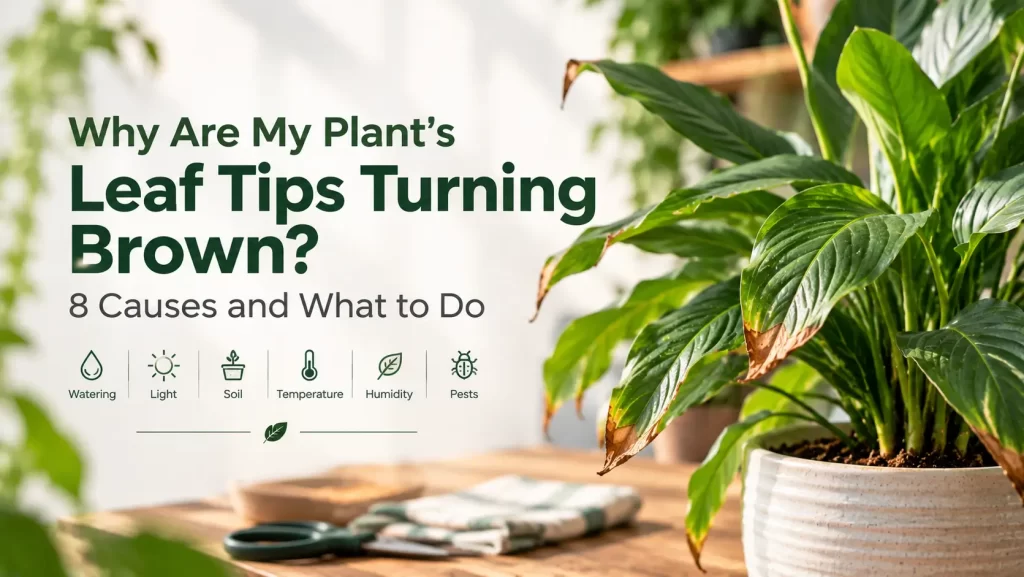
Brown leaf tips are usually a sign of stress somewhere in the plant’s water, root or growing environment. The cause might be dry air, inconsistent watering, excess fertilizer salts, poor root health, heat, wind or, in certain sensitive plants, minerals in the water. The same symptom can therefore have several very different fixes.
The useful question is not simply, “How do I cut off the brown tips?” It is, “Why is new leaf tissue continuing to brown?” This guide shows you how to read the pattern, check the root zone, identify the most likely cause and prevent the damage from continuing.
Quick Answer: What Causes Brown Leaf Tips?
For houseplants, common causes include low humidity, letting the potting mix become too dry between waterings, excess fertilizer or other soluble salts, overly wet soil that damages roots, and mineral sensitivity in certain species. Outdoor plants can also develop brown tips or margins during drought, strong wind, establishment stress, salt exposure or other environmental injury.
University of California Statewide IPM guidance lists excessive dryness, overwatering, fertilizer or other soluble salts, specific mineral toxicities, low humidity, pesticide injury and mechanical injury among possible causes of brown or scorched leaf tips. This is why tip browning should be diagnosed from the whole plant and its growing conditions rather than from the brown tissue alone.
| Clue | Possible cause | What to check next |
|---|---|---|
| Dry, crisp tips on an otherwise healthy indoor plant | Low humidity or mild water stress | Humidity, potting-mix moisture and watering consistency |
| Tips brown after the pot repeatedly becomes very dry | Inconsistent watering | How far the root ball dries between waterings |
| Brown tips plus white crust on soil or pot | Soluble salt buildup | Fertilizer rate, water quality and drainage |
| Brown tips with wet soil, yellowing or wilt | Root stress from excess moisture | Drainage and root condition |
| Repeated tip burn on a sensitive species despite otherwise good care | Possible mineral sensitivity | Plant species and local water chemistry |
| Brown margins after hot, windy or dry conditions outdoors | Drought or environmental scorch | Root-zone moisture, exposure and recent weather |
| Plant dries unusually fast and roots circle the pot | Root-bound container | Root density and remaining potting mix |
| Irregular spots, lesions or spreading patches rather than clean tip burn | Possible disease, pests or injury | Leaf undersides, stems, lesion pattern and recent treatments |
What Brown Leaf Tips Actually Mean
Once a leaf tip has turned brown and dry, that tissue is dead. It will not become green again. The goal of diagnosis is therefore to stop healthy tissue and new leaves from developing the same damage.
Tip burn is a symptom rather than a single disease. The tip or margin of a leaf can die when the plant cannot maintain a suitable water balance, when roots are damaged, or when salts or particular minerals accumulate to damaging levels. Environmental injury can produce a similar appearance.
Do not assume that every brown tip has exactly one cause. Iowa State University Extension emphasizes that houseplant problems often involve more than one factor. A plant could, for example, be growing in dry indoor air while also receiving too much fertilizer.
Brown tips are different from random brown spots
Uniform browning that begins at leaf tips or along margins is more suggestive of water balance, salt or environmental stress. Circular spots, water-soaked lesions, patches with yellow halos, fungal growth, webbing or damage concentrated around feeding sites point toward a different diagnostic pathway.
The pattern matters. Before changing anything, look at several leaves and ask whether the damage is consistently starting at the tips, moving along the margins, appearing only on the oldest leaves, or forming unrelated spots across the leaf blade.
1. Low Humidity
Low relative humidity is a common cause of dry brown tips on indoor plants, particularly species adapted to humid environments. Dry air increases the moisture gradient between a leaf and the surrounding atmosphere, which can increase water loss from foliage.
The Royal Horticultural Society identifies a dry atmosphere as one possible cause of brown leaf tips and margins. Iowa State’s current houseplant guidance likewise identifies low humidity as a common cause of brown tips indoors, especially during dry winter conditions.
Clues that low humidity may be involved
- The plant is a humidity-sensitive houseplant.
- Tips are dry and crisp while much of the remaining leaf looks healthy.
- The problem worsens when indoor heating or air conditioning dries the air.
- Several humidity-sensitive plants in the same room show similar tip damage.
- The potting mix is not chronically dry or waterlogged.
What to do
First confirm that the species actually benefits from higher humidity. If it does, a room humidifier is generally the most controllable way to increase ambient humidity around a collection of plants. Grouping plants can also create a somewhat more humid local microclimate.
Do not use higher humidity as a substitute for correct watering. A plant in dry air can still be overwatered at the roots. Likewise, not every houseplant needs tropical humidity, so match conditions to the species rather than chasing a universal humidity percentage.
2. Inconsistent Watering or Excessively Dry Soil
Allowing a plant to dry much farther than it tolerates can cause leaf margins and tips to die. Repeated cycles of severe drying followed by heavy watering can be particularly stressful for plants that prefer a more even moisture supply.
Clues that dryness is the main problem
- The potting mix becomes very dry between waterings.
- A container feels extremely light before it is watered.
- The plant sometimes wilts before watering.
- Leaf tips and margins are crisp rather than soft.
- The potting mix has shrunk away from the side of the pot in severe cases.
- The plant sits in a small pot or a warm, bright, windy position where it dries quickly.
What to do
Water according to the plant’s moisture requirements rather than a rigid calendar. Check the root zone before watering, then water thoroughly when it has dried to the appropriate level. If a potting mix has become so dry that water runs down the side without wetting the root ball, rewet it gradually.
Do not assume “consistent watering” means constantly wet soil. Consistency means avoiding moisture extremes that are inappropriate for that particular species.
3. Overwatering and Root Stress
It may seem contradictory, but brown tips can also occur when the root zone stays too wet. Waterlogged potting media contain less air, and roots that are deprived of oxygen or beginning to decay may struggle to absorb and transport water normally.
UC IPM includes excessively wet soil among possible causes of brown or scorched leaf tips. The RHS also notes that both overwatering and underwatering can contribute to leaf-tip or margin browning on houseplants.
Clues that excess moisture is involved
- The potting mix remains wet for a long time.
- Brown tips occur together with yellowing, wilt or slow growth.
- The pot has inadequate or blocked drainage.
- The plant frequently stands in water collected in a saucer or decorative outer pot.
- Roots are dark, soft or decaying instead of firm.
- The plant was recently moved into a much larger pot with a moisture-retentive mix.
What to do
Check drainage and root condition before adding more water. Allow the root zone to move toward the moisture level appropriate for the species, and correct whatever is keeping it saturated. If roots are clearly decaying, the plant may need more than a change in watering frequency, including removal of badly damaged roots and fresh, suitable growing medium where appropriate.
A brown tip by itself is not enough to diagnose root rot. Look for supporting evidence such as persistent wetness, root decay, wilting or yellowing.
4. Excess Fertilizer and Soluble Salt Buildup
Fertilizers are salts. Minerals from fertilizer and irrigation water can accumulate in container media over time, especially when plants are fertilized heavily or when water evaporates without enough excess solution draining from the pot.
University of Maryland Extension explains that soluble salt buildup can inhibit water uptake and cause brown leaf tips, reduced growth, root injury, lower-leaf drop and wilting. Its separate guidance on fertilizer toxicity also identifies browning or dieback of leaf tips and margins as a typical symptom of high soluble salts.
Clues that salts may be responsible
- Brown tips appeared after increasing fertilizer strength or frequency.
- A white or pale crust is visible on the potting medium, pot rim or drainage area.
- The plant has been repeatedly fertilized without occasional leaching through the pot.
- Root tips are damaged or growth has slowed.
- The growing medium is old and has accumulated minerals over a long period.
What to do
Stop unnecessary fertilizer applications and check whether the plant has actually been receiving more fertilizer than recommended. For a container with free drainage, excess soluble salts can often be reduced by slowly flushing the growing medium with suitable water and allowing it to drain thoroughly. University of Maryland guidance also notes that badly affected smaller pots may need fresh growing medium.
Do not compensate for fertilizer injury by adding another product. Correct the excess first and give the root system time to recover.
5. Water Quality and Mineral Sensitivity
Water quality deserves consideration, but it should not be blamed for every brown leaf tip. Some plants are more sensitive than others to particular dissolved minerals or chemicals.
Iowa State’s February 2026 guidance notes that spider plants, ti plants, dracaenas, prayer plants and calatheas are among houseplants that can develop brown leaf tips when exposed over time to water containing problematic levels of fluoride or other chemicals. University of Wisconsin Extension also identifies fluoride, chlorine, salt accumulation and dry conditions as possible contributors to spider-plant tip burn.
Clues that water quality deserves investigation
- The species is known to be sensitive to particular minerals.
- Watering and humidity are otherwise appropriate.
- New leaves repeatedly develop similar tip burn.
- Several sensitive plants watered from the same source show the same pattern.
- There are signs of mineral deposits on the growing medium or pot.
What to do
Check information from your local water supplier if available and confirm whether your plant is known to be sensitive. For a strongly suspected water-quality problem, try a suitable low-mineral water source, such as distilled water, for new irrigation and monitor whether newly produced leaves improve.
Do not assume that every household water filter removes the mineral or chemical you are concerned about. Filtration methods differ. Also remember that old brown tips will remain brown even after the cause is corrected, so judge success by new growth.
6. Heat, Strong Sun, Wind and Outdoor Drought Stress
Brown leaf tips are not limited to indoor plants. Outdoor foliage can scorch when roots cannot replace water lost during hot, dry or windy conditions. Newly planted trees and shrubs are especially vulnerable because their root systems have not yet expanded far into the surrounding soil.
RHS guidance on brown leaves in woody plants notes that brown tips and margins can indicate drought and may be worse in exposed, windy conditions. It also identifies establishment failure as a possible factor when dry weather follows planting.
Clues that environmental scorch is likely
- The browning began during hot, dry or windy weather.
- The plant is newly planted or recently moved outdoors.
- Damage is worse on the most exposed side.
- Soil around the active root zone is dry.
- Leaves show crisp margins or tips without classic spot-like disease lesions.
What to do
Check moisture at root depth and water appropriately if the plant is genuinely dry. For newly planted specimens, monitor the original root ball as well as the surrounding soil. Mulch can help conserve soil moisture around suitable outdoor plants, provided it is applied correctly and kept away from direct contact with trunks or vulnerable stems.
Plants suddenly moved from sheltered conditions into intense sun or wind may need gradual acclimation. However, do not permanently move a sun-loving species into unsuitable shade simply because one set of leaves was damaged during transition.
7. A Root-Bound Container
As roots fill a pot, there is less growing medium available to store water. A root-bound plant can therefore move from adequately moist to excessively dry much faster than it did when the pot contained more free growing medium.
University of Maryland Extension lists brown or dead leaf tips among possible symptoms of pot-bound indoor plants. This does not mean every crowded root system needs immediate repotting. Some species tolerate or even prefer a fairly snug container. The key question is whether root crowding is causing practical problems with moisture, growth or plant stability.
Clues that the pot is part of the problem
- The pot dries much faster than it used to.
- Roots densely circle the inside of the container.
- Roots emerge heavily from drainage holes.
- There is very little potting medium remaining between roots.
- The plant needs water again unusually soon after a thorough watering.
- Growth has slowed despite otherwise suitable care.
What to do
If the plant is genuinely root-bound and moisture management has become difficult, repot into a suitably larger container with fresh growing medium appropriate for the species. Avoid jumping into an unnecessarily oversized pot, which can stay wet for too long around a relatively small root system.
8. Chemical Injury, Physical Damage or Disease
Not every brown tip comes from routine watering or humidity. UC IPM lists pesticide and mechanical injury among possible causes of scorched leaf tips. Excess light, heat, chilling and chemical sprays can also create brown or damaged foliage.
Look for a different pattern
If the damage is irregular rather than consistently tip-first, broaden the diagnosis. Disease is more plausible when there are expanding lesions, water-soaked areas, spots with defined margins or halos, fungal structures, stem lesions or a pattern spreading from leaf to leaf.
Pests can also weaken foliage, although tip browning alone is usually not enough to identify an insect or mite problem. Examine leaf undersides, stems and new growth for insects, scale covers, webbing, distorted growth, sticky residue or characteristic feeding marks.
What to do
Review any pesticide, foliar feed, cleaning product or other spray used shortly before symptoms appeared. Make sure products were applied according to their labels and were appropriate for the plant and conditions.
If an infectious problem is suspected, identify the plant and obtain a diagnosis before applying a pesticide or fungicide. Regulations and approved uses differ by country, so locally qualified horticultural or plant-health advice is appropriate for valuable plants or rapidly spreading problems.
How to Diagnose Brown Leaf Tips Step by Step
Step 1: Identify the plant
Species matters. A spider plant with brown tips raises different questions about mineral sensitivity than a drought-tolerant succulent or an outdoor shrub. Confirm the plant’s normal requirements for moisture, humidity, light and temperature.
Step 2: Decide whether the damage is truly tip burn
Look at several leaves. Is the dead tissue starting at the point or edge and moving inward, or are there separate spots and lesions across the leaf? A consistent tip-and-margin pattern makes environmental or root-zone causes more likely.
Step 3: Check the root-zone moisture
If the growing medium is very dry, investigate watering consistency. If it is persistently wet, investigate drainage and root health. Do not respond to a brown tip by watering until you know which moisture condition you actually have.
Step 4: Review fertilizer use
Ask when the plant was last fertilized, how concentrated the product was, and how often it has been used. Look for white mineral deposits. If the browning began after feeding, excess salts deserve more attention.
Step 5: Consider humidity and exposure
For humidity-sensitive houseplants, consider whether indoor air is especially dry. Outdoors, review recent heat, drought, wind and transplanting. Indoors, check for strong heat through a window, cold drafts or abrupt environmental changes.
Step 6: Consider water quality only when the evidence fits
If the plant is a mineral-sensitive species and other care factors look appropriate, investigate local water chemistry or test a suitable alternative water source. Do not change water solely because a generic internet list says all brown tips are caused by tap water.
Step 7: Inspect roots and the pot if symptoms continue
Persistent browning with chronically wet soil can indicate root decline. Browning with a pot that dries extraordinarily fast can point toward root crowding. A careful root inspection can help distinguish those situations.
Step 8: Watch the new growth
Correcting the cause will not turn old brown tissue green. Monitor leaves that develop after the care change. Cleaner new growth is stronger evidence that the diagnosis and correction were useful.
Should You Cut Off Brown Leaf Tips?
Yes, if you want to improve the plant’s appearance. Trimming dead brown tissue is cosmetic and does not fix the underlying cause. Iowa State University Extension notes that brown portions can be trimmed with scissors, but new browning will continue if the underlying stress is not corrected.
How to trim brown tips
- Use clean, sharp scissors.
- Follow the natural shape of the leaf.
- Remove the dry brown tissue without taking unnecessary healthy green tissue.
- If most of a leaf is dead or badly damaged, removing the whole leaf may look better than repeatedly trimming the margin.
A very small brown edge may remain after trimming, and that is usually preferable to cutting deeply into healthy tissue merely to create a perfectly green edge.
How to Prevent New Brown Leaf Tips
Prevention is easier when you stop thinking of brown tips as a single problem. Build a care routine around the plant’s actual requirements.
Keep moisture appropriate, not automatically constant
Check the root zone and water when the plant reaches the dryness level suitable for its species. Avoid repeated severe drought as well as chronic saturation.
Use fertilizer at an appropriate rate
More fertilizer is not automatically better. Follow an appropriate product rate and feeding frequency for the plant and growth stage. If salts accumulate in a freely draining container, periodic leaching with suitable water may help prevent excessive buildup.
Match humidity to the species
If you grow humidity-sensitive tropical plants in dry indoor air, provide a more suitable environment where practical. Do not raise humidity indiscriminately around plants adapted to drier conditions.
Give roots both water and air
Use an appropriate growing medium and a container or planting site that drains correctly. Healthy roots need access to oxygen as well as moisture.
Watch for sudden environmental changes
Acclimate plants gradually when moving them into stronger light, outdoor wind or a substantially different temperature. Newly planted outdoor plants also need closer moisture monitoring while roots establish.
Know whether the species is sensitive to water chemistry
If a particular plant repeatedly develops tip burn despite appropriate watering, fertilization and humidity, investigate species-specific water-quality sensitivity rather than applying a blanket rule to every plant you own.
Common Mistakes When Leaf Tips Turn Brown
Watering more without checking the soil
Both dry and excessively wet root zones can contribute to brown tips. More water is not always the answer.
Assuming low humidity is always responsible
Low humidity is common indoors, but fertilizer salts, inconsistent watering, poor roots and species-specific mineral sensitivity can create similar damage.
Blaming tap water first
Some plants are genuinely sensitive to particular minerals, but water quality should be investigated in context. Check the plant species and other care conditions first.
Adding fertilizer to “help” a stressed plant
If excess salts are already contributing to tip burn, more fertilizer can worsen the problem.
Expecting old brown tissue to recover
Dead tissue will remain brown. Evaluate recovery by whether the browning stops advancing and whether new leaves develop normally.
Changing everything at once
If you repot, change water, move the plant, increase humidity, alter fertilizer and radically change watering on the same day, you will not know which factor mattered. Correct the strongest evidence first unless the plant is in an urgent condition such as severe root decay.
Frequently Asked Questions
Do brown leaf tips mean I am underwatering?
Sometimes, but not always. Excessive dryness and inconsistent watering are common causes, but overwatering, root damage, low humidity, soluble salts and mineral sensitivity can produce similar tip browning. Check the root-zone moisture before changing your watering routine.
Can overwatering cause brown tips?
Yes. Persistently wet soil can deprive roots of oxygen and contribute to root decline, making normal water uptake more difficult. Brown tips accompanied by wet soil, yellowing, wilt or damaged roots deserve a drainage and root-health check.
Will brown leaf tips turn green again?
No. Once leaf tissue is dead and brown, it will not become green again. Correcting the cause can prevent additional damage and allow future leaves to grow normally.
Should I cut the brown tips off my plant?
You can trim dry brown tips for appearance using clean, sharp scissors. Trimming does not cure the cause, so continue diagnosing why the browning developed.
Can fertilizer cause brown leaf tips?
Yes. Excess fertilizer can raise soluble salt levels in the growing medium, damaging roots and contributing to brown tips or margins. White crusting on the soil or pot, recent heavy feeding and root-tip damage are useful clues.
Does tap water cause brown tips?
It can in some mineral-sensitive plants, depending on local water chemistry. Spider plants, dracaenas, prayer plants, calatheas and ti plants are among species commonly mentioned in extension guidance. Do not assume tap water is the cause for every plant.
Why are only the tips brown while the rest of the leaf is green?
Tip-first browning often reflects relatively mild or chronic stress involving moisture balance, humidity, roots or salts. The rest of the leaf can remain functional while the most vulnerable tip tissue dies. The exact cause still needs to be identified from the plant’s care and environment.
Why are my outdoor plant’s leaf edges turning brown?
Drought, hot sun, dry wind, transplant stress and salt exposure can all contribute to margin or tip scorch outdoors. Check moisture at root depth and consider recent weather and whether the plant is newly established. Irregular spots or rapidly spreading lesions may indicate a different problem.
The Bottom Line
Brown leaf tips are a symptom, not a diagnosis. Start with the plant’s identity and the pattern of damage, then check root-zone moisture, drainage, fertilizer use, humidity, environmental exposure and root condition. Consider water quality when the species and circumstances make it plausible.
Do not expect damaged tips to turn green. Your measure of success is whether the browning stops progressing and whether new leaves emerge without the same problem.
Sources and Further Reading
- Iowa State University Extension: Why does my houseplant have brown leaf tips and edges?
- Iowa State University Extension: Diagnosing houseplant problems
- University of California Statewide IPM Program: Houseplant problems
- University of Maryland Extension: Watering indoor plants
- University of Maryland Extension: Fertilizer toxicity and high soluble salts
- Royal Horticultural Society: Leaf damage on houseplants
- Royal Horticultural Society: Brown leaves on woody plants
- University of Wisconsin Extension: Spider plant care and tip burn


