
Transplant Shock: Signs, Causes, and How to Help a Plant Recover

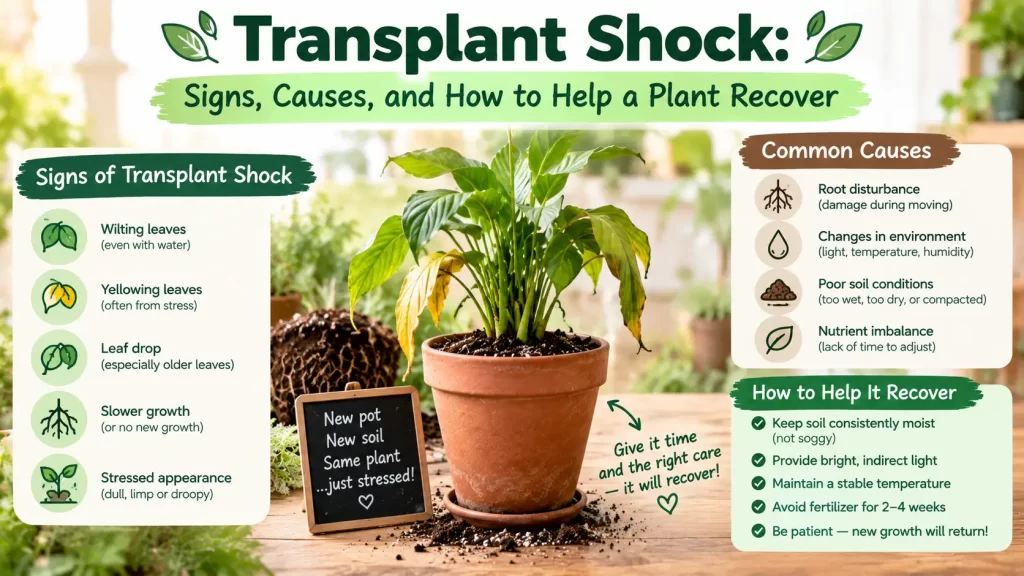
A plant that looked healthy before transplanting can suddenly wilt, yellow, drop leaves, stop growing, or develop brown edges after it is moved. Gardeners commonly call this transplant shock.
Transplant shock is not one disease. It is a broad term for the stress a plant experiences when its roots are disturbed, reduced, exposed, or moved into a new environment faster than the plant can adjust. The root system may temporarily struggle to replace the water being lost through the leaves, while the plant is also adapting to different light, temperature, wind, humidity, soil, and moisture conditions.
Mild transplant stress can be temporary. However, worsening wilt, continuously saturated soil, severe root damage, planting too deep, stem collapse, rot, or new pest and disease symptoms can indicate that something more serious is happening.
The goal is not to apply a universal “transplant shock treatment.” It is to reduce avoidable stress, keep the root zone appropriately moist and aerated, and determine whether the plant is actually establishing.
Quick Answer: What Should You Do for Transplant Shock?
If a recently moved plant is wilting or looking stressed, start with the root zone rather than the leaves.
- Check moisture around the actual root ball. It should not be allowed to dry severely, but it should not remain waterlogged either.
- Make sure drainage is adequate. Saturated soil can reduce oxygen around already stressed roots.
- Reduce extreme environmental stress. Protect vulnerable transplants from unusual heat, drying wind, frost, or sudden intense sun when appropriate for the plant.
- Avoid repeated disturbance. Do not keep digging up or repotting the plant to check it.
- Do not use fertilizer as a universal rescue treatment. Fertilizer recommendations differ between seedlings, houseplants, and woody plants.
- Watch for new growth. Stable foliage and new root or shoot growth are better signs of recovery than expecting damaged old leaves to become perfect again.
If the plant is wilting, compare the moisture conditions with Overwatering vs Underwatering: How to Tell the Difference. Wilting can happen in both dry and saturated soil.
What Is Transplant Shock?
Transplant shock describes the collection of stresses that can occur after a plant is moved, replanted, divided, repotted, lifted from the ground, or planted from a nursery container.
The central problem is often a temporary mismatch between the plant’s leaves and its roots. Leaves continue losing water through transpiration, but the roots may have been damaged or reduced during the move and may not yet have grown into the surrounding soil.
Penn State Extension explains that most plants experience some degree of shock when roots are disturbed and cannot absorb enough water. Colorado State University describes post-planting stress in trees as stress related to the reduced root system, while Purdue Extension describes transplant shock in trees and shrubs as a group of stresses associated with poor establishment rather than a single disease.
Environmental change can add another layer of stress. A seedling raised indoors or in a greenhouse may suddenly encounter stronger sunlight, wind, larger temperature swings, and faster drying conditions outdoors. Cornell University describes this abrupt change as an important part of transplant stress in vegetable seedlings.
That is why the same symptom can have more than one contributing cause.
Common Signs of Transplant Shock
Possible symptoms include:
- wilting or drooping,
- yellowing leaves,
- brown or scorched leaf edges,
- leaf curling or rolling,
- leaf drop,
- slowed or stalled growth,
- smaller new leaves,
- dull or pale foliage, and
- general decline after planting or repotting.
Woody plants may also show reduced shoot extension, premature seasonal color, or a prolonged establishment period.
These symptoms are not unique to transplant shock. Yellow leaves can also result from watering, nutrition, roots, pests, disease, or natural aging. See Why Are My Plant Leaves Turning Yellow? if yellowing is the main symptom.
Brown margins and tips can also result from several forms of water or root stress. See Why Are My Plant’s Leaf Tips Turning Brown? for a more focused diagnosis.
Transplant Shock or Something More Serious?
The timing matters. If a healthy plant begins drooping shortly after being repotted or moved into the garden, transplant stress is a reasonable possibility. That does not mean every problem that follows transplanting should be blamed on “shock.”
| What you observe | Possible interpretation | What to check |
|---|---|---|
| Mild wilt immediately after moving | Temporary root and water-balance stress | Root-ball moisture, weather, root disturbance |
| Wilt in very dry soil | Underwatering or poor root-soil contact | Moisture throughout the root ball |
| Wilt while soil remains saturated | Waterlogging, damaged roots, or root disease | Drainage and root condition |
| White, bleached, or scorched leaves after outdoor move | Possible sudden sun exposure | Whether the plant was hardened or acclimated |
| Stem is soft, dark, or collapsing | Possible rot or disease rather than simple adjustment | Stem base, roots, drainage, disease symptoms |
| Plant continues declining without new growth | Establishment failure or another unresolved stress | Planting depth, roots, water, light, pests, disease |
Transplant shock should become less convincing as an explanation if the plant continues getting worse and there is clear evidence of another problem.
What Causes Transplant Shock?
Several stresses often occur together.
1. Root Damage and Water Stress
Fine roots and root hairs play an important role in water and nutrient uptake. Lifting, dividing, repotting, bare-root handling, or cutting a plant from the ground can damage some of this active root system.
For field-grown trees and shrubs, a substantial portion of the root system may be left behind during digging. University of Minnesota Extension notes that bare-root stock can experience severe transplant shock because many roots are cut during field digging.
Container-grown plants usually keep more of their roots, but they can still be stressed if the root ball dries out, roots are torn, or badly circling roots require correction before planting.
Once root uptake is reduced, the plant may wilt even when the new soil contains some moisture. The solution is not automatically “more water.” The correct amount depends on how wet the root zone already is and whether oxygen can still reach the roots.
2. Sudden Changes in Light, Heat, Cold, Humidity or Wind
A plant raised in a protected environment may not be ready for open outdoor conditions.
Hard sunlight can damage leaves that developed under greenhouse glazing or indoor lights. Wind increases water loss and can physically stress tender stems. Hot conditions increase transpiration, while cold or frost can damage plants that have not been acclimated or are naturally tender.
This is why hardening off is commonly recommended for seedlings. University of Maryland Extension recommends gradually exposing vegetable seedlings to outdoor conditions over about one to two weeks, increasing sun exposure over time rather than moving them directly from protection into the garden.
For a deeper explanation of direct-sun intensity and why morning and afternoon exposure differ, see Full Sun vs Partial Sun vs Shade.
3. Planting and Root-Zone Problems
Sometimes the plant is not merely adjusting. The planting conditions themselves are preventing establishment.
Potential problems include:
- planting too deeply,
- leaving the root ball too high and exposed,
- poor soil-root contact,
- compacted or waterlogged soil,
- an unsuitable planting site,
- a root ball that dried before planting,
- circling or girdling roots that were not corrected,
- a container mix that dries much faster than the surrounding soil, and
- roots that were excessively damaged during moving.
For many herbaceous transplants, planting at roughly the same depth as the original container is a useful default unless the species has a different planting requirement. For trees and shrubs, planting depth is particularly important and the root flare should not be buried.
Poor drainage can turn transplant stress into a longer-term root problem. If the new location stays saturated, see What Is Well-Draining Soil?. If roots are soft, collapsing, or decayed, see Root Rot: Signs, Causes, Treatment, and Prevention.
How to Help a Plant Recover From Transplant Shock
The best recovery plan is usually conservative. Stabilize the plant’s environment instead of repeatedly changing it.
1. Check the root-zone moisture
Do not water based only on drooping leaves. Check the soil or growing medium where the roots actually are.
A newly planted root ball can sometimes be dry even when the surrounding garden soil is moist. The opposite can also happen: heavy surrounding soil may remain saturated while the gardener continues watering because the foliage is wilted.
2. Water thoroughly when water is needed
After transplanting, watering helps settle soil around the roots and reduces dry gaps. Penn State, RHS, University of Minnesota, and other extension sources emphasize maintaining adequate moisture during establishment.
The aim is not permanent saturation. Water should reach the active root zone, and excess water must be able to drain where the plant requires well-aerated soil.
3. Reduce avoidable environmental stress
If conditions are unusually hot, windy, cold, or bright for the plant, temporary protection may reduce additional stress. The type of protection depends on the plant and climate.
Do not permanently move a full-sun plant into deep shade just because it wilted after planting. Instead, determine whether the plant was properly acclimated and whether a short period of protection from extreme exposure is appropriate.
4. Leave the plant alone once major problems are corrected
Repeatedly lifting, repotting, dividing, moving, or inspecting the roots can create new damage. If planting depth, drainage, and root condition are acceptable, give the root system time to establish.
5. Keep competing stress low
For outdoor plants, a suitable mulch layer can help reduce evaporation and moderate soil conditions. Keep mulch away from stems and trunks rather than piling it against them.
For newly planted trees, Colorado State University recommends mulching the root zone while keeping mulch away from the trunk.
How Should You Water After Transplanting?
There is no universal “water every day for seven days” rule that works for every plant and climate.
Water demand depends on:
- plant species and size,
- how much root was lost,
- soil or potting-medium drainage,
- temperature,
- humidity,
- wind,
- sun exposure,
- container size, and
- rainfall or irrigation.
Young vegetable transplants may require close moisture monitoring while their roots grow into surrounding soil. Newly planted trees and shrubs can require supplemental water for much longer because root establishment takes longer.
The safest general rule is:
Check the root zone frequently enough that you catch excessive drying before severe wilt develops, but do not keep the soil saturated simply because the plant is newly transplanted.
For a full condition-based watering framework, see How Often Should You Water Plants?.
Should You Put a Transplanted Plant in Shade?
Sometimes, but not universally.
For a repotted houseplant whose roots were disturbed, Mississippi State University Extension recommends placing it in indirect light during the initial recovery period.
For seedlings being moved outdoors, the better strategy is to harden them gradually before permanent planting. If unusually hot or sunny conditions arrive immediately after transplanting, temporary protection can reduce stress for vulnerable plants.
However, RHS cautions that routine shading of vegetable transplants is not always beneficial and may only be needed in very hot conditions.
The correct approach is therefore plant-specific:
- Unhardened seedlings: gradually acclimate them to outdoor light before planting.
- Recently repotted indoor plants: bright indirect light can be appropriate while disturbed roots recover.
- Established sun-loving garden plants: do not permanently deprive them of the light they require.
- Extreme heat or strong wind: temporary protection may be useful while the root system is limited.
Should You Fertilize a Plant in Transplant Shock?
Do not treat fertilizer as a universal cure for transplant shock.
This is an area where recommendations legitimately differ by plant type.
Seedlings and herbaceous transplants
Some horticultural guidance, including RHS and Penn State recommendations for certain vegetable or annual transplants, allows a dilute starter fertilizer at planting to support establishment.
Newly planted trees and shrubs
The advice is different. University of Maryland Extension does not recommend fertilizer at planting for trees and shrubs, and Colorado State University advises keeping fertilization minimal during root establishment. CSU specifically warns against fertilizing an unestablished tree that is already showing signs of stress.
Repotted houseplants
Mississippi State University Extension advises waiting until the root system has reestablished before resuming regular fertilizer after repotting.
The practical conclusion is simple: do not reach for fertilizer merely because a plant is wilted after transplanting. Follow guidance for the specific plant and situation. Water, drainage, root health, and planting conditions should be checked first.
Should You Prune a Plant to Reduce Transplant Shock?
Heavy pruning is not a universal solution.
Leaves produce carbohydrates that support root growth and establishment. Removing healthy foliage can reduce the plant’s ability to recover.
RHS advises against unnecessary trimming of roots or foliage on vegetable transplants as an attempt to reduce stress. For recently planted trees, Colorado State University recommends limiting pruning mainly to dead, broken, or structurally necessary branches during establishment.
Remove clearly dead, broken, diseased, or badly damaged tissue when appropriate, but do not automatically cut back a healthy canopy simply because the plant was moved.
Transplant Shock After Repotting Houseplants
Houseplants can show transplant stress after repotting, particularly if roots were torn apart, washed, pruned, divided, or moved into a very different growing medium.
Possible signs include:
- temporary wilting,
- yellowing,
- leaf burn or splotching,
- leaf drop, and
- a pause in growth.
Mississippi State University Extension explains that root disruption can temporarily reduce water absorption and recommends caution against overwatering during recovery.
What to do
- Keep the plant in suitable indirect or moderated light if the species and situation call for it.
- Keep the potting medium appropriately moist, not saturated.
- Make sure the pot drains.
- Avoid another repotting unless there is a clear problem that must be corrected.
- Wait before resuming routine fertilizer if roots were significantly disturbed.
A container that is much larger than the old one can also remain wet for longer, especially around a small root system. Drainage and watering should be considered together.
Transplant Shock in Seedlings and Vegetables
Seedlings face two changes at once: root disturbance and a new outdoor environment.
Hardening off reduces the abruptness of that change. University of Maryland Extension recommends starting the process about one to two weeks before planting outdoors, beginning in a shaded, protected position and gradually increasing exposure.
University of Minnesota Extension likewise describes hardening as a way to reduce the growth delay associated with transplant shock and recommends transplanting during a cool, cloudy, calm period or later in the day when practical.
Before transplanting seedlings
- Make sure they are healthy and appropriately mature.
- Harden them gradually if they were raised indoors or under protection.
- Water before transplanting so the root ball is moist.
- Avoid planting tender crops into conditions colder than they can tolerate.
- Prepare the new location before removing plants from their containers.
During transplanting
- Handle the root ball rather than pulling the plant by its stem.
- Minimize unnecessary root damage.
- Plant at the appropriate depth for the species.
- Water after planting to settle soil around the roots.
Some species resent transplanting much more than others. RHS lists crops such as carrots among plants that are generally poor candidates for transplanting, while container-grown transplants with intact root balls usually experience less disturbance.
Transplant Shock in Trees and Shrubs
Woody plants require a different time scale from seedlings and houseplants.
A newly planted tree may have a much smaller functional root system than it had before nursery digging. Root regeneration and expansion into the surrounding soil can take multiple growing seasons.
Colorado State University notes that establishment time increases with tree size and may extend for years. RHS also warns that older established trees and shrubs are harder to move successfully than younger plants.
Key priorities for newly planted trees and shrubs
- correct planting depth,
- adequate but not excessive water,
- a wide, appropriate mulch zone without mulch against the trunk,
- minimal unnecessary pruning,
- correction of serious circling-root problems when planting container stock, and
- continued monitoring through establishment rather than assuming the job ends after planting day.
Persistent wilt in a newly planted tree should not trigger automatic daily watering. Soil type and moisture need to be checked because both drought and saturated roots can produce stress.
How Long Does Transplant Shock Last?
There is no reliable universal recovery time.
The answer depends on:
- plant type,
- plant size and age,
- amount of root disturbance,
- whether roots were kept moist,
- temperature and weather,
- light exposure,
- soil conditions,
- watering and drainage, and
- the health of the plant before it was moved.
For repotted houseplants, Mississippi State University describes an initial recovery period of roughly seven to ten days in its general guidance, with root reestablishment taking longer before routine fertilization resumes.
Young vegetable transplants may begin establishing into surrounding soil over the following couple of weeks when conditions are favorable. RHS notes that pot- or cell-raised vegetable transplants are generally kept watered until they root into surrounding soil, often around two weeks.
Trees and shrubs can take far longer. Colorado State University describes root establishment in newly planted trees as a process that may take from more than a year to several years depending on tree size and site conditions.
So instead of asking only “How many days has it been?”, ask:
Is the plant stabilizing and producing evidence of new root or shoot growth?
Signs a Transplanted Plant Is Recovering
Encouraging signs include:
- less wilting during normal conditions,
- new leaves or shoots appearing,
- existing healthy foliage remaining stable,
- new roots reaching into surrounding soil or potting medium,
- improved leaf color in new growth, and
- normal growth gradually resuming.
Do not judge recovery by whether every damaged leaf becomes green again. A scorched, yellowed, or badly injured leaf may remain damaged even after the root system recovers.
New growth is generally a better indicator.
How to Prevent Transplant Shock
Before moving the plant
- Choose an appropriate planting site for the species.
- Check drainage before planting.
- Prepare the planting hole or new container first.
- Water the plant so the root ball is adequately moist before handling.
- Harden off indoor-raised seedlings gradually.
- Avoid moving plants during extreme heat, wind, frost, or other severe conditions when you have a safer option.
During the move
- Protect exposed roots from drying.
- Handle the root system gently.
- Keep as much appropriate root mass intact as practical.
- Correct serious root defects when the plant type requires it.
- Plant at the proper depth.
- Do not bury trunks or crowns that should remain above the soil line.
Immediately afterward
- Water the root zone appropriately.
- Make sure excess water can drain.
- Use suitable mulch outdoors where appropriate.
- Protect vulnerable plants from extreme exposure without permanently placing them in unsuitable light.
- Avoid heavy pruning.
- Avoid unnecessary repotting or root disturbance.
- Monitor rather than reacting to every temporary droop.
Common Transplant Shock Mistakes
Mistake 1: Watering every time the plant wilts
A wilted transplant can be dry, but it can also be sitting in saturated soil with roots that are not functioning well. Check moisture first.
Mistake 2: Keeping the soil permanently wet
Roots need oxygen. Excessive watering can convert a temporary transplant setback into waterlogging and root decay.
Mistake 3: Fertilizing heavily to “wake the plant up”
Fertilizer is not a substitute for healthy roots. Recommendations vary by plant type, and stressed woody plants in particular should not be pushed into excessive top growth.
Mistake 4: Moving the plant repeatedly
Each new move can disturb roots or force another environmental adjustment.
Mistake 5: Cutting off lots of healthy foliage
Healthy leaves help supply energy for root establishment. Heavy pruning is rarely the default answer.
Mistake 6: Ignoring planting depth
A plant installed too deeply can continue declining no matter how carefully you water it.
Mistake 7: Blaming every post-transplant symptom on shock
Root rot, pests, disease, frost injury, sun scorch, drought, nutrient problems, and stem damage can occur at the same time as transplanting.
Mistake 8: Expecting damaged leaves to become perfect again
Recovery is better judged by stable tissue and healthy new growth.
Frequently Asked Questions
Can a Plant Die From Transplant Shock?
Yes. Mild transplant stress is common and many plants recover, but severe root loss, dehydration, waterlogging, planting errors, extreme weather, or combined stresses can lead to plant death.
Why Is My Plant Wilting After Transplanting Even Though the Soil Is Wet?
Root damage or saturated soil can reduce the plant’s ability to absorb and move water effectively. Check drainage and root-zone moisture before watering again.
Should I Water a Plant Immediately After Transplanting?
In most ordinary transplanting situations, watering after planting helps settle soil around the root system and supplies needed moisture. The amount and future frequency should be adjusted to the plant, soil, weather, and drainage.
Should I Use Sugar Water for Transplant Shock?
There is no need to use sugar water as a routine transplant-shock treatment. Focus on correct planting, root-zone moisture, drainage, appropriate light, temperature, and protection from unnecessary stress.
Should I Fertilize Immediately After Transplanting?
Not automatically. Some vegetable and bedding-plant guidance permits a dilute starter fertilizer, while extension guidance for woody plants and repotted houseplants is more conservative. Follow recommendations for the specific plant rather than treating fertilizer as a general cure.
Should I Put a Transplanted Plant in the Shade?
It depends on the plant and situation. Unhardened seedlings may need gradual acclimation, repotted houseplants may benefit from indirect light during early recovery, and outdoor plants may need temporary protection during extreme heat. A sun-loving plant should not be left permanently in unsuitable shade.
How Do I Know if Transplant Shock Is Over?
Look for stable foliage, reduced wilting, new shoots or leaves, and resumed growth. Damaged old leaves may remain damaged even after the plant has recovered.
How Long Does Transplant Shock Last?
There is no universal duration. Small seedlings and repotted houseplants may recover relatively quickly, while transplanted trees and shrubs can require multiple growing seasons for full root establishment.
Can Overwatering Make Transplant Shock Worse?
Yes. Excessive watering can reduce root-zone oxygen and contribute to root damage or rot. Keep moisture appropriate for the plant rather than automatically keeping the soil saturated.
Why Are the Leaves Turning Yellow After Repotting?
Root disturbance and temporary water stress can contribute to yellowing, but so can overwatering, poor drainage, nutrient problems, light changes, pests, and disease. Diagnose the full set of conditions rather than assuming every yellow leaf is normal repotting stress.
Sources and Further Reading
- Penn State Extension: Transplanting annuals into the garden
- University of Minnesota Extension: Planting the vegetable garden
- University of Maryland Extension: Hardening off vegetable seedlings
- Royal Horticultural Society: Vegetable transplanting tips
- Cornell University: Avoid transplant shock
- Mississippi State University Extension: Care and selection of indoor plants
- Colorado State University Extension: Care of recently planted trees
- University of Maryland Extension: Fertilizing trees and shrubs
- Royal Horticultural Society: Moving trees and shrubs
Bottom Line
Transplant shock is best understood as a period of root and environmental stress after a plant is moved, not as one specific disease with one treatment.
Start by checking the root zone. Keep it appropriately moist without waterlogging it, make sure drainage and planting depth are correct, reduce extreme environmental stress, and avoid unnecessary disturbance. Do not automatically fertilize, prune heavily, or add more water simply because the leaves droop.
Most importantly, watch the direction of change. A plant that is stabilizing and producing healthy new growth is establishing. A plant that continues to decline needs a fresh diagnosis rather than an indefinite label of “transplant shock.”


