
Why Are My Plant Leaves Curling? Causes and How to Diagnose Them

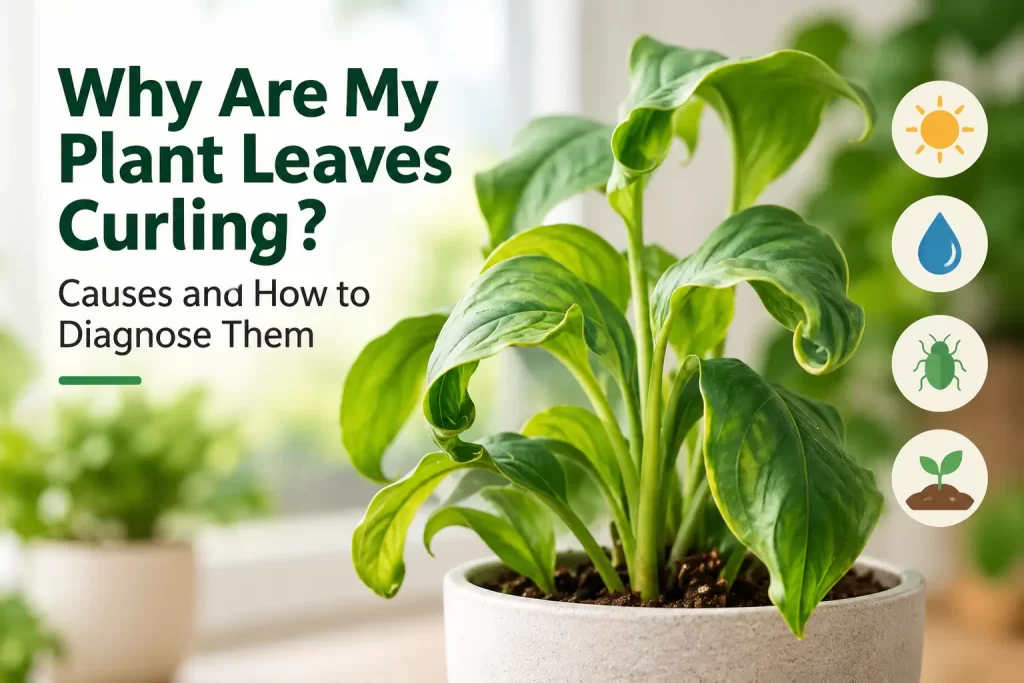
Curled leaves are a symptom, not a diagnosis. A plant may curl its leaves because it is too dry, too hot, sitting in wet soil, adjusting to changing conditions, being fed on by pests, affected by disease, or exposed to an herbicide. Some plants also curl or fold leaves temporarily as a normal response to heat or water stress.
The most useful clues are which leaves are curling, which direction they curl, whether the tissue is also yellow, brown, sticky, spotted, mottled or distorted, and what is happening around the roots.
Do not spray for pests, add fertilizer, or water automatically just because the leaves have curled. First identify the pattern.
Quick Answer: Why Are My Plant Leaves Curling?
The most common possibilities include:
- too little water,
- high heat or intense sun,
- too much water or poor drainage,
- irregular watering or rapid temperature changes,
- sap-feeding pests such as aphids, mites or other insects,
- viral or fungal disease,
- herbicide injury,
- transplant or root disturbance, and
- other root-zone or nutritional stresses.
University of Maryland Extension lists aphids, herbicide damage, physiological stress and virus diseases among causes of curled or distorted vegetable leaves. The Royal Horticultural Society likewise notes that curled or deformed leaves can result from drought, temperature changes, excessive light, sap-feeding pests and irregular watering.
The pattern matters more than the curl alone.
How to Diagnose Curled Leaves
Before changing the plant’s care, answer these questions.
Which leaves are affected?
- Only the newest leaves: pests, herbicide injury, virus, temperature stress or damage during leaf development deserve attention.
- Mostly older leaves: drought stress, physiological leaf roll, root stress or normal aging may be more plausible depending on the plant.
- The whole plant: look closely at the root zone, recent weather, watering, systemic disease and chemical exposure.
What else is happening?
Look for:
- yellowing,
- brown or scorched margins,
- sticky residue,
- white shed insect skins,
- fine webbing,
- white powdery growth,
- mosaic or ring patterns,
- twisted stems,
- small or strap-like new leaves,
- wilting,
- stunted growth, and
- root decay.
What changed recently?
Recent heat, drought, heavy rain, a new watering routine, repotting, transplanting, movement into stronger light, pesticide or herbicide use nearby, and sudden temperature changes can all be relevant.
If the plant is also growing unusually slowly, use Why Is My Plant Growing Slowly? to check the broader growth-limiting factors.
Leaf-Curl Pattern Guide
| What you see | Possible explanation | What to check next |
|---|---|---|
| Leaves roll upward during hot, dry conditions | Heat or drought response | Root-zone moisture, temperature, sun and wind |
| Leaves curl while soil is very dry | Underwatering | Moisture deeper in the root zone |
| Leaves curl or wilt while soil stays wet | Waterlogging or root stress | Drainage and root health |
| Young leaves are curled with sticky residue | Aphids or another honeydew-producing pest | Leaf undersides, stems and growing tips |
| Leaves are speckled or bronzed with fine webbing | Spider mites | Leaf undersides with a hand lens |
| Leaves are twisted, cupped or strap-like; several nearby plants are affected | Possible herbicide injury | Recent spraying, drift direction and newest growth |
| Curled leaves also have mosaic, rings or unusual mottling | Possible virus | Species-specific disease symptoms and professional diagnosis if needed |
| Curled leaves have white powdery growth | Possible powdery mildew | Both leaf surfaces, stems and nearby plants |
| New leaves emerge crinkled after inconsistent care | Irregular watering or temperature fluctuations | Conditions while the leaf was developing |
| Leaves curl after repotting or planting | Transplant stress | Root damage, water, drainage and new exposure |
These patterns are clues, not guarantees. A plant can experience more than one stress at the same time.
1. Drought or Underwatering
Leaf curling can reduce exposed leaf area and water loss, so some plants curl or roll foliage during drought stress.
University of Maryland Extension notes that plants can wilt and curl when roots cannot supply enough moisture to stems and leaves. University of Minnesota also identifies upward leaf roll in tomatoes as a common physiological response associated with drought stress.
Clues that drought may be involved
- soil is dry through much of the active root zone,
- the plant wilts as well as curls,
- leaf edges become dry or brown,
- the pot feels much lighter than after watering,
- the problem is worse during hot or windy weather, and
- the plant improves after appropriate watering if roots remain healthy.
Do not diagnose drought from the soil surface alone. The upper layer can dry while deeper soil remains moist.
For a more complete watering diagnosis, see Overwatering vs Underwatering: How to Tell the Difference.
2. Heat and Intense Sun
Hot, bright conditions can cause leaves to curl even when soil moisture is not completely depleted.
During extreme heat, leaves may lose water faster than roots can replace it. University of Minnesota Extension notes that plants can wilt, curl or stall during hot, windy weather and describes inward leaf folding in crops such as tomatoes and peppers as a way of reducing water loss.
Look for a combination of:
- curling during the hottest part of the day,
- rapid recovery in cooler evening conditions,
- drying soil,
- brown or scorched edges,
- bleached patches on exposed foliage, and
- damage concentrated on the sunniest side.
A plant can receive the recommended number of sunlight hours and still experience excessive heat in a reflected or exposed microclimate.
See Full Sun vs Partial Sun vs Shade for guidance on hours, time of day and sun intensity.
Do not assume curling in tomatoes always means disease
Physiological tomato leaf roll is common. University of Maryland Extension describes upward rolling of lower tomato leaves during high temperatures and moisture stress and notes that some cultivars are more prone to it. In that situation, the curling itself may not reduce growth or yield.
If the foliage also has mosaic patterns, severe distortion, stunting, rings, unusual fruit symptoms or widespread decline, investigate other causes.
3. Overwatering, Poor Drainage or Root Stress
Curled leaves are often associated with dry conditions, but a wet root zone can also produce leaf stress.
Roots require oxygen. When soil remains saturated, root function can decline and the plant may struggle to move water and nutrients normally. Leaves may wilt, yellow, curl or develop other stress symptoms even while the soil is wet.
Clues that the root zone is too wet
- the soil or potting mix remains saturated for a long time,
- the plant is limp despite wet soil,
- leaves are yellowing as well as curling,
- growth has slowed,
- the container drains poorly, or
- roots are soft, collapsing or decayed.
If water routinely stays around the roots, see What Is Well-Draining Soil? How to Test and Improve It.
If roots show actual decay, see Root Rot: Signs, Causes, Treatment, and Prevention.
4. Irregular Watering or Temperature Swings
Sometimes the issue is not simply “too wet” or “too dry.” Rapid changes while a new leaf is developing can distort the tissue.
RHS guidance on houseplant leaf deformation notes that crinkled or creased foliage can result from stop-start development associated with temperature variation and irregular watering. It also notes that some plants curl inward in bright, dry conditions, while cold and dry conditions can cause different forms of leaf-margin curling.
This pattern may fit when:
- new leaves emerge wrinkled or uneven,
- older leaves look relatively normal,
- watering alternates between very dry and very wet,
- the plant sits near a heating or cooling draft, or
- temperatures fluctuate sharply between day and night.
Damaged leaves may not flatten again. Judge improvement by whether later leaves develop normally after conditions become more stable.
5. Aphids, Spider Mites and Other Pests
Sap-feeding pests are an important cause of curled or distorted growth.
Aphids
Aphids often feed on tender new leaves, shoots and buds. University of Maryland Extension notes that young leaves still expanding during aphid feeding can become permanently stunted, crinkled or curled.
Look for:
- clusters of small soft-bodied insects,
- curled new leaves,
- sticky honeydew,
- black sooty mold growing on honeydew,
- white shed aphid skins, and
- ants moving over stems or tending aphid colonies.
Open curled leaves gently because aphids can hide inside the protected fold.
Spider mites
Spider mites are extremely small and often become troublesome under hot, dry conditions. University of Minnesota diagnostic guidance links mite feeding with leaf distortion and, in heavier infestations, fine webbing.
Look for:
- fine pale stippling,
- bronzed or dull-looking foliage,
- distorted leaves, and
- very fine webbing on leaf undersides or between stems.
Other insects
Thrips, leafhoppers, psyllids, leafrollers and other pests can also curl or deform foliage depending on the plant.
Do not identify an insect from the curl alone. Look for the pest itself or a distinctive feeding pattern before choosing a control.
Start with integrated pest management
University of Maryland recommends an IPM approach for aphids, using monitoring and lower-impact controls before pesticides where practical. For many aphid infestations, physical removal or a strong stream of water may substantially reduce numbers.
If a pesticide is needed, identify the pest and follow the product label and local regulations. A pesticide label is a legal document in many jurisdictions, and available products differ by country.
6. Viral or Fungal Disease
Some diseases cause leaf curling, but disease is more convincing when other characteristic symptoms appear alongside the curl.
Possible virus clues
University of Maryland Extension lists mosaic or mottled color patterns, rings, malformed new growth and stunting among common virus symptoms. University of Minnesota similarly describes virus-affected foliage as potentially curled, twisted, unusually narrow or distorted.
Look for:
- yellow and green mosaic patterns,
- ringspots,
- unusually narrow or shoestring-like leaves,
- distorted new growth,
- stunting,
- unusual flower color or shape, and
- fruit discoloration or rings in susceptible crops.
Symptoms alone may not identify the exact virus. Laboratory testing can be necessary when a precise diagnosis matters.
Most plant virus diseases do not have a curative spray. Management typically focuses on preventing spread, controlling relevant vectors when appropriate, sanitation, resistant varieties and removal of infected material where recommended for the specific crop.
Powdery mildew and other fungal diseases
Some fungal diseases can distort foliage. University of Minnesota diagnostic resources show that powdery mildew can cause young leaves to curl, twist or pucker on susceptible plants.
A white or gray powdery coating makes mildew more plausible than a purely physiological curl.
Disease diagnosis should remain species-specific because different pathogens produce different symptoms on different hosts.
7. Herbicide Injury
Herbicide exposure can produce some of the most dramatic curled, twisted and malformed leaves in a garden.
Plant-growth-regulator herbicides such as products containing 2,4-D or dicamba can distort sensitive broadleaf plants. University of Minnesota diagnostic guidance describes leaves, stems and petioles becoming twisted, cupped or distorted, often with thickened or unusually arranged veins. Newest growth may be especially affected.
Clues that herbicide exposure is possible
- new leaves are tightly twisted, cupped or strap-like,
- stems or petioles are also distorted,
- several different broadleaf species develop similar symptoms at the same time,
- damage is worse on the side nearest a treated lawn, field or pathway,
- symptoms appeared after spraying nearby, or
- young growth is more affected than old growth.
University of Minnesota notes that when different plant species in the same spray area show similar distortion, herbicide injury becomes a stronger possibility.
Do not assume the source is always your own spray
Exposure may occur through direct application, spray drift, volatilization from certain products, contaminated equipment, or in some situations contaminated plant material, compost or manure. Which pathways matter depends on the herbicide.
If crop safety, food use, liability or significant landscape damage is involved, contact a qualified local extension service, agronomist, pesticide regulator or plant diagnostic service rather than guessing.
8. Transplant or Repotting Stress
Leaf curling can begin after roots are disturbed or after a plant moves suddenly into a different environment.
A transplanted plant may temporarily have less functional root capacity while its leaves continue losing water. If it also encounters stronger sun, heat, wind or lower humidity, the mismatch becomes greater.
Transplant stress is more plausible when:
- curling began shortly after planting or repotting,
- roots were disturbed, divided or damaged,
- the plant was moved into stronger light,
- the root ball dried during the move, or
- the plant is otherwise stable and beginning to establish.
Persistent decline should trigger a fresh diagnosis rather than an indefinite assumption of “shock.” See Transplant Shock: Signs, Causes, and How to Help a Plant Recover.
9. Nutrient, Salt or Other Growing-Condition Problems
Nutrition is sometimes involved in malformed growth, but leaf curling is not specific enough to diagnose a nutrient deficiency by itself.
Root damage, unsuitable pH, high soluble salts, irregular water availability and nutrient imbalance can interfere with normal leaf development.
Look for a broader pattern
Ask whether the plant also has:
- interveinal yellowing,
- unusually small leaves,
- marginal scorch,
- weak overall growth,
- root injury, or
- a known history of excessive fertilizer use.
Do not add fertilizer merely because leaves are curled. If the roots are stressed by drought, waterlogging or salts, additional fertilizer may make the situation worse.
If brown tips accompany curling, see Why Are My Plant’s Leaf Tips Turning Brown?.
Leaves Curling Up vs Leaves Curling Down
The direction of curling can offer a clue, but it is not reliable enough to diagnose the cause by itself.
Leaves curling upward
Possible causes include:
- heat or drought-related physiological rolling,
- some pest damage,
- powdery mildew on susceptible plants,
- herbicide injury, and
- species-specific disease.
Tomato physiological leaf roll commonly produces upward and inward rolling, particularly during heat and moisture stress.
Leaves curling downward
Downward curling can occur with:
- environmental stress,
- root-zone problems,
- pest feeding,
- temperature-related deformation, and
- species-specific disorders.
There is no dependable universal rule that “upward means underwatered” and “downward means overwatered.” Diagnose moisture and other conditions directly.
Why Are Only the New Leaves Curling?
New growth is especially informative because young leaves are still expanding and can be permanently distorted when development is interrupted.
When only new leaves are curled, check for:
- aphids or thrips around growing tips,
- herbicide exposure,
- rapid temperature swings,
- irregular watering while the leaf was expanding,
- virus symptoms,
- nutrient or pH problems affecting new tissue, and
- physical damage to buds or young leaves.
University of Maryland specifically notes that aphid feeding on young expanding leaves can cause permanent crinkling or curling.
If conditions improve, damaged leaves may remain misshapen. Watch whether the next leaves emerge normally.
Why Are My Houseplant Leaves Curling?
Indoor plants face a particular combination of environmental stresses.
Common causes include:
- potting mix drying too far,
- overwatering and root stress,
- low humidity for sensitive species,
- heating or air-conditioning drafts,
- rapid temperature changes,
- too much direct sun after a move,
- aphids, mites, thrips or other pests,
- recent repotting, and
- salt accumulation or root problems.
RHS notes that houseplant leaf deformation can be associated with irregular watering and temperature fluctuations, and that some species curl inward in bright, dry conditions.
Start with the simplest checks
- Feel the potting medium below the surface.
- Check whether drainage holes are open.
- Inspect the underside of curled leaves.
- Look for sticky residue, webbing or insects.
- Think about recent moves, drafts or stronger sunlight.
- Inspect roots if the plant is declining and moisture clues are confusing.
A fixed watering schedule is particularly risky indoors because drying speed changes with season, light and temperature. See How Often Should You Water Plants?.
Why Are My Vegetable Leaves Curling?
Vegetable leaves can curl for both harmless and serious reasons.
University of Maryland Extension lists physiological leaf roll, aphids, herbicide damage, leafhoppers and viruses among possible causes of curling or distortion in vegetable crops.
Tomatoes
Tomatoes are a good example of why diagnosis matters. Upward physiological leaf roll can occur during heat or moisture stress and may not harm yield, while herbicide injury can cause severely twisted, strappy growth and viruses can produce curling combined with mosaic patterns, stunting or fruit symptoms.
Peppers and other vegetables
Aphids can distort young growth on peppers and many other crops. Viral disease, chemical injury, heat and root stress can produce overlapping symptoms.
Do not treat every vegetable curl with pesticide
If no pest is present, an insecticide cannot solve the problem. Check the entire plant and its environment first.
What to Do First When Plant Leaves Curl
- Identify the plant. Leaf behavior and disease susceptibility differ by species.
- Check which leaves are affected. New, old, upper, lower or all?
- Look at the pattern. Upward roll, downward curl, twisting, puckering or tight cupping?
- Check root-zone moisture. Determine whether the soil is dry, appropriately moist or saturated.
- Check drainage. Do not keep adding water to a saturated root zone.
- Inspect for pests. Look underneath leaves and inside folds.
- Look for disease clues. Mosaic, rings, powdery growth, lesions or severe stunting matter.
- Review recent weather. Heat, drought, cold and wind can trigger physiological curling.
- Consider recent spraying. Herbicide injury becomes more plausible when several plants show similar distorted new growth.
- Consider recent transplanting or relocation.
- Change the most likely cause first. Avoid applying several treatments simultaneously.
Common Mistakes When Leaves Curl
Mistake 1: Assuming the plant needs water
Dry soil can cause curling, but wet roots can also stress foliage. Check the root zone.
Mistake 2: Assuming leaf curl means a virus
Viruses can curl leaves, but environmental stress, insects, herbicides and fungal diseases can produce similar distortion.
Mistake 3: Spraying pesticide without finding a pest
Do not treat the symptom. Identify the organism or at least gather evidence that a pest is responsible.
Mistake 4: Fertilizing distorted new growth immediately
Nutrition is only one possibility. Root stress or herbicide injury will not be corrected by fertilizer.
Mistake 5: Ignoring nearby herbicide use
If several unrelated broadleaf plants develop similar twisted new growth at the same time, chemical injury deserves serious consideration.
Mistake 6: Expecting curled leaves to straighten after the problem is fixed
Leaves that developed abnormally may remain curled. Healthy new growth is a better recovery indicator.
Mistake 7: Treating all tomato leaf curl as dangerous
Physiological tomato leaf roll can occur during heat and moisture stress and may not reduce growth or yield. Look for additional symptoms before assuming infection.
Mistake 8: Making several major changes at once
Repotting, spraying, fertilizing, moving the plant and changing watering simultaneously can add stress and make diagnosis harder.
Frequently Asked Questions
Why Are My Plant Leaves Curling Up?
Upward curling can occur with heat, drought, physiological leaf roll, pests, herbicide injury, disease or other environmental stress. Check root-zone moisture, temperature and the rest of the symptom pattern rather than using curl direction alone.
Why Are My Plant Leaves Curling Down?
Downward curling can result from several stresses, including root problems, environmental changes, pests or species-specific disorders. There is no universal rule that downward curl proves overwatering.
Can Overwatering Cause Leaves to Curl?
Yes. A saturated root zone can reduce root oxygen and impair normal water uptake, which can contribute to wilting, yellowing, curling and slow growth. Check drainage and root health.
Can Underwatering Cause Leaves to Curl?
Yes. Some plants curl or roll leaves during drought stress, particularly when water loss from foliage exceeds what roots can supply.
Can Too Much Sun Make Leaves Curl?
Yes. Intense sun and heat can increase water loss and trigger curling, wilting or scorch in sensitive plants. Consider the time of day, local heat and the plant’s light requirement.
Why Are Only the New Leaves Curling?
Young leaves can be distorted by aphid or thrips feeding, herbicide exposure, irregular watering, temperature changes, viruses, nutrient-related problems or physical damage while the leaf is expanding.
Why Are My Tomato Leaves Curling?
Tomato leaves can curl from physiological heat or water stress, aphids, herbicide injury, viruses and other causes. Upward rolling of otherwise normal lower leaves during hot or stressful conditions can be physiological and may not harm yield.
Do Curled Leaves Mean My Plant Has Pests?
Not necessarily. Inspect for insects, webbing, sticky honeydew, shed skins, stippling or other feeding clues. Curling without pest evidence may have an environmental, root, disease or chemical cause.
Will Curled Leaves Go Back to Normal?
Sometimes mild temporary curling can relax when conditions improve. Leaves that were permanently distorted while developing may remain misshapen. Judge recovery by healthy new growth.
Should I Cut Off Curled Leaves?
Not automatically. Green curled leaves may still photosynthesize. Remove leaves when they are dead, badly diseased, heavily infested in a way that makes removal useful, or when species-specific management recommends it.
Can Fertilizer Fix Curled Leaves?
Only if a diagnosed nutritional problem is actually responsible. Fertilizer will not correct heat stress, drought, waterlogging, aphids, viruses or herbicide injury and can worsen root stress when overapplied.
Sources and Further Reading
- University of Maryland Extension: Leaf curling on vegetables
- University of Maryland Extension: Key to common problems of tomatoes
- University of Maryland Extension: Aphids in home gardens
- University of Maryland Extension: Virus diseases of shrubs
- Royal Horticultural Society: Leaf damage on houseplants
- Royal Horticultural Society: Leaf damage on woody plants
- University of Minnesota Extension: Tomato leaves curled or distorted
- University of Minnesota Extension: Curled or distorted leaves and herbicide injury
- University of Minnesota Extension: Spider mites and distorted leaves
Bottom Line
Curled leaves are a clue that something has affected leaf development or the plant’s water balance, but the curl itself does not tell you exactly what happened.
Start with the pattern. Check whether the affected leaves are old or new, whether they curl up or down, and whether they also show yellowing, browning, sticky residue, webbing, powdery growth, mosaic patterns or twisted stems. Then check root-zone moisture, drainage, recent weather, pest activity, chemical exposure and recent transplanting.
The right treatment depends on the cause. A thirsty plant needs a different response from a waterlogged plant, an aphid infestation, a virus infection or herbicide injury. Diagnose first, then act.


